\n
## Diagram: Balancing Chemical Equations - Step-by-Step Guide
### Overview
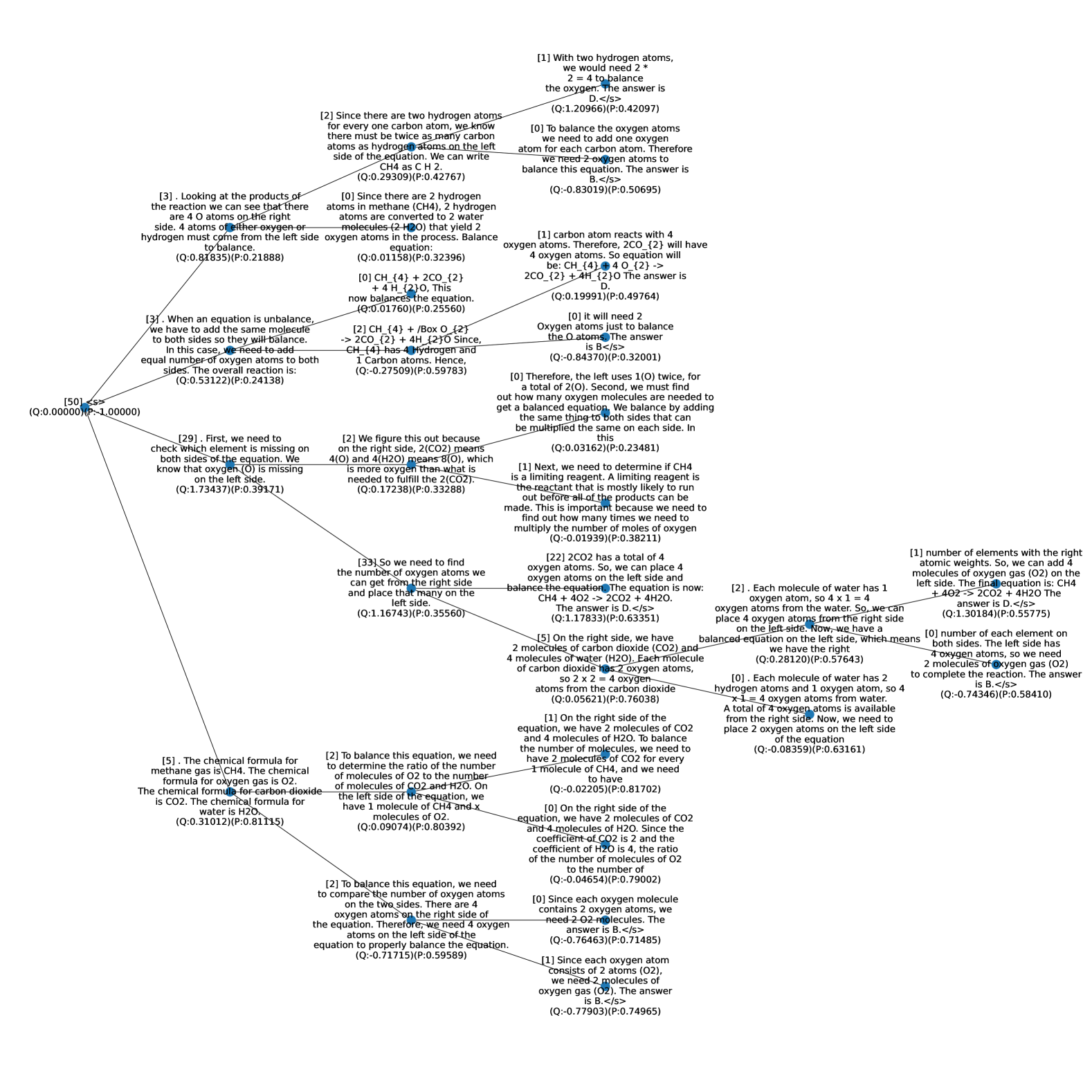
The image presents a hand-drawn diagram illustrating the step-by-step process of balancing chemical equations. It features a series of numbered boxes, each containing text and chemical equations, demonstrating how to balance equations by adding coefficients. The diagram is organized in a roughly circular flow, starting from the top and moving clockwise. There is a section at the bottom with a visual representation of molecules and a scale.
### Components/Axes
The diagram consists of the following components:
* **Numbered Boxes (1-7):** Each box represents a step in the balancing process, containing text explanations and chemical equations.
* **Molecular Representation:** At the bottom, there are illustrations of molecules (circles representing atoms) and a balance scale.
* **Text Annotations:** Numerous handwritten notes and explanations are scattered throughout the diagram.
* **Chemical Equations:** Various chemical equations are presented in different stages of balancing.
* **Scale:** A balance scale with labeled sides "Reactants" and "Products".
### Detailed Analysis or Content Details
Here's a transcription of the content within each numbered box, along with the equations:
**[1]** With two hydrogen atoms, we need two H₂ to balance the equation. The answer is:
H₂ + ½ O₂ → H₂O
(Q=1.2096)(P=0.42097)
**[2]** Since there are two hydrogen for every one carbon atom, we know we need two molecules of hydrogen atoms on the left side of the equation.
CH₄ + 2H₂
(Q=0.28335)(P=0.2188)
**[3]** Looking at the products of the reaction, we can see that there are 4 O atoms on the right side. Therefore, 2 molecules of hydrogen must come from the left side to balance.
Q(0.28335)(P=0.2188)
**[4]** Since there are 2 hydrogen atoms converted to 2 water molecules, we know that we need 2 oxygen atoms in the reactants. Balance the oxygen atoms.
(Q=0.01158)(P=0.3396)
CH₄ + 2H₂ + 2O₂ →
(Q=0.16704)(P=0.23560)
**[5]** [CH₄] + 2[H₂] + 2[O₂] now balance the equation.
CH₄ + 2H₂ + 2O₂ →
(Q=0.16704)(P=0.23560)
CH₄ has 1 hydrogen and 4 hydrogen atoms.
**[6]** When an equation is unbalanced, we have to add the same molecule to both sides of the equation. In this case, we need to add another molecule of CH₄ to both sides of the equation.
CH₄ + 2H₂ + 2O₂ →
(Q=0.0000)(P=0.0000)
**[7]** Therefore, we need 1 molecule of CH₄. We know that CH₄ has 1 carbon atom, so we need 1 molecule of CO₂ on the right side.
CH₄ + 2H₂O → CO₂ + 2H₂
(Q=0.0000)(P=0.0000)
**Bottom Section:**
* **Molecular Representation:** Shows various combinations of circles representing atoms (e.g., two red circles connected to one blue circle).
* **Scale:** The scale has "Reactants" on the left and "Products" on the right. The left side shows 1 blue circle and 4 red circles. The right side shows 1 black circle and 2 red circles.
* **Text:** "To balance the equation, we must have the same number of molecules on both sides. Therefore, we need 1 CH₄ on the left side to balance the equation."
* **Equation:** CH₄ + 2H₂O → CO₂ + 2H₂
* **Additional Notes:** "Therefore, the balanced equation is CH₄ + 2H₂O → CO₂ + 2H₂." and "The number of atoms must be the same on both sides of the equation."
### Key Observations
* The diagram uses a step-by-step approach to explain balancing chemical equations.
* The equations are progressively balanced throughout the numbered boxes.
* The molecular representation and scale visually demonstrate the concept of balancing atoms on both sides of the equation.
* The values in parentheses (Q=...)(P=...) appear to be numerical data associated with each step, potentially representing some kind of weighting or calculation, but their meaning is not explicitly defined.
* The diagram is hand-drawn and contains handwritten annotations, suggesting it's a personal learning aid or a teacher's illustration.
### Interpretation
The diagram demonstrates the fundamental principle of balancing chemical equations: ensuring that the number of atoms of each element is equal on both the reactant and product sides. The step-by-step approach breaks down the process into manageable stages, making it easier to understand. The use of visual aids, such as the molecular representation and scale, reinforces the concept of conservation of mass.
The values in parentheses (Q and P) are intriguing but their purpose is unclear without further context. They might represent probabilities, energy levels, or some other quantitative measure related to the reaction.
The diagram highlights the importance of adding coefficients to chemical formulas to achieve balance, rather than changing the formulas themselves. The final balanced equation (CH₄ + 2H₂O → CO₂ + 2H₂) confirms that the number of carbon, hydrogen, and oxygen atoms is equal on both sides.
The overall message is a clear and concise explanation of a core concept in chemistry, presented in a visually engaging and accessible manner. The diagram serves as a valuable learning tool for students or anyone seeking to understand the principles of chemical equation balancing.