## Table of Mathematical Expressions and Theorem Conclusions
### Overview
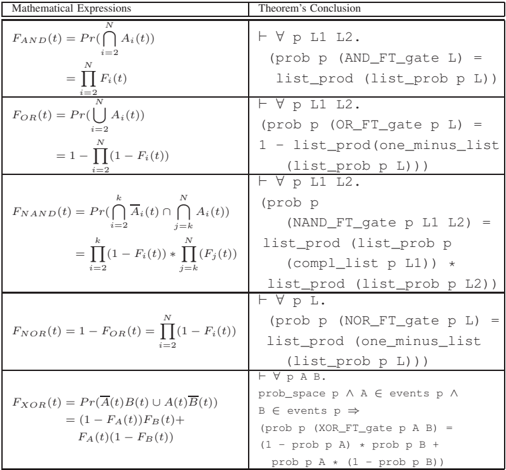
The image displays a two-column table. The left column is titled "Mathematical Expressions" and contains probability formulas for various logic gate functions (FAND, FOR, FNAND, FNOR, FXOR). The right column is titled "Theorem's Conclusion" and contains corresponding formal logical statements, likely in a syntax used for theorem proving or formal verification, which define or relate to the probability calculations on the left.
### Components/Axes
* **Structure:** A table with two columns and five data rows.
* **Column Headers:**
* Left Column: `Mathematical Expressions`
* Right Column: `Theorem's Conclusion`
* **Row Labels (Implicit):** The rows correspond to the functions: FAND, FOR, FNAND, FNOR, and FXOR.
### Content Details
| Mathematical Expressions | Theorem's Conclusion |
|--------------------------|----------------------|
| **FAND (AND Gate Probability)**<br>`F_AND(t) = Pr(⋂_{i=2}^{N} A_i(t)) = ∏_{i=2}^{N} F_i(t)` | `⊢ ∀ p L1 L2. (prob p (AND_FT_gate L) = list_prod (list_prob p L))` |
| **FOR (OR Gate Probability)**<br>`F_OR(t) = Pr(⋃_{i=2}^{N} A_i(t)) = 1 - ∏_{i=2}^{N} (1 - F_i(t))` | `⊢ ∀ p L1 L2. (prob p (OR_FT_gate p L) = 1 - list_prod(one_minus_list (list_prob p L)))` |
| **FNAND (NAND Gate Probability)**<br>`F_NAND(t) = Pr( (⋂_{i=2}^{k} ¬A_i(t)) ∩ (⋂_{j=k}^{N} A_j(t)) ) = ∏_{i=2}^{k} (1 - F_i(t)) * ∏_{j=k}^{N} F_j(t)` | `⊢ ∀ p L1 L2. (prob p (NAND_FT_gate p L1 L2) = list_prod (list_prob p (compl_list p L1)) * list_prod (list_prob p L2))` |
| **FNOR (NOR Gate Probability)**<br>`F_NOR(t) = 1 - F_OR(t) = ∏_{i=2}^{N} (1 - F_i(t))` | `⊢ ∀ p L. (prob p (NOR_FT_gate p L) = list_prod (one_minus_list (list_prob p L)))` |
| **FXOR (XOR Gate Probability)**<br>`F_XOR(t) = Pr(Ā(t)B(t) ∪ A(t)B̄(t)) = (1 - F_A(t))F_B(t) + F_A(t)(1 - F_B(t))` | `⊢ ∀ p A B. prob_space p ∧ A ∈ events p ∧ B ∈ events p ⇒ (prob p (XOR_FT_gate p A B) = (1 - prob p A) * prob p B + prob p A * (1 - prob p B))` |
### Key Observations
1. **Consistent Pattern:** Each row pairs a standard probability formula for a logic gate (used in reliability/fault tree analysis) with a formal theorem statement that appears to be its implementation or proof in a specific formal language or proof assistant.
2. **Notation:** The mathematical expressions use standard probability (`Pr`), set intersection (`⋂`), set union (`⋃`), product (`∏`), and negation (`¬`, `Ā`) notation. The theorem conclusions use a LISP-like or formal logic syntax with predicates like `prob`, `list_prod`, `list_prob`, `one_minus_list`, and `compl_list`.
3. **Variable Mapping:** The theorem conclusions introduce formal parameters (`p`, `L`, `L1`, `L2`, `A`, `B`) which correspond to the probability space and event lists/variables in the mathematical expressions.
4. **Complexity:** The FNAND theorem conclusion is the most complex, splitting the input list into two parts (`L1` and `L2`) to model the gate's behavior, which matches the split product in its mathematical expression.
### Interpretation
This table serves as a **formal specification or verification reference**. It bridges the gap between intuitive, mathematical probability theory for fault tree gates and their rigorous, machine-checkable definitions in a formal system.
* **What it demonstrates:** It shows how core reliability engineering formulas can be encoded into a formal language for automated reasoning. This is crucial for safety-critical systems where proofs about system failure probabilities are required.
* **Relationship between elements:** The left column provides the "ground truth" mathematical definition. The right column provides a corresponding "executable" or "provable" statement. The theorem statements are not just translations; they define the operational semantics of functions like `AND_FT_gate` within a formal probability space `p`.
* **Notable implication:** The presence of such a table suggests work in **formal methods for reliability analysis**. It allows one to prove properties about fault trees using theorem provers, ensuring that the computational models used in analysis software are correct with respect to the underlying probability theory. The FXOR theorem conclusion explicitly states the preconditions (`prob_space p ∧ A ∈ events p ∧ B ∈ events p`), highlighting the formal rigor involved.