## Table: Mathematical Expressions and Theorem Conclusions
### Overview
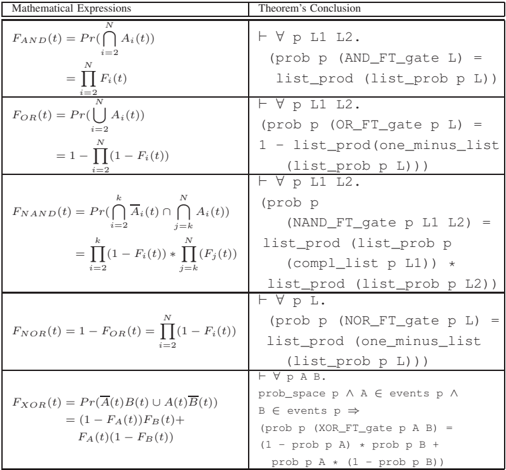
The image presents a structured table with two columns: "Mathematical Expressions" and "Theorem's Conclusion". Each row pairs a probabilistic/mathematical definition with a corresponding logical conclusion involving propositional logic (P), list operations, and gate functions (e.g., AND_FT_gate, OR_FT_gate). The table appears to formalize relationships between probabilistic events and logical operations.
### Components/Axes
- **Columns**:
1. **Mathematical Expressions**: Contains probabilistic definitions (e.g., intersections, unions, products) and recursive formulas.
2. **Theorem's Conclusion**: Contains logical equivalences (⊨) and mappings to propositional logic (P), list operations (list_prod, list_prod_one_minus_list), and gate functions (AND_FT_gate, OR_FT_gate).
### Detailed Analysis
#### Row 1
- **Mathematical Expression**:
```
F_AND(t) = Pr(∩_{i=2}^N A_i(t)) = ∏_{i=2}^N F_i(t)
```
- **Theorem's Conclusion**:
```
⊨ ∨ p P L L2. (prob p (AND_FT_gate p L) = (list_prod (list_prod p L))
```
- **Interpretation**: The probability of the intersection of events `A_i(t)` equals the product of individual probabilities `F_i(t)`. This maps to a logical conclusion where the AND_FT_gate operation on `p` and `L` corresponds to nested list products.
#### Row 2
- **Mathematical Expression**:
```
F_OR(t) = Pr(∪_{i=2}^N A_i(t)) = 1 - ∏_{i=2}^N (1 - F_i(t))
```
- **Theorem's Conclusion**:
```
⊨ ∨ p P L L2. (prob p (OR_FT_gate p L) = (list_prod (list_prod (1 - list_prod (one_minus_list p)) L))
```
- **Interpretation**: The probability of the union of events is derived via inclusion-exclusion. The OR_FT_gate maps to a nested list product involving the complement of `p` and `L`.
#### Row 3
- **Mathematical Expression**:
```
F_NAND(t) = Pr(∩_{i=2}^k Ā_i(t) ∩ ∩_{j=k+1}^N A_j(t)) = ∏_{i=2}^k (1 - F_i(t)) * ∏_{j=k+1}^N F_j(t)
```
- **Theorem's Conclusion**:
```
⊨ ∨ p P L L2. (prob p (NAND_FT_gate p L L2) = (list_prod (list_prod p L) * (list_prod (list_prod (compl_list p L1)) L2))
```
- **Interpretation**: The NAND_FT_gate combines two list products: one for `p` and `L`, and another for the complement of `p` (L1) and `L2`.
#### Row 4
- **Mathematical Expression**:
```
F_NOR(t) = 1 - F_OR(t) = ∏_{i=2}^N (1 - F_i(t))
```
- **Theorem's Conclusion**:
```
⊨ ∨ p P. (prob p (NOR_FT_gate p L) = (list_prod (one_minus_list (list_prod p L)))
```
- **Interpretation**: The NOR_FT_gate inverts the list product of `p` and `L`, reflecting the negation of the OR operation.
#### Row 5
- **Mathematical Expression**:
```
F_XOR(t) = Pr((Ā(t) ∩ B(t)) ∪ (A(t) ∩ B̄(t))) = (1 - F_A(t))F_B(t) + F_A(t)(1 - F_B(t))
```
- **Theorem's Conclusion**:
```
⊨ ∨ p P A B. (prob p (XOR_FT_gate p A B) = (1 - prob p A) * prob p B + prob p A * (1 - prob p B))
```
- **Interpretation**: The XOR_FT_gate maps to a probabilistic combination of `A` and `B` events, mirroring the XOR formula.
### Key Observations
1. **Recursive Structure**: Many expressions (e.g., F_AND, F_OR) use recursive products over indices, suggesting hierarchical event dependencies.
2. **Logical-Gate Mapping**: Each probabilistic function (AND, OR, NAND, NOR, XOR) corresponds to a specific gate operation with list-based interpretations.
3. **Complement Operations**: Terms like `one_minus_list` and `compl_list` indicate explicit handling of event negations in logical conclusions.
4. **List Product Recursion**: Nested list products (e.g., `list_prod (list_prod p L)`) imply multi-stage aggregation of probabilistic outcomes.
### Interpretation
The table formalizes a framework where probabilistic events (modeled as intersections/unions of `A_i(t)`) are translated into propositional logic via gate functions. These gates (AND_FT_gate, OR_FT_gate, etc.) operate on lists (`L`, `L1`, `L2`) using list products and complements, bridging probability theory and formal logic. This structure likely supports theorem proving or formal verification systems, where probabilistic outcomes are decomposed into logical operations for analysis or automation. The recursive and nested nature of the expressions suggests scalability to complex event interactions.