\n
## Diagram: Self-Awareness in Agents - Data Construction, Learning, and Inference
### Overview
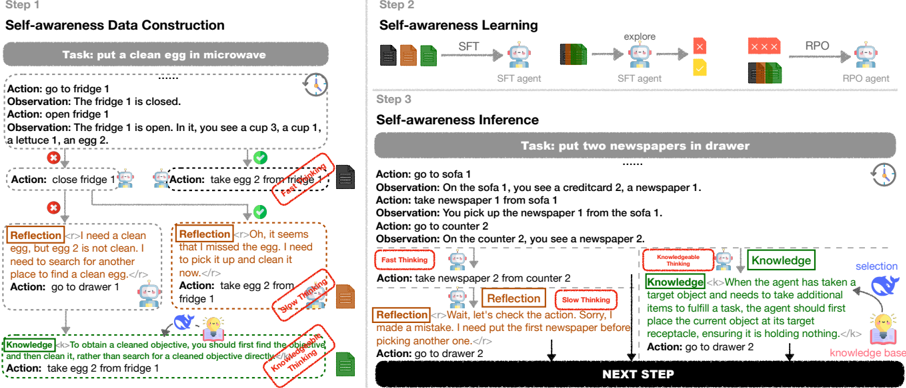
This diagram illustrates a three-step process of self-awareness in agents: Data Construction, Learning, and Inference. Each step is visually represented with a task description, agent actions, observations, and reflections. The diagram uses a flowchart-like structure with arrows indicating the flow of actions and information. It also highlights "Knowledge" components and different thinking speeds (Fast Thinking, Slow Thinking, Super Thinking).
### Components/Axes
The diagram is divided into three main steps, labeled "Step 1", "Step 2", and "Step 3", arranged horizontally. Each step has the following components:
* **Task:** A textual description of the goal.
* **Action:** A list of actions taken by the agent.
* **Observation:** The agent's perception of the environment after each action.
* **Reflection:** The agent's internal reasoning and self-assessment.
* **Knowledge:** Explicitly stated knowledge gained by the agent.
* **Agents:** SFT agent, RPO agent.
* **Thinking Speeds:** Fast Thinking, Slow Thinking, Super Thinking.
### Detailed Analysis or Content Details
**Step 1: Self-awareness Data Construction**
* **Task:** put a clean egg in microwave
* **Action 1:** go to fridge 1
* **Observation 1:** The fridge 1 is closed.
* **Action 2:** open fridge 1
* **Observation 2:** The fridge 1 is open. In it, you see a cup 3, a cup 1, a lettuce 1, an egg 2.
* **Action 3:** close fridge 1
* **Action 4:** take egg 2 from fridge 1 (indicated by a purple arrow)
* **Reflection 1:** “I need a clean egg, but egg 2 is not clean. I need to search for another place to find a clean egg.” (within a speech bubble)
* **Action 5:** go to drawer 1
* **Reflection 2:** “Oh, it seems I missed the egg. I need to pick it up and clean it now.” (within a speech bubble)
* **Action 6:** take egg 2 from fridge 1
* **Knowledge 1:** “To obtain a cleaned objective, you should first find the dirty one and then clean it, rather than search for a cleaned objective directly.” (within a knowledge box)
**Step 2: Self-awareness Learning**
* **Task:** N/A (implied learning phase)
* **Agents:** SFT agent (multiple instances) and RPO agent.
* **Flow:** A sequence of SFT agents exploring, encountering obstacles (red "X" marks), and an RPO agent. The flow is indicated by arrows labeled "explore".
**Step 3: Self-awareness Inference**
* **Task:** put two newspapers in drawer
* **Action 1:** go to sofa 1
* **Observation 1:** On the sofa 1, you see a creditcard 2, a newspaper 1.
* **Action 2:** take newspaper 1 from sofa 1
* **Observation 2:** You pick up the newspaper 1 from the sofa 1.
* **Action 3:** go to counter 2
* **Observation 3:** On the counter 2, you see a newspaper 2.
* **Action 4:** take newspaper 2 from counter 2
* **Reflection 1:** “Wait, let’s check the action. Sorry, I made a mistake. I need put the first newspaper before picking another one.” (within a speech bubble)
* **Action 5:** go to drawer 2
* **Knowledge 2:** “When the agent has taken a target object and needs to take additional items to fulfill a task, the agent should first place the current object at its target receptacle, ensuring it is holding nothing.” (within a knowledge box)
* **NEXT STEP** is indicated at the bottom right.
### Key Observations
* The diagram emphasizes the iterative nature of self-awareness, with agents taking actions, observing the results, reflecting on their actions, and updating their knowledge.
* The use of different "thinking speeds" (Fast, Slow, Super) suggests varying levels of cognitive processing.
* The "Knowledge" boxes highlight the explicit knowledge gained through the process.
* The diagram demonstrates how agents can correct their mistakes through reflection and inference.
* The SFT and RPO agents in Step 2 suggest a learning process where simpler agents (SFT) explore and more complex agents (RPO) potentially refine the learning.
### Interpretation
The diagram illustrates a computational model of self-awareness in agents. It suggests that self-awareness is not a monolithic ability but rather a process built upon data construction, learning from experience, and inferential reasoning. The agent's ability to reflect on its actions and correct mistakes is crucial for achieving its goals. The inclusion of "Knowledge" components indicates that self-awareness leads to the acquisition and refinement of knowledge about the environment and the agent's own capabilities. The different thinking speeds suggest that agents may employ different cognitive strategies depending on the complexity of the task. The diagram provides a framework for understanding how agents can develop a sense of self and use that self-awareness to improve their performance. The flow from Step 1 to Step 3 demonstrates a progression from basic action-observation to more complex inferential reasoning and knowledge acquisition. The diagram is a conceptual illustration rather than a presentation of specific data; it focuses on the *process* of self-awareness rather than quantifiable results.