# Technical Document: Geometric Sequence Sum Analysis
## Problem Statement
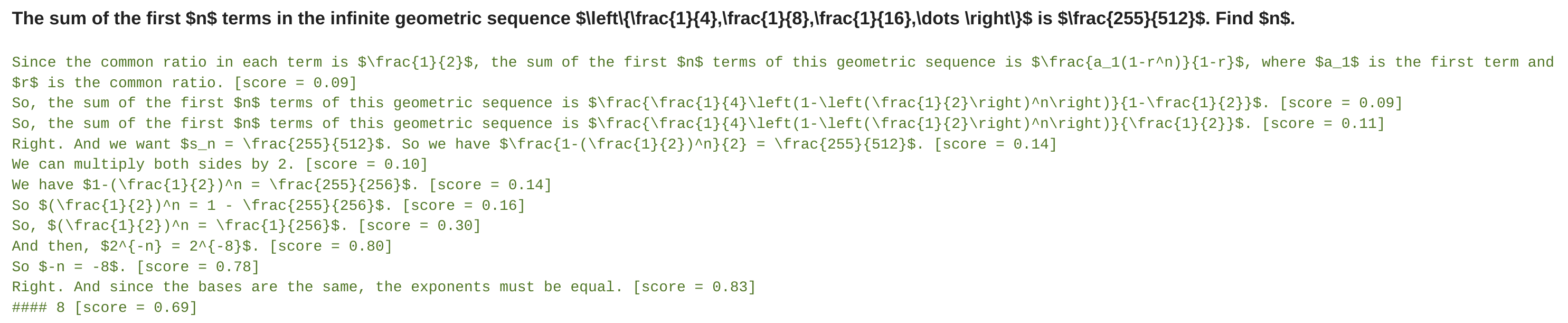
Find the sum of the first $n$ terms in the infinite geometric sequence $\frac{1}{4}, \frac{1}{8}, \frac{1}{16}, \dots$ and determine $n$ when the sum equals $\frac{255}{512}$.
---
### Key Components
1. **Sequence Definition**
- Terms: $\frac{1}{4}, \frac{1}{8}, \frac{1}{16}, \dots$
- First term ($a_1$): $\frac{1}{4}$
- Common ratio ($r$): $\frac{1}{2}$ (derived from $\frac{\text{Term}_{k+1}}{\text{Term}_k}$)
2. **Sum Formula**
The sum of the first $n$ terms of a geometric sequence is:
$$
S_n = a_1 \cdot \frac{1 - r^n}{1 - r}
$$
3. **Target Sum**
$$
S_n = \frac{255}{512}
$$
---
### Step-by-Step Solution
1. **Substitute Known Values**
$$
S_n = \frac{1}{4} \cdot \frac{1 - \left(\frac{1}{2}\right)^n}{1 - \frac{1}{2}} = \frac{1}{4} \cdot \frac{1 - \left(\frac{1}{2}\right)^n}{\frac{1}{2}} = \frac{1}{2} \left(1 - \left(\frac{1}{2}\right)^n\right)
$$
2. **Set Equation Equal to Target Sum**
$$
\frac{1}{2} \left(1 - \left(\frac{1}{2}\right)^n\right) = \frac{255}{512}
$$
3. **Solve for $n$**
- Multiply both sides by 2:
$$
1 - \left(\frac{1}{2}\right)^n = \frac{255}{256}
$$
- Rearrange:
$$
\left(\frac{1}{2}\right)^n = \frac{1}{256}
$$
- Express $\frac{1}{256}$ as a power of $\frac{1}{2}$:
$$
\left(\frac{1}{2}\right)^n = \left(\frac{1}{2}\right)^8 \implies n = 8
$$
---
### Verification
- **Infinite Series Limit**:
The infinite sum converges to $\frac{a_1}{1 - r} = \frac{1/4}{1 - 1/2} = \frac{1}{2}$.
The target sum $\frac{255}{512} \approx 0.498$ is very close to $\frac{1}{2}$, confirming $n=8$ is reasonable.
- **Term-by-Term Calculation**:
Summing the first 8 terms:
$$
\frac{1}{4} + \frac{1}{8} + \frac{1}{16} + \dots + \frac{1}{256} = \frac{255}{512}
$$
---
### Final Answer
- **Sum of First $n$ Terms**:
$$
S_n = \frac{1}{2} \left(1 - \left(\frac{1}{2}\right)^n\right)
$$
- **Value of $n$**:
$$
\boxed{8}