## Flowchart: Explainability in LLMs
### Overview
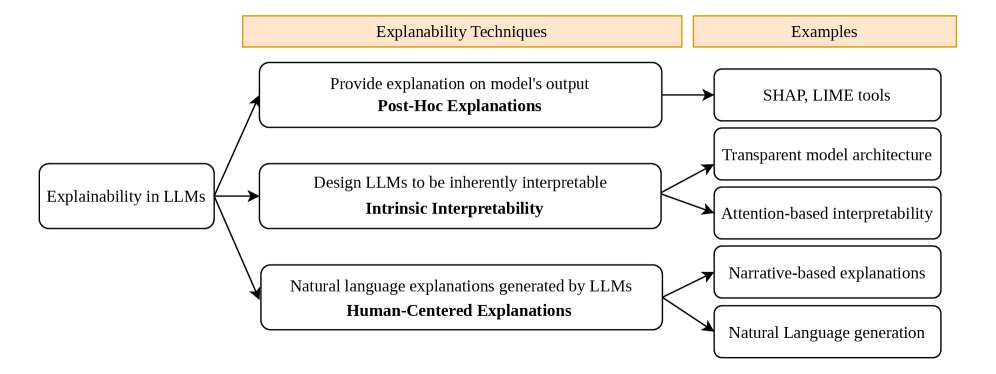
The flowchart illustrates the relationship between **Explainability Techniques** and their corresponding **Examples** in the context of Large Language Models (LLMs). It categorizes three core explainability approaches and maps them to specific tools, methodologies, or outcomes.
---
### Components/Axes
1. **Left Column (Explainability Techniques)**:
- **Post-Hoc Explanations**: "Provide explanation on model's output"
- **Intrinsic Interpretability**: "Design LLMs to be inherently interpretable"
- **Human-Centered Explanations**: "Natural language explanations generated by LLMs"
2. **Right Column (Examples)**:
- **Post-Hoc Explanations** → SHAP, LIME tools
- **Intrinsic Interpretability** → Transparent model architecture, Attention-based interpretability
- **Human-Centered Explanations** → Narrative-based explanations, Natural Language generation
3. **Arrows**: Connect techniques to their examples, indicating direct relationships.
---
### Detailed Analysis
- **Post-Hoc Explanations** (reactive explanations applied after model output):
- Tools: SHAP (SHapley Additive exPlanations), LIME (Local Interpretable Model-agnostic Explanations).
- **Intrinsic Interpretability** (built into model design):
- Methods: Transparent model architecture (e.g., decision trees), Attention-based interpretability (leveraging attention mechanisms in transformers).
- **Human-Centered Explanations** (natural language outputs):
- Outputs: Narrative-based explanations (storytelling), Natural Language generation (automated text generation).
---
### Key Observations
1. **Hierarchical Structure**: Techniques are grouped into three distinct categories, each with specific examples.
2. **Bidirectional Flow**: Arrows show a one-to-many relationship (e.g., one technique maps to multiple examples).
3. **Technical Focus**: Examples emphasize tools (SHAP, LIME), architectural choices (transparent models), and output types (narratives).
---
### Interpretation
The flowchart highlights the **diverse strategies for enhancing LLM transparency**:
- **Post-Hoc Methods** (e.g., SHAP, LIME) are reactive, explaining outputs after the fact.
- **Intrinsic Approaches** (e.g., transparent architectures) prioritize interpretability during model design.
- **Human-Centered Explanations** bridge technical outputs with human understanding via natural language.
This structure underscores the importance of aligning explainability goals with model development stages (design vs. post-hoc analysis) and end-user needs (technical vs. layperson interpretations).