## Flowchart: Solving Remainder Problems Using Modular Arithmetic
### Overview
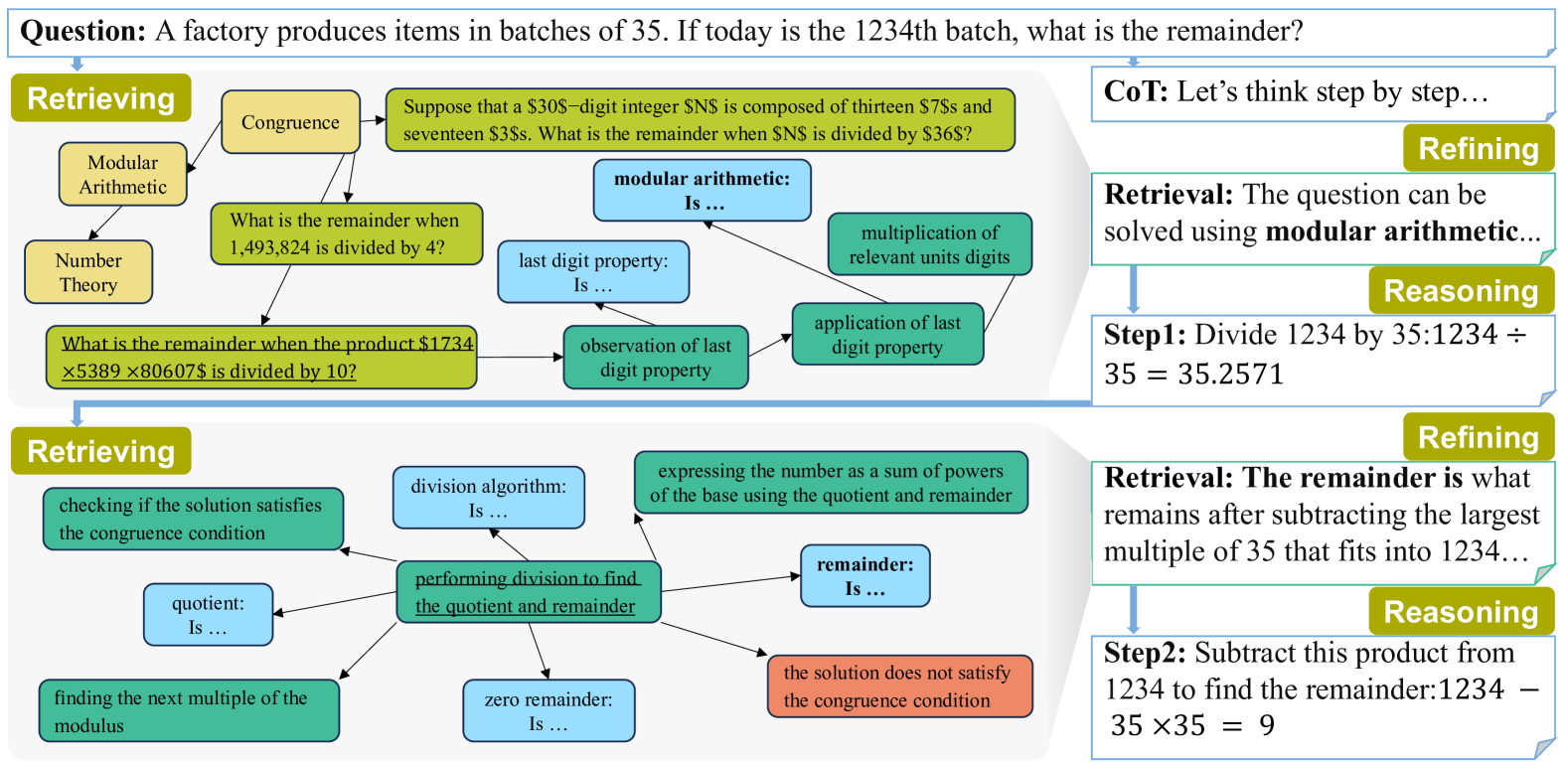
The flowchart illustrates a step-by-step process to solve a remainder problem: "A factory produces items in batches of 35. If today is the 1234th batch, what is the remainder?" It combines mathematical reasoning (modular arithmetic, congruence) with algorithmic steps (division, subtraction) to derive the solution.
### Components/Axes
- **Nodes**:
- **Question**: "A factory produces items in batches of 35. If today is the 1234th batch, what is the remainder?"
- **Retrieving**: Subsections for "Modular Arithmetic" and "Number Theory."
- **Congruence**: Example problem about a 30-digit integer composed of 13 $7s and 17 $3s.
- **Modular Arithmetic**: Substeps like "last digit property" and "multiplication of relevant units digits."
- **Refining**: Final steps to compute the remainder.
- **Arrows**: Indicate logical flow (e.g., "What is the remainder when 1,493,824 is divided by 4?" → "modular arithmetic").
- **Colors**:
- Green: "Retrieving" (e.g., division algorithm, checking congruence).
- Yellow: "Congruence" (e.g., example problem).
- Blue: "Modular Arithmetic" (e.g., last digit property).
- Red: "Refining" (e.g., final remainder calculation).
### Detailed Analysis
1. **Step 1 (Refining)**:
- **Text**: "Divide 1234 by 35: 1234 ÷ 35 = 35.2571."
- **Calculation**: Quotient = 35, remainder = 1234 - (35 × 35) = 9.
2. **Step 2 (Refining)**:
- **Text**: "Subtract this product from 1234 to find the remainder: 1234 − 35 × 35 = 9."
3. **Congruence Example**:
- **Text**: "Suppose a 30-digit integer $N$ is composed of thirteen $7s and seventeen $3s. What is the remainder when $N$ is divided by 36?"
- **Substeps**:
- "last digit property" (blue node).
- "multiplication of relevant units digits" (green node).
4. **Modular Arithmetic**:
- **Text**: "What is the remainder when the product $1734 × 5389 × 80607$ is divided by 10?"
- **Substeps**: "observation of last digit property" (green node).
### Key Observations
- **Modular Arithmetic Focus**: The flowchart emphasizes breaking down large numbers using properties like last-digit behavior and congruence conditions.
- **Algorithmic Steps**: Division and subtraction are used to isolate the remainder.
- **Redundancy Check**: The flowchart includes a step to verify if the solution satisfies the congruence condition (e.g., "checking if the solution satisfies the congruence condition").
### Interpretation
The flowchart demonstrates a systematic approach to solving remainder problems by:
1. **Decomposing the problem** into smaller, manageable parts (e.g., using modular arithmetic to simplify division).
2. **Applying mathematical properties** (e.g., last-digit rules, congruence conditions) to reduce computational complexity.
3. **Validating solutions** through iterative checks (e.g., ensuring the remainder aligns with the original problem constraints).
The example of dividing 1234 by 35 highlights how modular arithmetic simplifies large divisions by focusing on remainders rather than full quotients. The final answer (remainder = 9) is derived by subtracting the largest multiple of 35 (35 × 35 = 1225) from 1234. This method avoids direct computation of large products or divisions, leveraging number theory principles for efficiency.
**Note**: The flowchart does not include numerical data for all substeps (e.g., the 30-digit integer example lacks a final answer), suggesting it is a template for problem-solving rather than a complete solution.