## System Architecture Diagram: LoRA Adapters, Agent Runner, and DualRadixTree Caching System
### Overview
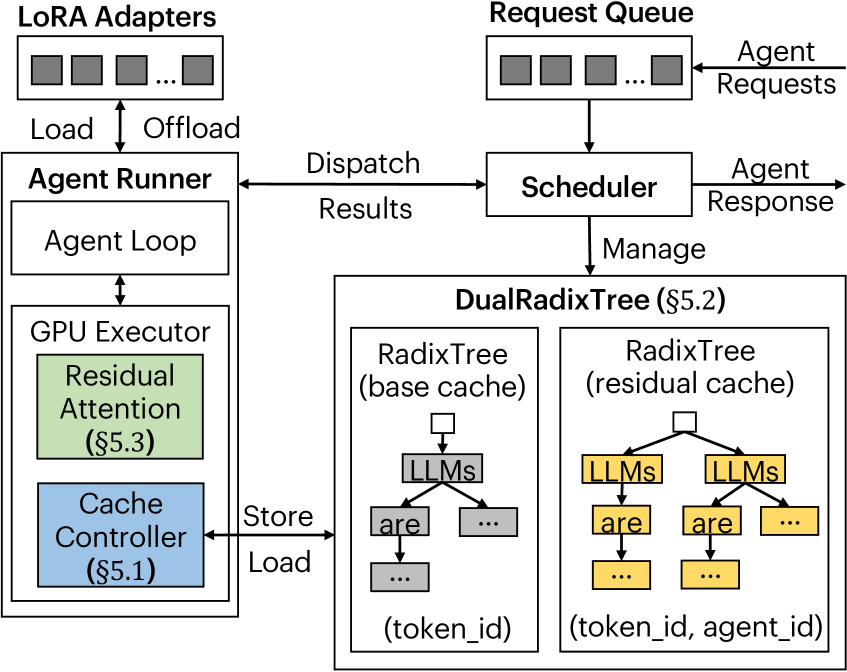
The diagram illustrates a distributed system architecture for managing large language model (LLM) operations, featuring LoRA adapters, an agent runner, a scheduler, and a dual caching system. Components are interconnected via directional arrows indicating data flow and control signals.
### Components/Axes
1. **Top-Left Section (LoRA Adapters)**
- Contains gray rectangles labeled "LoRA Adapters"
- Arrows labeled "Load" (upward) and "Offload" (downward) connect to the Agent Runner
2. **Center-Left Section (Agent Runner)**
- Contains:
- "Agent Loop" (rectangle)
- "GPU Executor" (rectangle)
- "Residual Attention (§5.3)" (green rectangle)
- "Cache Controller (§5.1)" (blue rectangle)
- Arrows labeled "Dispatch" (rightward) and "Store/Load" (rightward) connect to the Scheduler and DualRadixTree
3. **Top-Right Section (Request Queue)**
- Contains gray rectangles labeled "Request Queue"
- Arrows labeled "Agent Requests" (leftward) and "Agent Response" (rightward) connect to the Scheduler
4. **Center Section (Scheduler)**
- Contains "Scheduler" (rectangle)
- Arrows labeled "Results" (leftward) and "Manage" (downward) connect to the Agent Runner and DualRadixTree
5. **Bottom-Right Section (DualRadixTree)**
- Contains two sub-components:
- **RadixTree (base cache)**:
- Gray rectangles labeled "LLMs"
- Arrows labeled "token_id" (downward)
- **RadixTree (residual cache)**:
- Yellow rectangles labeled "LLMs"
- Arrows labeled "token_id, agent_id" (downward)
### Detailed Analysis
- **LoRA Adapters**: Positioned at the top-left, these components interface with the Agent Runner via load/offload operations.
- **Agent Runner**: Central processing unit with GPU acceleration (Residual Attention) and cache management (Cache Controller).
- **Scheduler**: Acts as a mediator between the Agent Runner and Request Queue, managing task dispatch and results.
- **DualRadixTree**: Implements a two-tier caching strategy:
- **Base Cache**: Stores LLM data by `token_id` (gray nodes).
- **Residual Cache**: Stores LLM data by `token_id` and `agent_id` (yellow nodes), enabling agent-specific optimizations.
### Key Observations
1. **Color Coding**:
- Gray: Base cache components (LoRA Adapters, Request Queue, base RadixTree).
- Green: Residual Attention module (GPU-accelerated processing).
- Blue: Cache Controller (cache management logic).
- Yellow: Residual cache components (agent-specific LLM data).
2. **Data Flow**:
- Requests flow from the Request Queue to the Scheduler, which coordinates with the Agent Runner and DualRadixTree.
- Results from the Agent Runner are stored in the DualRadixTree via the Cache Controller.
3. **Hierarchical Caching**:
- The DualRadixTree separates general LLM data (base cache) from agent-specific optimizations (residual cache), suggesting a design for scalability and personalization.
### Interpretation
This architecture optimizes LLM operations by:
1. **Offloading Computation**: Using LoRA adapters to manage model parameters efficiently.
2. **Parallel Processing**: Leveraging GPU Executors for residual attention tasks.
3. **Caching Strategy**: The dual RadixTree structure reduces redundant computations by caching base LLM data globally and agent-specific residuals locally.
The system prioritizes modularity, with clear separation between computation (Agent Runner), coordination (Scheduler), and data management (DualRadixTree). The use of agent-specific caching (`token_id, agent_id`) implies a focus on personalized or context-aware LLM responses.
**Note**: No numerical data or explicit trends are present; the diagram focuses on structural relationships and workflow.