TECHNICAL ASSET FINGERPRINT
00c6391a0f0da473951f7236
Click to view fullscreen
Press ESC or click to close
FOUND IN PAPERS
EXPERT: gemini-2.0-flash VERSION 1
RUNTIME: nugit/gemini/gemini-2.0-flash
INTEL_VERIFIED
## Logical Rules: Type Systems and Properties
### Overview
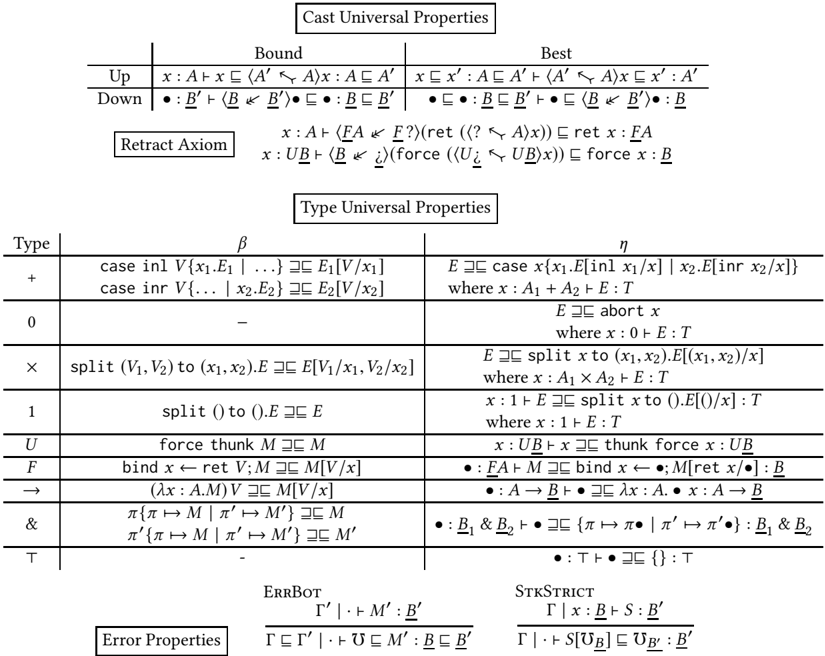
The image presents a collection of logical rules, likely related to type systems or program semantics. These rules are expressed using mathematical notation and logical symbols, defining relationships between types, expressions, and contexts. The rules are grouped into categories such as "Cast Universal Properties", "Type Universal Properties", and "Error Properties".
### Components/Axes
**1. Cast Universal Properties:**
- Located at the top of the image.
- Subdivided into "Bound" and "Best" categories.
- Contains rules involving type casting or subtyping, denoted by symbols like "⊢" and "⊏".
**2. Retract Axiom:**
- Located below "Cast Universal Properties".
- Presents axioms related to retracting or unwrapping types.
**3. Type Universal Properties:**
- Located in the center of the image.
- Organized in a table format with columns for "Type", "β" (beta reduction), and "η" (eta conversion).
- Lists rules for various types such as +, 0, ×, 1, U, F, →, &, and ⊤.
**4. Error Properties:**
- Located at the bottom of the image.
- Contains rules related to error handling or type checking in erroneous situations.
- Includes labels "ERRBOT" and "STKSTRICT".
### Detailed Analysis or ### Content Details
**Cast Universal Properties:**
* **Up (Bound):** x: A ⊢ x ⊏ (A' ⇦ A) x: A ⊏ A'
* **Up (Best):** x ⊏ x': A ⊏ A' ⊢ (A' ⇦ A) x ⊏ x': A'
* **Down (Bound):** •: B' ⊢ (B ⇦ B') • ⊏: B ⊏ B'
* **Down (Best):** • ⊏: B ⊏ B' ⊢ (B ⇦ B') •: B
**Retract Axiom:**
* x: A ⊢ (FA ⇐ F?) (ret (? ⇐ A) x)) ⊏ ret x: FA
* x: UB ⊢ (B ⇐) (force (U¿ ⊏ UB) x)) ⊏ force x: B
**Type Universal Properties:**
| Type | β AND THE LIST GOES ON!
DECODING INTELLIGENCE...
EXPERT: nemotron-free VERSION 1
RUNTIME: free/nvidia/nemotron-nano-12b-v2-vl:free
INTEL_VERIFIED
## Technical Document: Type System Properties and Error Handling
### Overview
The image presents a formal specification of type system properties, error handling rules, and type universal properties in a programming language context. It combines logical assertions, type operations, and error propagation mechanisms using mathematical notation and type theory constructs.
### Components/Axes
1. **Cast Universal Properties Table**
- **Columns**: Bound, Best, Retract Axiom
- **Rows**: Up, Down
- **Notation**: Uses type casts (`⊆`), logical implications (`⇒`), and set operations (`⊆`, `⊇`)
2. **Type Universal Properties Table**
- **Columns**: β (beta), η (eta)
- **Rows**: Type constructors (`+`, `0`, `×`, `1`, `U`, `F`, `→`, `&`, `T`)
- **Notation**: Case analysis, type splitting, and monadic operations
3. **Error Properties Section**
- **Subsections**: ErrBot, StkStrict
- **Notation**: Type refinement (`⊆`), error propagation (`⊆`), and strictness annotations
### Detailed Analysis
#### Cast Universal Properties
| Bound | Best | Retract Axiom |
|-------|------|---------------|
| Up: `x : A - x ⊆ ⟨A' ⇸ A⟩x : A ⊆ A'` | Up: `x ⊆ x' : A ⊆ A' - ⟨A' ⇸ A⟩x ⊆ x' : A` | `x : A ↦ ⟨FA ⇸ F?⟩(ret (⟨? ⇸ A⟩x)) ⊆ ret x : FA` |
| Down: `• : B' - ⟨B ⇸ B'⟩• ⊆ • : B ⊆ B'` | Down: `• ⊆ • : B ⊆ B' - ⟨B ⇸ B'⟩• : B` | `x : U_B ↦ ⟨B ⇸ ?⟩(force (⟨U_? ⇸ U_B⟩x)) ⊆ force x : B` |
#### Type Universal Properties
| Type | β (Beta) | η (Eta) |
|------|----------|---------|
| `+` | `case inl V{x1.E1 | ...} ⇒ E1[V/x1]` | `E ⇒ case x{x1.E[inl x1/x] | x2.E[inr x2/x]}` |
| `0` | - | `E ⇒ abort x` |
| `×` | `split (V1,V2) to (x1,x2).E ⇒ E[V1/x1,V2/x2]` | `E ⇒ split x to (x1,x2).E[(x1,x2)/x]` |
| `1` | `split () to ().E ⇒ E` | `x : 1 ↦ split x to ().E[()]/x : T` |
| `U` | `force M ⇒ M` | `x : U_B ↦ x ⇒ thunk force x : U_B` |
| `F` | `bind x ← ret V; M ⇒ M[V/x]` | `• : FA ↦ bind x ← •; M[ret x/•] : B` |
| `→` | `(λx : A.M) V ⇒ M[V/x]` | `• : A → B ↦ λx : A. • x : A → B` |
| `&` | `π{π ↦ M | π' ↦ M'} ⇒ M` | `• : B₁ & B₂ ↦ {π ↦ π • | π' ↦ π' •} : B₁ & B₂` |
| `T` | - | `• : T ↦ { } : T` |
#### Error Properties
- **ErrBot**:
- `Γ' | · ↦ M' : B'`
- `Γ ⊆ Γ' | · ↦ U ⊆ M' : B ⊆ B'`
- **StkStrict**:
- `Γ | x : B ↦ S : B'`
- `Γ | · ↦ S[U_B] ⊆ U_B' : B'`
### Key Observations
1. **Type Safety**: The Cast Universal Properties enforce safe type casting through bidirectional implications between source and target types.
2. **Monadic Operations**: The `bind` and `force` operations in the `F` and `U` rows implement monadic behavior for effect handling.
3. **Product/Union Types**: The `×` and `+` rows define tuple and sum type operations with explicit case analysis.
4. **Error Propagation**: The ErrBot and StkStrict sections formalize error handling through type refinement and strictness annotations.
### Interpretation
This document formalizes a type system with:
1. **Type Casting Rules**: Ensuring safe upcasts (`A ⊆ A'`) and downcasts (`B' ⊆ B`) through logical implications.
2. **Effect Handling**: Using monadic operations (`bind`, `force`) to manage side effects and errors.
3. **Error Handling**: Differentiating between recoverable errors (`ErrBot`) and strict error propagation (`StkStrict`).
4. **Type Theory Foundations**: Employing dependent types (`π`, `λ`) and case analysis for algebraic data types.
The specifications appear to implement a **graded type system** with:
- **Bounded Casting**: Restricting casts to subtypes (`A ⊆ A'`)
- **Error Annotations**: Explicit error handling through type refinements
- **Strictness Control**: Differentiating between lazy (`U`) and strict (`F`) evaluation contexts
The document likely serves as a formal verification of a programming language's type system, ensuring type safety while allowing controlled type casting and error handling.
DECODING INTELLIGENCE...