\n
## Diagram: Rule Application Over Time
### Overview
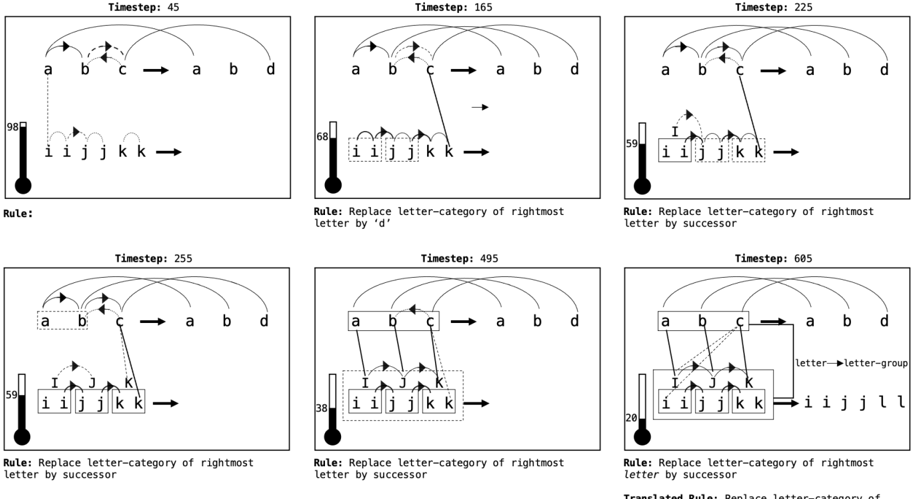
The image presents a series of six diagrams illustrating a rule-based transformation applied to a sequence of letters over time. Each diagram represents a specific timestep (45, 165, 225, 255, 495, 605). The diagrams show a state transition system with a circular flow between letter categories (a, b, c, d) and a sequence of letters (i, j, k, l) undergoing modification based on the applied rule.
### Components/Axes
Each diagram consists of:
* **Timestep:** Located at the top-left corner, indicating the current time step.
* **State Transition Diagram:** A circular diagram with four letter categories (a, b, c, d) connected by arrows, representing a state transition.
* **Letter Sequence:** A horizontal sequence of letters (i, j, k, l) enclosed in a rectangular box.
* **Rule:** A text description below the letter sequence, explaining the rule applied at that timestep.
* **Value:** A number located below the letter sequence, representing a value associated with the sequence.
### Detailed Analysis / Content Details
**Diagram 1: Timestep 45**
* Value: 98
* Letter Sequence: iijjkk
* Rule: (No rule stated)
**Diagram 2: Timestep 165**
* Value: 68
* Letter Sequence: iijjkk
* Rule: Replace letter-category of rightmost letter by 'd'
**Diagram 3: Timestep 225**
* Value: 59
* Letter Sequence: iijjkk
* Rule: Replace letter-category of rightmost letter by successor
**Diagram 4: Timestep 255**
* Value: 59
* Letter Sequence: I j J k K
* Rule: Replace letter-category of rightmost letter by successor
**Diagram 5: Timestep 495**
* Value: 38
* Letter Sequence: I j J k K
* Rule: Replace letter-category of rightmost letter by successor
**Diagram 6: Timestep 605**
* Value: 20
* Letter Sequence: iijjll
* Rule: Replace letter-category of rightmost letter by successor
* Annotation: "letter-letter-group" pointing to the last two letters.
### Key Observations
* The value associated with the letter sequence generally decreases over time, from 98 at timestep 45 to 20 at timestep 605.
* The rule applied at timesteps 165, 225, 255, 495, and 605 involves replacing the letter category of the rightmost letter, either with 'd' or its successor.
* The letter sequence changes over time, with some letters being capitalized (I, J, K) at timesteps 255 and 495.
* At timestep 605, the last two letters are annotated as "letter-letter-group".
### Interpretation
The diagrams demonstrate a dynamic system where a sequence of letters is transformed according to a set of rules over time. The decreasing value suggests a process of decay or convergence. The rules applied seem to be designed to modify the letter sequence, potentially driving it towards a specific state. The capitalization of letters at certain timesteps and the annotation of the last two letters at timestep 605 indicate that the system may be sensitive to specific letter patterns or groupings. The initial diagram (timestep 45) lacks a stated rule, suggesting a starting condition or an initial state before the rule-based transformations begin. The system appears to be exploring different states of the letter sequence based on the applied rules, and the value likely represents some metric related to the state of the sequence. The "letter-letter-group" annotation suggests that the system is recognizing or reacting to specific patterns within the sequence. The overall process could be modeling a form of evolutionary algorithm or a state machine with a defined set of transitions.