TECHNICAL ASSET FINGERPRINT
00d6df9e9e87b8c8a20e46a8
Click to view fullscreen
Press ESC or click to close
FOUND IN PAPERS
EXPERT: healer-alpha-free VERSION 1
RUNTIME: free/openrouter/healer-alpha
INTEL_VERIFIED
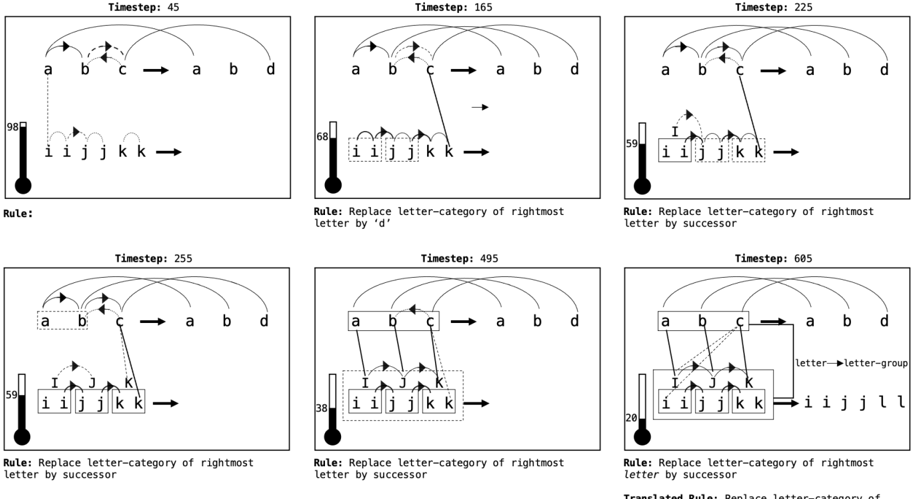
## Diagram: Rule-Based Letter-Category Transformation Over Timesteps
### Overview
The image is a six-panel diagram illustrating the step-by-step application of a rule-based transformation on sequences of letters. The process is shown at six discrete timesteps (45, 165, 225, 255, 495, 605). Each panel depicts a "before" state (left) transforming into an "after" state (right) via a rule stated below the panel. The diagram visualizes how a grouping or categorization of letters evolves, culminating in a final transformation from individual letters to letter-groups.
### Components/Axes
* **Panels:** Six rectangular panels arranged in a 2x3 grid (two rows, three columns).
* **Timestep Labels:** Each panel is titled with "Timestep: [Number]" at its top center. The timesteps are: 45, 165, 225 (top row, left to right); 255, 495, 605 (bottom row, left to right).
* **Vertical Bar:** A vertical bar with a circular base is positioned on the left side of each panel's lower section. It contains a numerical value (e.g., 98, 68, 99, 59, 38, 20) that decreases over successive timesteps.
* **Top Sequence:** A horizontal sequence of three letters (a, b, c) with curved arrows indicating relationships or operations. An arrow points to a resulting sequence (a, b, d).
* **Bottom Sequence:** A horizontal sequence of six letters (e.g., i, i, j, j, k, k) enclosed in boxes. Dotted lines and arrows show groupings and transformations within this sequence.
* **Rule Text:** A line of text below each panel describing the transformation rule applied.
* **Final Transformation Label:** In the final panel (Timestep: 605), an additional label "letter → letter-group" appears, pointing to the final output sequence.
### Detailed Analysis
**Panel 1 (Timestep: 45)**
* **Top Sequence:** `a b c` → `a b d`. Curved arrows connect `a` to `b`, `b` to `c`, and `c` to the output `d`.
* **Bottom Sequence:** `i i j j k k`. The first two `i`s are grouped with a dotted box. An arrow points from the last `k` to the right.
* **Vertical Bar Value:** 98.
* **Rule:** "Rule:" (The rule text is incomplete or not yet defined in this initial state).
**Panel 2 (Timestep: 165)**
* **Top Sequence:** `a b c` → `a b d`. Same arrow structure as Panel 1.
* **Bottom Sequence:** `i i j j k k`. The first four letters (`i i j j`) are now enclosed in a single dotted box. An arrow points from the last `k` to the right.
* **Vertical Bar Value:** 68.
* **Rule:** "Rule: Replace letter-category of rightmost letter by 'd'"
**Panel 3 (Timestep: 225)**
* **Top Sequence:** `a b c` → `a b d`. Same arrow structure.
* **Bottom Sequence:** `i i j j k k`. The grouping has changed. The first `i` is in its own box, the next `i` and first `j` are grouped, the second `j` is in its own box, and the two `k`s are grouped. An arrow points from the last `k` group to the right.
* **Vertical Bar Value:** 99.
* **Rule:** "Rule: Replace letter-category of rightmost letter by successor"
**Panel 4 (Timestep: 255)**
* **Top Sequence:** `a b c` → `a b d`. Same arrow structure.
* **Bottom Sequence:** `i i j j k k`. Grouping: `i` (box), `i j` (dotted box), `j` (box), `k k` (dotted box). An arrow points from the last `k` group to the right.
* **Vertical Bar Value:** 59.
* **Rule:** "Rule: Replace letter-category of rightmost letter by successor"
**Panel 5 (Timestep: 495)**
* **Top Sequence:** `a b c` → `a b d`. Same arrow structure.
* **Bottom Sequence:** `i i j j k k`. Grouping: `i i` (dotted box), `j j` (dotted box), `k k` (dotted box). Arrows point from each group (`i i`, `j j`, `k k`) upwards to the letters `a`, `b`, `c` in the top sequence, indicating a mapping.
* **Vertical Bar Value:** 38.
* **Rule:** "Rule: Replace letter-category of rightmost letter by successor"
**Panel 6 (Timestep: 605)**
* **Top Sequence:** `a b c` → `a b d`. Same arrow structure.
* **Bottom Sequence:** `i i j j k k`. Grouping: `i i` (dotted box), `j j` (dotted box), `k k` (dotted box). Arrows point from each group upwards to `a`, `b`, `c`.
* **New Element:** A label "letter → letter-group" with an arrow points from the top sequence's output (`a b d`) to a new, final output sequence.
* **Final Output Sequence:** `i i j j l l`. The last group has changed from `k k` to `l l`.
* **Vertical Bar Value:** 20.
* **Rule:** "Rule: Replace letter-category of rightmost letter by successor"
* **Translated Rule (Partial):** At the very bottom, partially cut off, is the text "Translated Rule: Replace letter-category of..."
### Key Observations
1. **Progression of Grouping:** The bottom sequence's grouping evolves from a single group (Panel 2) to a complex, non-uniform grouping (Panels 3 & 4) and finally to three uniform pairs (Panels 5 & 6: `ii`, `jj`, `kk`).
2. **Rule Evolution:** The rule changes from an incomplete statement (Panel 45) to a specific rule using 'd' (Panel 165), and then to a more general "successor" rule (Panels 225 onward).
3. **Mapping Emergence:** At Timestep 495, a clear mapping is established between the bottom letter-groups (`ii`, `jj`, `kk`) and the top letters (`a`, `b`, `c`).
4. **Final Transformation:** At Timestep 605, the process culminates. The rule is applied to the rightmost letter-category (`k`), replacing it with its successor (`l`). This change propagates through the established mapping, transforming the entire bottom sequence from `i i j j k k` to `i i j j l l`.
5. **Vertical Bar Trend:** The numerical value in the vertical bar generally decreases over time (98 → 68 → 99 → 59 → 38 → 20), with an anomalous increase at Timestep 225. This may represent a confidence score, step counter, or energy metric that decreases as the process converges.
### Interpretation
This diagram illustrates a **hierarchical, rule-based learning or transformation system**. The top sequence (`a b c` → `a b d`) appears to be a fixed, high-level rule or target pattern. The bottom sequence is a lower-level data string undergoing a process of **categorization and alignment** with the high-level rule.
The process demonstrates several key concepts:
* **Abstraction:** The system moves from raw letters (`i,i,j,j,k,k`) to grouped categories (`ii`, `jj`, `kk`), which are then mapped to abstract symbols (`a`, `b`, `c`).
* **Rule Application:** The stated rule ("Replace letter-category of rightmost letter by successor") is applied at the categorical level. The "successor" of category `k` is `l`.
* **Propagation of Change:** Once the rightmost category is changed, the mapping ensures the entire output sequence reflects this change, showing how a local rule can have a global effect in a structured system.
* **Convergence:** The decreasing value in the vertical bar suggests the process is moving towards a stable or complete state, which is achieved at Timestep 605 with the final transformed output.
The diagram likely models a computational or cognitive process where low-level data is progressively structured and mapped to high-level concepts, allowing for the application of abstract rules that modify the original data in a consistent, predictable way. The anomalous value at Timestep 225 might indicate a phase of reorganization or increased uncertainty before a more stable grouping is found.
DECODING INTELLIGENCE...