## Chart: Aerodynamic Coefficients vs. Angle of Attack for Cube and Cylinder
### Overview
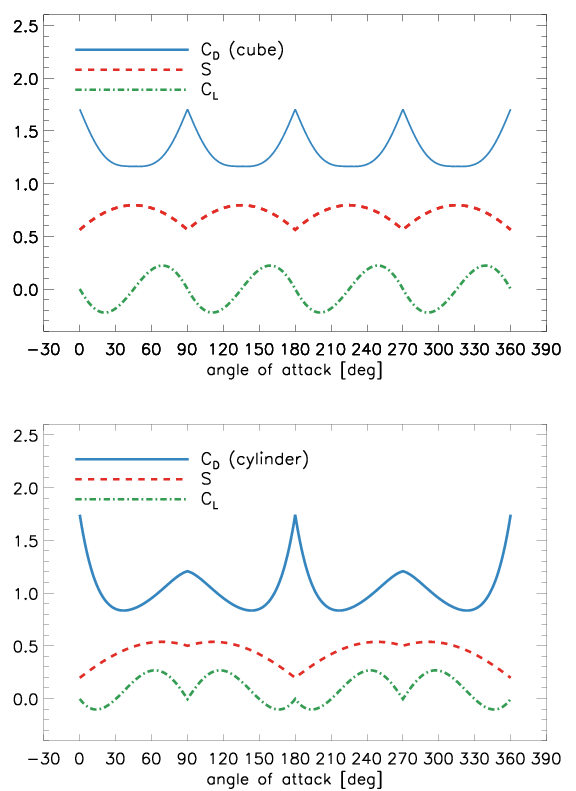
The image presents two line charts comparing the aerodynamic coefficients of a cube (top chart) and a cylinder (bottom chart) as a function of the angle of attack. Each chart displays three coefficients: drag coefficient (C_D), side force (S), and lift coefficient (C_L). The x-axis represents the angle of attack in degrees, ranging from -30 to 390. The y-axis represents the magnitude of the aerodynamic coefficients, ranging from 0.0 to 2.5.
### Components/Axes
**Top Chart (Cube):**
* **X-axis:** Angle of attack [deg], ranging from -30 to 390 in increments of 30.
* **Y-axis:** Aerodynamic coefficient magnitude, ranging from 0.0 to 2.5 in increments of 0.5.
* **Legend (top-right):**
* Blue solid line: C\_D (cube)
* Red dashed line: S
* Green dash-dotted line: C\_L
**Bottom Chart (Cylinder):**
* **X-axis:** Angle of attack [deg], ranging from -30 to 390 in increments of 30.
* **Y-axis:** Aerodynamic coefficient magnitude, ranging from 0.0 to 2.5 in increments of 0.5.
* **Legend (top-left):**
* Blue solid line: C\_D (cylinder)
* Red dashed line: S
* Green dash-dotted line: C\_L
### Detailed Analysis
**Top Chart (Cube):**
* **C\_D (cube) (Blue solid line):** The drag coefficient oscillates between approximately 1.1 and 1.7. Peaks occur roughly at 0, 90, 180, 270, and 360 degrees.
* Angle of attack = 0 deg, C\_D = 1.7
* Angle of attack = 45 deg, C\_D = 1.2
* Angle of attack = 90 deg, C\_D = 1.7
* Angle of attack = 135 deg, C\_D = 1.2
* Angle of attack = 180 deg, C\_D = 1.7
* Angle of attack = 225 deg, C\_D = 1.2
* Angle of attack = 270 deg, C\_D = 1.7
* Angle of attack = 315 deg, C\_D = 1.2
* Angle of attack = 360 deg, C\_D = 1.7
* **S (Red dashed line):** The side force oscillates between approximately 0.5 and 0.8. Peaks occur roughly at 45, 135, 225, and 315 degrees.
* Angle of attack = 0 deg, S = 0.6
* Angle of attack = 45 deg, S = 0.8
* Angle of attack = 90 deg, S = 0.6
* Angle of attack = 135 deg, S = 0.8
* Angle of attack = 180 deg, S = 0.6
* Angle of attack = 225 deg, S = 0.8
* Angle of attack = 270 deg, S = 0.6
* Angle of attack = 315 deg, S = 0.8
* Angle of attack = 360 deg, S = 0.6
* **C\_L (Green dash-dotted line):** The lift coefficient oscillates between approximately -0.1 and 0.2. Peaks occur roughly at 45, 135, 225, and 315 degrees.
* Angle of attack = 0 deg, C\_L = 0.0
* Angle of attack = 45 deg, C\_L = 0.2
* Angle of attack = 90 deg, C\_L = 0.0
* Angle of attack = 135 deg, C\_L = 0.2
* Angle of attack = 180 deg, C\_L = 0.0
* Angle of attack = 225 deg, C\_L = 0.2
* Angle of attack = 270 deg, C\_L = 0.0
* Angle of attack = 315 deg, C\_L = 0.2
* Angle of attack = 360 deg, C\_L = 0.0
**Bottom Chart (Cylinder):**
* **C\_D (cylinder) (Blue solid line):** The drag coefficient has sharp peaks at 0, 180, and 360 degrees, reaching approximately 1.8. It has minimums at approximately 90 and 270 degrees, reaching approximately 0.8.
* Angle of attack = 0 deg, C\_D = 1.8
* Angle of attack = 45 deg, C\_D = 1.2
* Angle of attack = 90 deg, C\_D = 0.8
* Angle of attack = 135 deg, C\_D = 1.2
* Angle of attack = 180 deg, C\_D = 1.8
* Angle of attack = 225 deg, C\_D = 1.2
* Angle of attack = 270 deg, C\_D = 0.8
* Angle of attack = 315 deg, C\_D = 1.2
* Angle of attack = 360 deg, C\_D = 1.8
* **S (Red dashed line):** The side force oscillates between approximately 0.2 and 0.5. Peaks occur roughly at 45, 135, 225, and 315 degrees.
* Angle of attack = 0 deg, S = 0.2
* Angle of attack = 45 deg, S = 0.5
* Angle of attack = 90 deg, S = 0.2
* Angle of attack = 135 deg, S = 0.5
* Angle of attack = 180 deg, S = 0.2
* Angle of attack = 225 deg, S = 0.5
* Angle of attack = 270 deg, S = 0.2
* Angle of attack = 315 deg, S = 0.5
* Angle of attack = 360 deg, S = 0.2
* **C\_L (Green dash-dotted line):** The lift coefficient oscillates between approximately -0.1 and 0.3. Peaks occur roughly at 45, 135, 225, and 315 degrees.
* Angle of attack = 0 deg, C\_L = -0.1
* Angle of attack = 45 deg, C\_L = 0.3
* Angle of attack = 90 deg, C\_L = -0.1
* Angle of attack = 135 deg, C\_L = 0.3
* Angle of attack = 180 deg, C\_L = -0.1
* Angle of attack = 225 deg, C\_L = 0.3
* Angle of attack = 270 deg, C\_L = -0.1
* Angle of attack = 315 deg, C\_L = 0.3
* Angle of attack = 360 deg, C\_L = -0.1
### Key Observations
* The drag coefficient (C\_D) for the cube exhibits a more consistent oscillation compared to the cylinder, which has sharp peaks at multiples of 180 degrees.
* The side force (S) and lift coefficient (C\_L) show similar oscillatory patterns for both the cube and the cylinder, but with different magnitudes.
* The cylinder's drag coefficient is more sensitive to the angle of attack than the cube's.
### Interpretation
The charts illustrate the aerodynamic behavior of a cube and a cylinder as the angle of attack changes. The oscillatory nature of the coefficients suggests that the forces acting on these shapes vary significantly with the angle of attack. The sharp peaks in the cylinder's drag coefficient indicate that the cylinder experiences significantly higher drag when the flow is directly aligned with its axis (0, 180, and 360 degrees). The side force and lift coefficient oscillations suggest that these forces are also dependent on the angle of attack, likely due to changes in the flow separation and vortex shedding patterns around the shapes. The data suggests that the cylinder's aerodynamic performance is more sensitive to the angle of attack compared to the cube.