## Diagram: Hierarchical Body Part Decomposition
### Overview
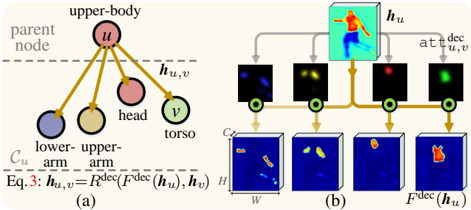
The image presents a diagram illustrating a hierarchical decomposition of the human body into parts, likely within the context of a computer vision or machine learning system. It shows a parent node representing the "upper-body" and its connections to child nodes representing "lower-arm", "upper-arm", "head", and "torso". The diagram also depicts a process involving feature extraction and attention mechanisms.
### Components/Axes
**Part (a): Hierarchical Tree Structure**
* **Parent Node:** Labeled "parent node" with a dashed horizontal line indicating the level. The node itself is labeled "u" and "upper-body".
* **Child Nodes:** Four child nodes connected to the parent node "u" via gold-colored arrows. These nodes represent:
* "lower-arm" (blue circle)
* "upper-arm" (yellow circle)
* "head" (pink circle)
* "torso" (green circle)
* **Edge Labels:** The edges connecting the parent node to the child nodes are labeled "h<sub>u,v</sub>".
* **Node Labels:** The nodes are labeled with "C<sub>u</sub>" below the lower-arm and upper-arm nodes.
* **Equation:** "Eq. 3: h<sub>u,v</sub> = R<sup>dec</sup>(F<sup>dec</sup>(h<sub>u</sub>), h<sub>v</sub>)"
**Part (b): Feature Extraction and Attention**
* **Top Row:**
* A 3D representation of a person with a heat map overlay, labeled "h<sub>u</sub>".
* Four feature maps, each connected to the "h<sub>u</sub>" representation via gray arrows.
* Each feature map is connected to a green circle.
* The connection between the "h<sub>u</sub>" representation and the feature maps is labeled "att<sup>dec</sup><sub>u,v</sub>".
* **Bottom Row:**
* Four 3D representations of feature maps, each connected to the green circles above via gold-colored arrows.
* The final 3D representation is labeled "F<sup>dec</sup>(h<sub>u</sub>)".
* Dimensions of the 3D representations are labeled "W", "H", and "C".
### Detailed Analysis
**Part (a): Hierarchical Tree Structure**
* The diagram represents a tree-like structure where the "upper-body" is the root, and the other body parts are its children.
* The arrows indicate a flow of information or dependency from the parent node to the child nodes.
* The equation "h<sub>u,v</sub> = R<sup>dec</sup>(F<sup>dec</sup>(h<sub>u</sub>), h<sub>v</sub>)" likely describes the computation of features or relationships between the parent node "u" and its child nodes "v".
**Part (b): Feature Extraction and Attention**
* The "h<sub>u</sub>" representation shows a person with a heat map, indicating areas of interest or activation.
* The feature maps in the top row likely represent different features extracted from the "h<sub>u</sub>" representation.
* The "att<sup>dec</sup><sub>u,v</sub>" label suggests an attention mechanism is used to focus on relevant features.
* The bottom row shows the processed feature maps, with the final representation "F<sup>dec</sup>(h<sub>u</sub>)" potentially representing a refined or decoded feature representation.
### Key Observations
* The diagram combines a hierarchical representation of body parts with a feature extraction and attention mechanism.
* The equation in part (a) and the labels in part (b) suggest a complex computation involving feature decoding and attention.
* The heat map on the person in part (b) indicates a focus on specific body regions.
### Interpretation
The diagram illustrates a system for analyzing human body pose or activity. The hierarchical decomposition allows for a structured representation of the body, while the feature extraction and attention mechanisms enable the system to focus on relevant features and relationships between body parts. The equation suggests a recursive or iterative process for refining the feature representation. This approach could be used for tasks such as pose estimation, action recognition, or human-computer interaction.