## Diagram: Human Pose Decomposition and Reconstruction
### Overview
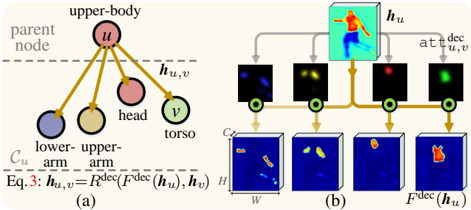
The image depicts a diagram illustrating a hierarchical decomposition of a human body into parts and a reconstruction process using attention mechanisms. It appears to be a visual representation of a model for understanding and generating human poses. The diagram is split into two main sections, (a) and (b), with (a) showing the hierarchical structure and (b) illustrating the reconstruction process.
### Components/Axes
The diagram consists of the following components:
* **Parent Node:** Labeled "parent node" and represented by a red circle labeled "u" (upper-body).
* **Child Nodes:** Represented by colored circles labeled: "lower-", "upper-arm", "head", and "torso". The torso is labeled "v".
* **Arrows:** Yellow arrows connecting the parent node to the child nodes, indicating hierarchical relationships.
* **Equation:** "Eq.3: h<sub>u,v</sub> = R<sup>dec</sup>(F<sup>dec</sup>(h<sub>u</sub>), h<sub>v</sub>) H"
* **Image of a Person:** A 3D rendering of a person in a dynamic pose, labeled "h<sub>u</sub>".
* **Attention Maps:** Four black square images with colored highlights, labeled "att<sub>u,v</sub>".
* **Reconstructed Features:** Four 3D renderings of body parts, labeled "F<sup>dec</sup>(h<sub>u</sub>)".
* **Reconstructed Body Parts:** Four 3D renderings of body parts with color overlays, labeled "C<sub>t</sub>".
* **Labels:** "W" and "H" are present at the bottom of the diagram.
### Detailed Analysis or Content Details
**(a) Hierarchical Decomposition:**
* The upper-body ("u") is the parent node.
* The child nodes are: lower-body (dark blue), upper-arm (yellow), head (red), and torso ("v", light blue).
* The arrows indicate that the upper-body node decomposes into these four parts.
* The equation "Eq.3: h<sub>u,v</sub> = R<sup>dec</sup>(F<sup>dec</sup>(h<sub>u</sub>), h<sub>v</sub>) H" describes a reconstruction process, where h<sub>u,v</sub> is reconstructed from the features of the parent (h<sub>u</sub>) and child (h<sub>v</sub>) nodes.
**(b) Reconstruction Process:**
* The image of the person (h<sub>u</sub>) is at the top-center.
* Four attention maps (att<sub>u,v</sub>) are shown, each with a different color focus:
* First map: Primarily black with some white highlights.
* Second map: Yellow highlights.
* Third map: Red highlights.
* Fourth map: Green highlights.
* These attention maps are connected to four reconstructed feature representations (F<sup>dec</sup>(h<sub>u</sub>)):
* First feature: Primarily blue with some white highlights.
* Second feature: Yellow highlights on a blue background.
* Third feature: Red highlights on a blue background.
* Fourth feature: Green highlights on a blue background.
* These features are then used to reconstruct the body parts (C<sub>t</sub>):
* First part: Blue with white and red highlights.
* Second part: Blue with yellow highlights.
* Third part: Blue with red highlights.
* Fourth part: Blue with green highlights.
* "W" and "H" are positioned at the bottom of the diagram, likely representing width and height dimensions.
### Key Observations
* The diagram illustrates a hierarchical approach to representing human poses.
* Attention mechanisms are used to focus on relevant parts of the body during reconstruction.
* The reconstruction process involves decoding features from both the parent and child nodes.
* The color-coding of the attention maps and reconstructed features suggests that different parts of the body are being highlighted and reconstructed independently.
### Interpretation
The diagram demonstrates a method for decomposing a human pose into a hierarchical structure and then reconstructing it using attention-guided feature decoding. The parent node represents the overall pose, while the child nodes represent individual body parts. The attention maps allow the model to focus on the most relevant features for reconstructing each body part. The equation suggests that the reconstruction process combines information from both the parent and child nodes. This approach could be useful for tasks such as pose estimation, action recognition, and human-computer interaction. The use of color-coding suggests that the model is capable of distinguishing between different body parts and reconstructing them independently. The "W" and "H" labels likely indicate that the reconstructed body parts are represented as images or volumes with specific dimensions. The diagram suggests a sophisticated model capable of understanding and generating realistic human poses.