## Diagram: Hierarchical Attention Mechanism for Upper-Body Pose Estimation
### Overview
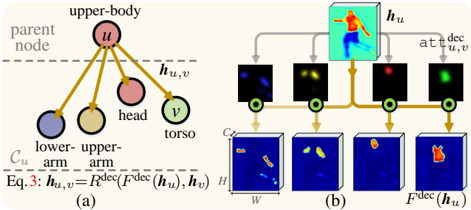
The image depicts a two-part technical diagram illustrating a hierarchical attention mechanism for upper-body pose estimation. Part (a) shows a parent-child node structure representing body parts, while part (b) visualizes attention maps generated by the model.
### Components/Axes
**Part (a): Hierarchical Node Structure**
- **Parent Node**: Labeled "upper-body" (topmost node)
- **Child Nodes**:
- Lower-arm (blue)
- Upper-arm (yellow)
- Head (pink)
- Torso (green)
- **Equation**:
- `Eq.3: h_u,v = R^dec(F^dec(h_u), h_v)`
- Positioned below the node hierarchy
- **Spatial Relationships**:
- Parent node at top-center
- Child nodes arranged in a horizontal row below parent
- Arrows connect parent to children (gold/yellow)
**Part (b): Attention Maps**
- **Input**:
- `h_u` (upper-body feature map) at top-center
- **Attention Maps**:
- `att^dec_u,v` (attention distribution maps) above each heatmap
- **Heatmaps**:
- Four 2D grids labeled `F^dec(h_u)`
- Each grid corresponds to a body part (lower-arm, upper-arm, head, torso)
- Color gradients indicate attention intensity (red = high attention)
- **Spatial Relationships**:
- Heatmaps arranged in 2x2 grid below attention maps
- Vertical alignment with parent node `h_u`
### Detailed Analysis
**Part (a) Node Hierarchy**
- Parent node "upper-body" connects to four child nodes via directed edges
- Child nodes represent distinct body parts with unique color coding
- Equation suggests recursive decoding (`R^dec`) of feature maps (`F^dec`) between parent (`h_u`) and child (`h_v`) nodes
**Part (b) Attention Visualization**
- **Input Feature Map**:
- `h_u` shows a human figure in motion (running pose)
- **Attention Maps**:
- Each `att^dec_u,v` highlights specific regions of `h_u`
- Example: Head attention map focuses on the figure's head region
- **Heatmaps**:
- Lower-arm heatmap shows red highlights on lower limb regions
- Torso heatmap emphasizes central body area
- Color intensity correlates with attention strength
### Key Observations
1. **Hierarchical Organization**: Body parts are structured in a top-down hierarchy with the upper-body as the root node
2. **Attention Localization**: Model focuses on distinct anatomical regions for each body part
3. **Color Coding**: Red dominates heatmaps where attention is concentrated
4. **Spatial Consistency**: Attention maps align spatially with corresponding body parts in the input image
### Interpretation
This diagram demonstrates a neural network architecture that:
1. **Decomposes** upper-body pose estimation into hierarchical components
2. **Localizes Attention** to specific body regions through attention mechanisms
3. **Recursively Processes** features between parent and child nodes (Eq.3)
The attention maps reveal how the model isolates different body parts during processing, which is critical for:
- Accurate pose estimation
- Action recognition
- Human-computer interaction systems
The hierarchical structure suggests the model first identifies the upper-body as a whole before decomposing it into constituent parts, mirroring human visual processing strategies. The attention visualization provides insight into the model's decision-making process, showing clear spatial correspondence between input features and learned representations.