## Flowchart: Broadcast System Architecture
### Overview
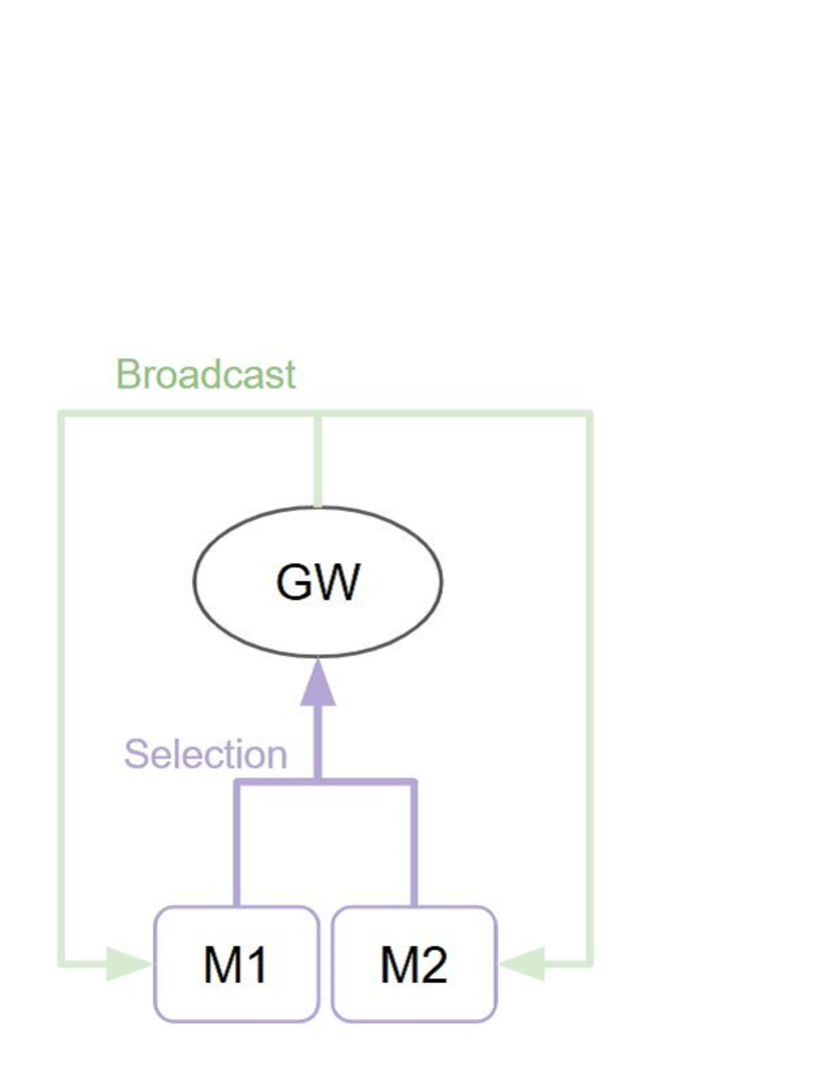
The diagram illustrates a broadcast system architecture with a central gateway (GW) distributing data to two modules (M1 and M2). Arrows indicate data flow direction, with distinct colors for different processes. The system emphasizes a hierarchical flow from GW to modules via labeled pathways.
### Components/Axes
- **Labels**:
- Central node: "GW" (oval shape)
- Terminal nodes: "M1" and "M2" (rectangular shapes)
- **Arrows**:
- **Green (Broadcast)**:
- Left arrow: Connects GW to M1
- Right arrow: Connects GW to M2
- **Purple (Selection)**:
- Vertical arrow: Connects GW to the split between M1 and M2
- **Text Elements**:
- "Broadcast" (green text above green arrows)
- "Selection" (purple text above purple arrow)
### Detailed Analysis
- **GW Node**: Positioned centrally, acting as the origin for all data flows.
- **M1/M2 Nodes**: Terminal nodes receiving broadcast data. Both are equidistant from GW horizontally.
- **Arrow Colors**:
- Green arrows (Broadcast) dominate the horizontal plane.
- Purple arrow (Selection) is vertical, creating a bifurcation point.
- **Spatial Relationships**:
- "Selection" arrow originates at GW's base, directing flow downward before splitting.
- "Broadcast" arrows extend horizontally from GW's top, bypassing the Selection process.
### Key Observations
1. **Dual Pathways**: GW uses two distinct mechanisms (Broadcast and Selection) to interact with modules.
2. **Color Coding**: Green (Broadcast) and purple (Selection) arrows provide visual differentiation of processes.
3. **Hierarchical Flow**: Selection precedes Broadcast in the vertical axis, suggesting prioritization or filtering before distribution.
### Interpretation
This diagram represents a modular communication system where:
- **GW** serves as a central hub with dual functionality:
- **Selection Process**: Likely filters or routes data before distribution (purple pathway).
- **Broadcast Mechanism**: Directly sends unfiltered data to both modules (green pathways).
- The separation of Broadcast and Selection suggests a design choice to either:
- Prioritize efficiency (direct Broadcast) or
- Ensure data integrity (Selection filtering first).
- The absence of feedback loops implies a unidirectional flow, typical of broadcast-centric systems.
### Notable Patterns
- **Symmetry**: M1 and M2 are mirrored in position and connection type (both receive Broadcast).
- **Process Isolation**: Selection is a singular, vertical process, while Broadcast is duplicated horizontally.
- **No Redundancy**: No backup pathways or error-handling mechanisms are depicted.
### Technical Implications
- **Scalability**: Adding more modules would require extending Broadcast arrows horizontally.
- **Bottleneck Risk**: GW's central role could create a single point of failure.
- **Use Case**: Likely models a network topology (e.g., IoT gateways, media distribution systems) where selective routing and mass distribution coexist.