## Diagram: Knowledge Graph for Question Answering
### Overview
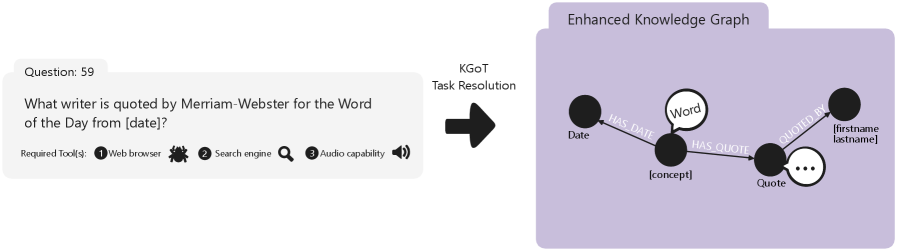
The image illustrates the process of resolving a question using an enhanced knowledge graph. It shows a question being processed and transformed into a structured knowledge graph representation.
### Components/Axes
* **Left Side:**
* **Question:** "What writer is quoted by Merriam-Webster for the Word of the Day from [date]?"
* **Question Number:** 59
* **Required Tool(s):**
* 1 Web browser (represented by a globe icon)
* 2 Search engine (represented by a magnifying glass icon)
* 3 Audio capability (represented by a speaker icon)
* **Middle:**
* **KGOT Task Resolution:** An arrow pointing from left to right, indicating the flow of information.
* **Right Side:**
* **Enhanced Knowledge Graph:** A purple rounded rectangle containing a knowledge graph.
* **Nodes:**
* Date (black circle)
* Concept (black circle, labeled as "[concept]")
* Quote (black circle)
* Word (white circle with "Word" inside)
* [firstname lastname] (white circle with "..." inside)
* **Edges:**
* HAS_DATE: Connects Date to Concept
* HAS QUOTE: Connects Concept to Quote
* QUOTED BY: Connects Quote to [firstname lastname]
### Detailed Analysis
The diagram shows how a question is transformed into a knowledge graph. The question requires the use of a web browser, search engine, and audio capability. The KGOT Task Resolution process converts the question into a knowledge graph with nodes representing Date, Concept, Quote, Word, and [firstname lastname]. The edges represent the relationships between these nodes: HAS_DATE, HAS_QUOTE, and QUOTED BY.
### Key Observations
* The question is about finding the writer quoted by Merriam-Webster for the Word of the Day.
* The knowledge graph represents the relationships between the date, the concept, the quote, the word, and the writer's name.
* The use of "[date]" and "[firstname lastname]" indicates that these are placeholders for specific values that would be extracted during the task resolution process.
### Interpretation
The diagram illustrates a knowledge-based approach to question answering. The question is parsed and transformed into a structured representation (the knowledge graph), which can then be used to retrieve the answer. The knowledge graph captures the key entities and relationships involved in the question, allowing for more efficient and accurate information retrieval. The diagram highlights the importance of tools like web browsers, search engines, and audio capabilities in the question answering process.