\n
## Diagram: Knowledge Graph Task Resolution
### Overview
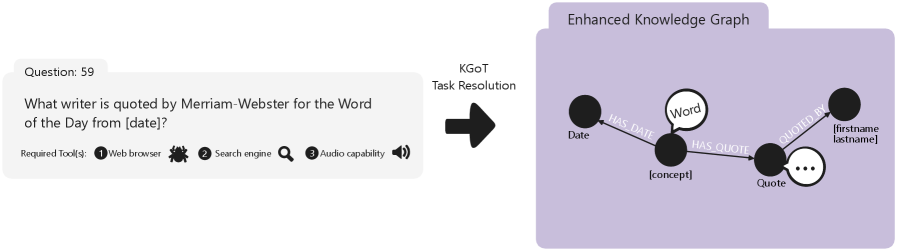
The image depicts a diagram illustrating the process of Knowledge Graph Task Resolution (KGOT) for answering a specific question. The diagram shows a question input on the left and the corresponding enhanced knowledge graph representation on the right, connected by an arrow indicating the resolution process.
### Components/Axes
The diagram consists of two main sections:
1. **Question Input:** A rectangular box containing the question "What writer is quoted by Merriam-Webster for the Word of the Day from [date]?" along with a list of required tools: Web browser, Search engine, and Audio capability.
2. **Enhanced Knowledge Graph:** A larger, lavender-colored rectangular area representing the knowledge graph. This graph consists of nodes and edges representing entities and relationships.
### Detailed Analysis or Content Details
The knowledge graph contains the following nodes and relationships:
* **Date:** A black circular node.
* **Word:** A white rectangular node labeled "Word". An edge labeled "HAS DATE" connects "Date" to "Word".
* **Quote:** A white circular node labeled "Quote". An edge labeled "HAS QUOTE" connects "Word" to "Quote". The "Quote" node has an ellipsis (...) indicating further details.
* **[firstname lastname]:** A white rectangular node representing the author's name. An edge labeled "QUOTED BY" connects "Quote" to "[firstname lastname]".
* **[concept]:** A white rectangular node labeled "concept". An edge labeled "HAS QUOTE" connects "Quote" to "[concept]".
The arrow labeled "KGOT Task Resolution" points from the question input box to the enhanced knowledge graph, indicating the transformation of the question into a graph representation.
### Key Observations
The diagram illustrates how a natural language question is translated into a structured knowledge graph representation. The graph highlights the key entities (Date, Word, Quote, Author) and their relationships (HAS DATE, HAS QUOTE, QUOTED BY). The use of brackets around "firstname lastname" and "concept" suggests these are placeholders for specific values that would be filled in during the resolution process.
### Interpretation
This diagram demonstrates a method for question answering using knowledge graphs. The KGOT process converts a natural language query into a graph structure, enabling a system to reason about the relationships between entities and retrieve the answer. The required tools (Web browser, Search engine, Audio capability) suggest that the system may leverage external resources to populate the knowledge graph or refine the query. The diagram highlights the importance of representing knowledge in a structured format to facilitate automated reasoning and information retrieval. The ellipsis on the "Quote" node suggests that the system may need to access additional information to fully resolve the query. The diagram is a conceptual illustration of the process and does not contain specific data or numerical values.