## Diagram: GAN-Based Audio Generation Architecture with Vector Quantization
### Overview
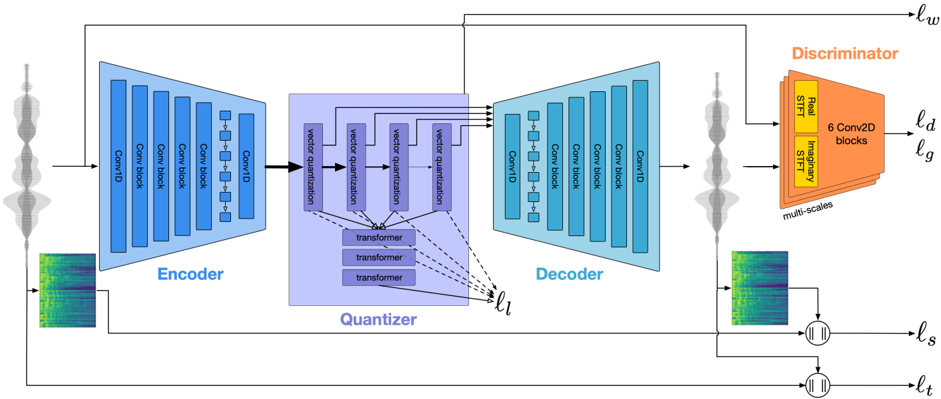
The diagram illustrates a Generative Adversarial Network (GAN) architecture for audio generation, incorporating a vector quantization (VQ) module. The system includes an Encoder, Quantizer, Decoder, and Discriminator, with explicit loss functions and data flow paths. The architecture uses 1D convolutional layers for feature extraction and 2D convolutional layers in the Discriminator for multi-scale frequency analysis.
### Components/Axes
1. **Encoder**:
- Input: Waveform (time-domain audio signal).
- Structure: 6 Conv1D blocks (convolutional layers with 1D filters).
- Output: Vector representation of the input waveform.
2. **Quantizer**:
- Input: Vector from the Encoder.
- Structure:
- Vector quantization (5 quantization layers).
- 3 Transformer blocks (self-attention mechanisms).
- Output: Quantized vector for the Decoder.
3. **Decoder**:
- Input: Quantized vector from the Quantizer.
- Structure: 6 Conv1D blocks (mirroring the Encoder).
- Output: Reconstructed waveform (time-domain audio signal).
4. **Discriminator**:
- Input: Real waveform (ground truth) and Imaginary waveform (generated by the Decoder).
- Structure: 6 Conv2D blocks (multi-scale frequency analysis).
- Output: Loss functions:
- `l_d`: Discriminator loss.
- `l_g`: Generator (Decoder) loss.
- `l_w`: Waveform reconstruction loss.
- `l_s`, `l_t`: Additional losses (possibly for spectral/temporal consistency).
5. **Loss Functions**:
- Connected to the Discriminator and Quantizer outputs.
- Labeled as `l_w`, `l_d`, `l_g`, `l_s`, `l_t`.
### Detailed Analysis
- **Encoder/Decoder Symmetry**: Both use identical 6 Conv1D blocks, suggesting a symmetric architecture for feature extraction and reconstruction.
- **Quantizer Complexity**: The inclusion of 5 quantization layers and 3 Transformers indicates a focus on high-resolution discrete representation learning.
- **Discriminator Design**:
- Uses Conv2D blocks for multi-scale frequency analysis (spatial-temporal features).
- Separates real/imaginary STFT components for phase-sensitive discrimination.
- **Loss Connections**:
- `l_w`: Links the Encoder/Decoder to waveform reconstruction quality.
- `l_d`/`l_g`: Standard GAN adversarial losses for the Discriminator and Generator.
- `l_s`/`l_t`: Likely spectral/temporal consistency losses to preserve audio characteristics.
### Key Observations
1. **Symmetry**: Encoder and Decoder mirror each other, ensuring balanced feature learning and reconstruction.
2. **Quantization Depth**: 5 quantization layers suggest fine-grained discrete codebook learning.
3. **Multi-Scale Discrimination**: Conv2D blocks in the Discriminator enable analysis at multiple frequency resolutions.
4. **Transformer Integration**: Transformers in the Quantizer introduce non-local dependencies for better codebook alignment.
### Interpretation
This architecture combines GANs with vector quantization and Transformers for high-fidelity audio generation. The Encoder-Decoder symmetry ensures efficient feature learning, while the Quantizer bridges continuous and discrete representations. The Discriminator’s multi-scale Conv2D blocks and STFT-based inputs enable robust frequency-domain discrimination. The loss functions (`l_w`, `l_d`, `l_g`, `l_s`, `l_t`) guide the model to balance waveform quality, adversarial training, and spectral/temporal consistency. The use of Transformers in the Quantizer highlights the importance of attention mechanisms for codebook optimization, making this architecture suitable for complex audio tasks like speech synthesis or music generation.