## Line Charts: Model Performance Metrics vs. Number of Actions
### Overview
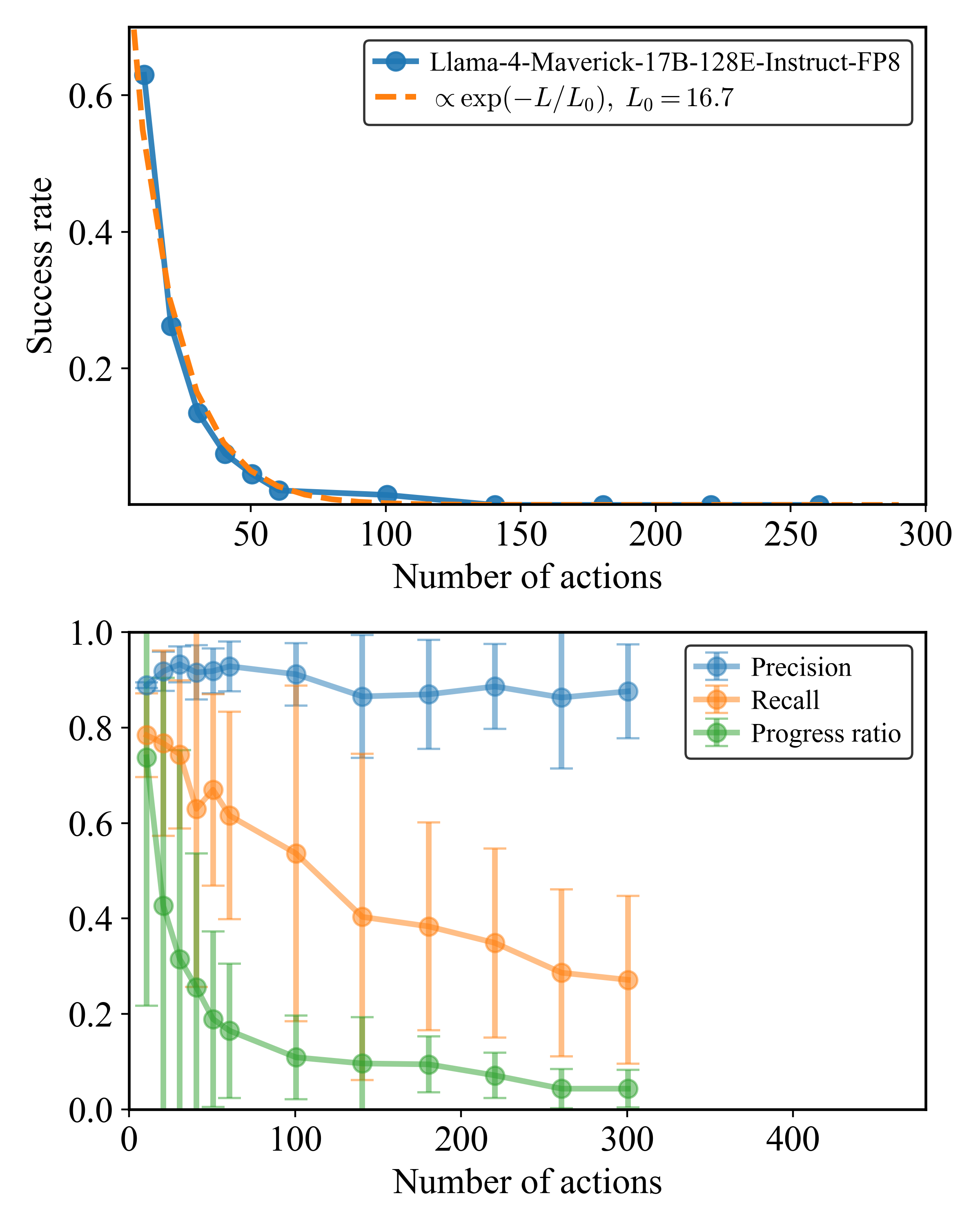
The image contains two line charts that depict the performance of a language model ("Llama-4-Maverick-17B-128E-Instruct-FP8") as a function of the number of actions taken. The top chart shows the success rate, while the bottom chart shows precision, recall, and progress ratio, each plotted against the number of actions. Error bars are included in the bottom chart to indicate variability.
### Components/Axes
**Top Chart:**
* **Y-axis:** "Success rate", ranging from 0.0 to 0.6.
* **X-axis:** "Number of actions", ranging from 0 to 300.
* **Legend (top-right):**
* Blue line with circles: "Llama-4-Maverick-17B-128E-Instruct-FP8"
* Orange dashed line: "∝ exp(-L/L₀), L₀ = 16.7"
**Bottom Chart:**
* **Y-axis:** Implicitly ranging from 0.0 to 1.0.
* **X-axis:** "Number of actions", ranging from 0 to 400.
* **Legend (top-right):**
* Blue line with circles and error bars: "Precision"
* Orange line with circles and error bars: "Recall"
* Green line with circles and error bars: "Progress ratio"
### Detailed Analysis
**Top Chart: Success Rate**
* **Llama-4-Maverick-17B-128E-Instruct-FP8 (Blue):** The success rate starts at approximately 0.62 for a small number of actions and rapidly decreases as the number of actions increases. It approaches 0 as the number of actions reaches 100.
* Approximate data points: (10, 0.62), (20, 0.27), (30, 0.14), (50, 0.05), (100, 0.01), (150, 0.005), (200, 0.003), (250, 0.002), (300, 0.001)
* **∝ exp(-L/L₀), L₀ = 16.7 (Orange Dashed):** This exponential decay curve closely matches the trend of the "Llama-4-Maverick-17B-128E-Instruct-FP8" line. It starts at approximately 0.65 and decreases rapidly, approaching 0 as the number of actions increases.
**Bottom Chart: Precision, Recall, and Progress Ratio**
* **Precision (Blue):** The precision starts high, around 0.95, and remains relatively stable with some fluctuations as the number of actions increases. The error bars indicate some variability.
* Approximate data points: (0, 0.95), (50, 0.96), (100, 0.88), (150, 0.89), (200, 0.88), (250, 0.89), (300, 0.85)
* **Recall (Orange):** The recall starts high, around 0.8, and decreases as the number of actions increases. The error bars become larger as the number of actions increases, indicating greater variability.
* Approximate data points: (0, 0.8), (50, 0.7), (100, 0.6), (150, 0.45), (200, 0.4), (250, 0.3), (300, 0.3)
* **Progress Ratio (Green):** The progress ratio starts at approximately 0.45 and decreases rapidly as the number of actions increases, approaching a value close to 0.1. The error bars are relatively large, especially for smaller numbers of actions.
* Approximate data points: (0, 0.45), (50, 0.25), (100, 0.15), (150, 0.1), (200, 0.12), (250, 0.1), (300, 0.1)
### Key Observations
* The success rate of the model decreases exponentially with the number of actions.
* Precision remains relatively stable, while recall decreases as the number of actions increases.
* The progress ratio decreases significantly with the number of actions.
* The error bars in the bottom chart suggest that the variability in recall and progress ratio increases with the number of actions.
### Interpretation
The data suggests that while the model maintains a relatively consistent level of precision as the number of actions increases, its ability to recall relevant information and make progress towards a goal diminishes. The exponential decay of the success rate indicates that the model's performance degrades rapidly with increasing task complexity (as represented by the number of actions required). The exponential decay is well modeled by the equation provided. The increasing variability in recall and progress ratio suggests that the model becomes less reliable in its performance as the number of actions increases.