\n
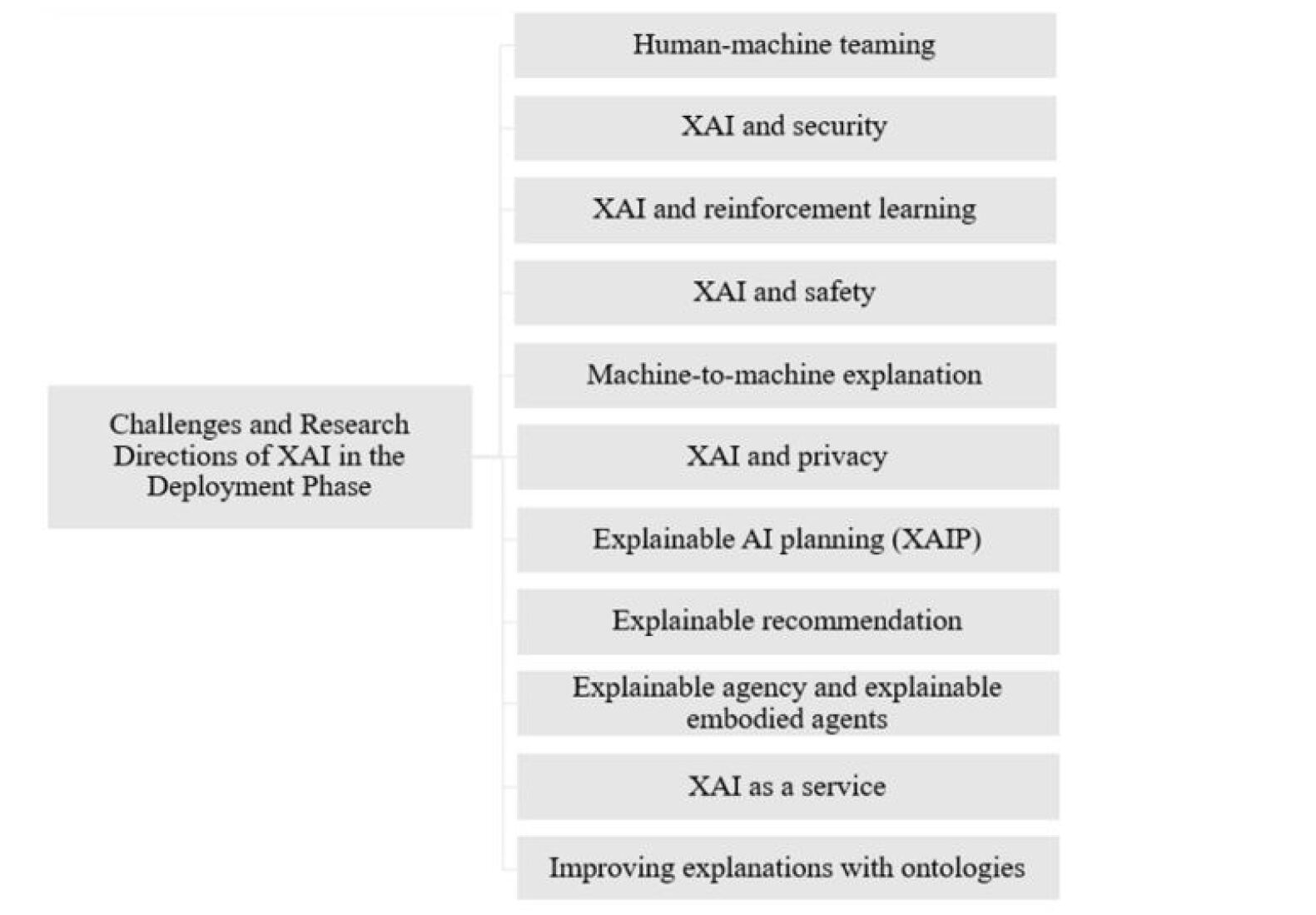
## Diagram: Challenges and Research Directions of XAI in the Deployment Phase
### Overview
The image presents a vertically oriented diagram listing challenges and research directions for Explainable Artificial Intelligence (XAI) during the deployment phase. It consists of a left-aligned label and a series of horizontally oriented rectangular blocks, each containing a specific research area. There is no quantitative data or axes; it's a qualitative listing of topics.
### Components/Axes
* **Left Label:** "Challenges and Research Directions of XAI in the Deployment Phase" - positioned on the left side of the diagram.
* **Rectangular Blocks:** Ten blocks, stacked vertically, each containing a text label.
### Content Details
The following research areas are listed, from top to bottom:
1. Human-machine teaming
2. XAI and security
3. XAI and reinforcement learning
4. XAI and safety
5. Machine-to-machine explanation
6. XAI and privacy
7. Explainable AI planning (XAIP)
8. Explainable recommendation
9. Explainable agency and explainable embodied agents
10. XAI as a service
11. Improving explanations with ontologies
### Key Observations
The diagram presents a list of research areas without any prioritization or ranking. The topics cover a broad range of concerns related to deploying XAI systems, including human interaction, security, safety, privacy, and technical aspects like planning and recommendation systems.
### Interpretation
The diagram suggests that the successful deployment of XAI requires addressing a multifaceted set of challenges. The listed areas represent key research directions needed to ensure XAI systems are not only explainable but also trustworthy, secure, safe, and aligned with human values. The inclusion of topics like "XAI as a service" and "Improving explanations with ontologies" indicates a move towards more standardized and knowledge-based approaches to XAI. The diagram doesn't provide any insights into the relative importance of these challenges or the relationships between them, but it serves as a useful overview of the current research landscape in XAI deployment. It is a high-level conceptual map rather than a data-driven visualization.