## Hierarchical Diagram: Challenges and Research Directions of XAI in the Deployment Phase
### Overview
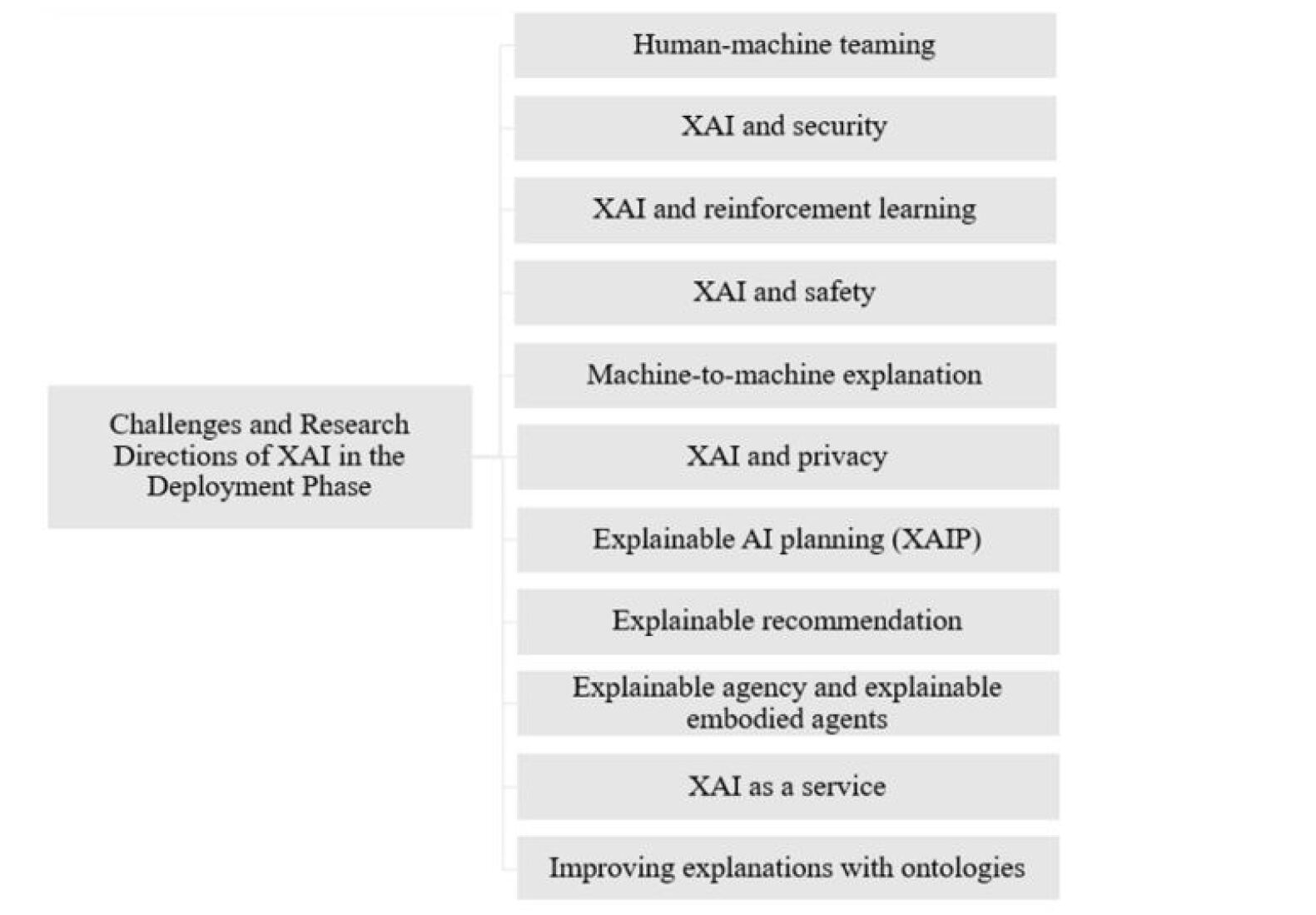
The image presents a hierarchical structure outlining key challenges and research directions for Explainable Artificial Intelligence (XAI) during the deployment phase. A central box labeled "Challenges and Research Directions of XAI in the Deployment Phase" connects via lines to 11 sub-topic boxes on the right, organized vertically.
### Components/Axes
- **Left Box**: Contains the main title: "Challenges and Research Directions of XAI in the Deployment Phase."
- **Right-Side Sub-Topics**: 11 vertically stacked boxes connected to the main title by lines. Sub-topics include:
1. Human-machine teaming
2. XAI and security
3. XAI and reinforcement learning
4. XAI and safety
5. Machine-to-machine explanation
6. XAI and privacy
7. Explainable AI planning (XAIP)
8. Explainable recommendation
9. Explainable agency and explainable embodied agents
10. XAI as a service
11. Improving explanations with ontologies
### Detailed Analysis
- **Structure**: The diagram uses a simple hierarchical layout with no numerical data, colors, or legends. All sub-topics are text-based and directly linked to the central theme.
- **Textual Content**: All sub-topics are explicitly labeled, with no embedded diagrams or additional annotations. The connections imply a causal or thematic relationship between the main title and each sub-topic.
### Key Observations
- The diagram emphasizes **11 distinct research areas** under XAI deployment challenges.
- Sub-topics span technical (e.g., "XAI and privacy"), application-specific (e.g., "XAI as a service"), and methodological (e.g., "Improving explanations with ontologies") domains.
- No sub-topic is visually prioritized (e.g., no larger font or bold text), suggesting equal emphasis.
### Interpretation
This diagram maps the multidisciplinary scope of XAI research in deployment, highlighting technical, ethical, and practical challenges. The absence of quantitative data suggests it is a conceptual framework rather than an empirical study. The interconnected sub-topics imply that addressing XAI deployment requires interdisciplinary collaboration across AI, security, human-computer interaction, and domain-specific applications. The inclusion of "XAI as a service" and "Improving explanations with ontologies" reflects emerging trends toward scalable, interpretable AI systems. The diagram underscores the complexity of deploying XAI systems, where technical robustness (e.g., safety, privacy) must align with user-centric design (e.g., human-machine teaming, recommendations).