## Screenshot: Document-Level Event Argument Extraction Example
### Overview
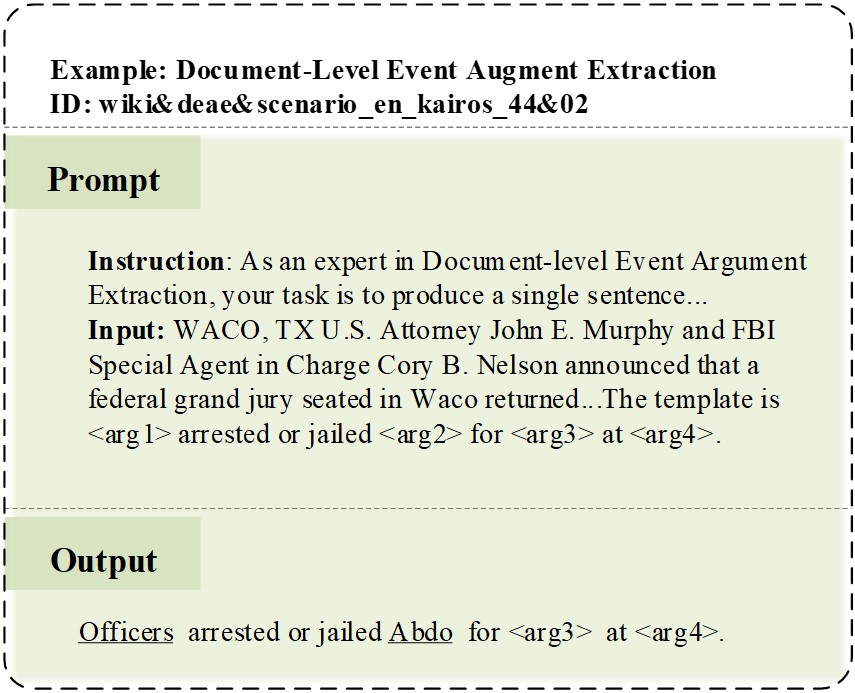
The image displays a technical example of document-level event argument extraction, showcasing a template-based transformation of input text into structured output. The example includes an ID, prompt instructions, input text, and a generated output.
### Components/Axes
- **Header**:
- Title: "Example: Document-Level Event Argument Extraction"
- ID: `wiki&deae&scenario_en_kairos_44&02`
- **Prompt Section**:
- **Instruction**:
- Task: "As an expert in Document-level Event Argument Extraction, your task is to produce a single sentence..."
- **Input**:
- Text: "WACO, TX U.S. Attorney John E. Murphy and FBI Special Agent in Charge Cory B. Nelson announced that a federal grand jury seated in Waco returned..."
- **Template**:
- Structure: `<arg1> arrested or jailed <arg2> for <arg3> at <arg4>`.
- **Output Section**:
- Result: "Officers arrested or jailed Abdo for <arg3> at <arg4>."
### Content Details
- **Input Text**:
- Mentions entities: WACO, TX U.S. Attorney John E. Murphy, FBI Special Agent Cory B. Nelson, federal grand jury, Waco.
- Event: "a federal grand jury seated in Waco returned."
- **Template Placeholders**:
- `<arg1>`: Replaced with "Officers" (implied by context).
- `<arg2>`: Replaced with "Abdo" (specific entity from input).
- `<arg3>` and `<arg4>`: Retained as placeholders (no explicit values provided in input).
### Key Observations
- The output retains placeholders (`<arg3>`, `<arg4>`) from the template, indicating incomplete extraction or reliance on external data for full resolution.
- The input text describes an event (federal grand jury returning) but does not explicitly mention arrests or jailing, suggesting the template may infer or generalize event types.
- The ID (`wiki&deae&scenario_en_kairos_44&02`) implies a structured dataset or corpus identifier, possibly linking to a larger collection of examples.
### Interpretation
This example demonstrates a template-driven approach to event argument extraction, where predefined slots (`<arg1>`–`<arg4>`) are populated based on contextual clues in the input text. The use of placeholders in the output suggests either:
1. **Partial Extraction**: The system identified some arguments (e.g., "Officers," "Abdo") but requires additional data to resolve others (e.g., `<arg3>`, `<arg4>`).
2. **Generalization**: The template may map abstract event descriptions (e.g., "federal grand jury returned") to standardized event types (e.g., arrests/jailings), even if the input lacks explicit details.
The ID format (`wiki&deae&scenario_en_kairos_44&02`) hints at a multilingual or cross-domain dataset (e.g., "wiki" for Wikipedia, "en" for English, "kairos" as a temporal or event-related corpus). This aligns with the task of extracting structured arguments from diverse document types.
No numerical data, trends, or visualizations are present in the image. The focus is on textual transformation and template application.