## Document Analysis: Event Argument Extraction Example
### Overview
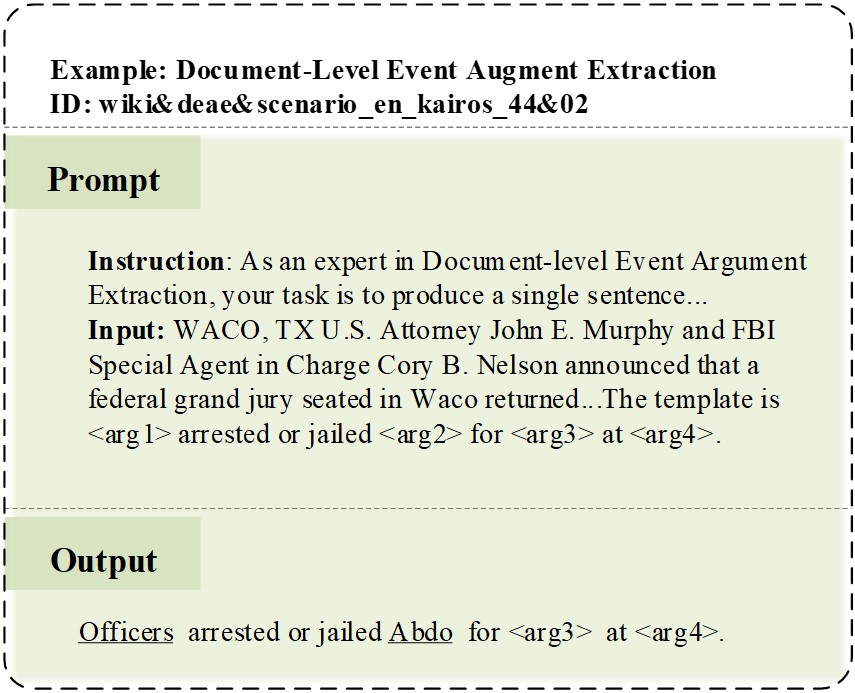
The image presents an example of document-level event argument extraction. It shows an input text and the desired output, demonstrating how to extract specific information and structure it into a predefined template.
### Components/Axes
The image is structured into three main sections:
1. **Header**: Contains the example title and ID.
2. **Prompt**: Includes the instruction and input text.
3. **Output**: Shows the extracted information formatted according to the template.
### Detailed Analysis or ### Content Details
**Header:**
* **Example:** Document-Level Event Augment Extraction
* **ID:** wiki&deae&scenario\_en\_kairos\_44&02
**Prompt:**
* **Instruction:** As an expert in Document-level Event Argument Extraction, your task is to produce a single sentence...
* **Input:** WACO, TX U.S. Attorney John E. Murphy and FBI Special Agent in Charge Cory B. Nelson announced that a federal grand jury seated in Waco returned...The template is <arg1> arrested or jailed <arg2> for <arg3> at <arg4>.
**Output:**
* Officers arrested or jailed Abdo for <arg3> at <arg4>.
### Key Observations
The example demonstrates the process of extracting key information (who was arrested/jailed) from a given text and fitting it into a predefined template. The input text provides context, and the output shows the extracted information.
### Interpretation
The image illustrates a task in natural language processing (NLP) where the goal is to automatically extract structured information from unstructured text. The "Prompt" section defines the task and provides the input text, while the "Output" section shows the desired result. The example highlights the ability to identify and extract specific entities and relationships from text, which is crucial for various NLP applications such as information retrieval, knowledge base construction, and question answering. The use of placeholders like `<arg1>`, `<arg2>`, `<arg3>`, and `<arg4>` in the template indicates a structured approach to information extraction, where specific roles or arguments are identified and filled with the corresponding information from the input text.