## Structured Example: Document-Level Event Argument Extraction
### Overview
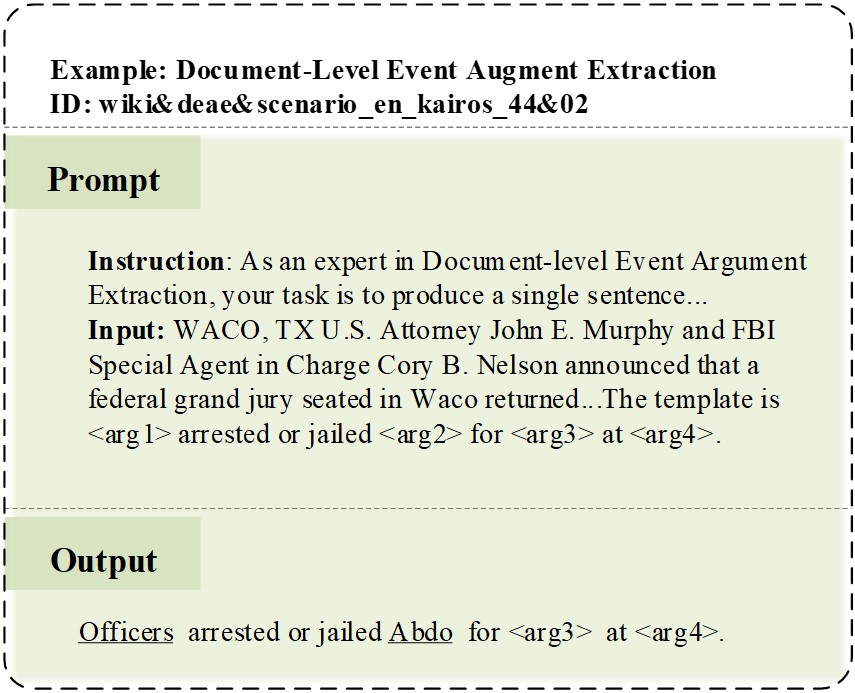
The image displays a structured, bordered example illustrating a task for "Document-Level Event Argument Extraction." It is formatted as a technical diagram or figure, likely from a research paper or instructional material, showing a prompt and its corresponding output for a specific natural language processing task.
### Components/Axes
The image is organized into distinct sections within a dashed rectangular border:
1. **Header Section (Top):**
* **Title:** "Example: Document-Level Event Augment Extraction"
* **Identifier:** "ID: wiki&deae&scenario_en_kairos_44&02"
2. **Prompt Section (Middle, light green background):**
* **Section Label:** "Prompt" (in a darker green box).
* **Instruction Text:** "Instruction: As an expert in Document-level Event Argument Extraction, your task is to produce a single sentence..."
* **Input Text:** "Input: WACO, TX U.S. Attorney John E. Murphy and FBI Special Agent in Charge Cory B. Nelson announced that a federal grand jury seated in Waco returned...The template is <arg1> arrested or jailed <arg2> for <arg3> at <arg4>."
3. **Output Section (Bottom, light green background):**
* **Section Label:** "Output" (in a darker green box).
* **Result Sentence:** "Officers arrested or jailed Abdo for <arg3> at <arg4>." (Note: "Officers" and "Abdo" are underlined in the image).
### Detailed Analysis
* **Task Definition:** The example defines a specific information extraction task where the goal is to populate a predefined sentence template (`<arg1> arrested or jailed <arg2> for <arg3> at <arg4>`) using information from a source document (the "Input").
* **Input Content:** The input text describes a legal announcement from Waco, Texas, involving U.S. Attorney John E. Murphy and FBI Special Agent Cory B. Nelson regarding a federal grand jury. The text is truncated with "..." indicating it is an excerpt.
* **Output Structure:** The output demonstrates the filled template. Two arguments have been extracted and inserted:
* `<arg1>` is filled with "Officers" (underlined).
* `<arg2>` is filled with "Abdo" (underlined).
* `<arg3>` and `<arg4>` remain as unfilled placeholders in this example.
* **Spatial Layout:** The "Prompt" and "Output" sections are vertically stacked, separated by a dashed line. The labels "Prompt" and "Output" are left-aligned in colored boxes that span the width of their respective sections.
### Key Observations
* **Template-Based Extraction:** The core mechanism shown is slot-filling into a rigid linguistic template.
* **Selective Filling:** The example output only partially fills the template, suggesting either that the input text contained information for only the first two arguments, or that this is a simplified illustrative example.
* **Underlined Text:** The underlining of "Officers" and "Abdo" in the output visually highlights the extracted arguments, distinguishing them from the static template text.
* **Identifier Code:** The ID string (`wiki&deae&scenario_en_kairos_44&02`) suggests this example is part of a larger dataset or benchmark, possibly related to the "KAIROS" project and using Wikipedia data.
### Interpretation
This image serves as a concrete specification for an automated text processing task. It demonstrates the transformation of unstructured narrative text (the Input) into a structured, relational format (the Output template). The "arrested or jailed" event frame is being populated with specific entities (the arresting party "Officers" and the arrestee "Abdo") extracted from the source document.
The example highlights the challenge and goal of document-level argument extraction: to identify and link dispersed pieces of information (who arrested whom, for what crime, and where) across a text to form a coherent event summary. The unfilled placeholders (`<arg3>`, `<arg4>`) indicate that the full extraction would require identifying the alleged crime and the location of the event or legal proceeding, which may be present elsewhere in the complete input document. The structured format is typical of tasks in information extraction, knowledge base population, and event understanding within computational linguistics.