## Line Graphs: Effective Bandwidth vs. Offloading Ratio with and without Multicast for N=512 and N=1024
### Overview
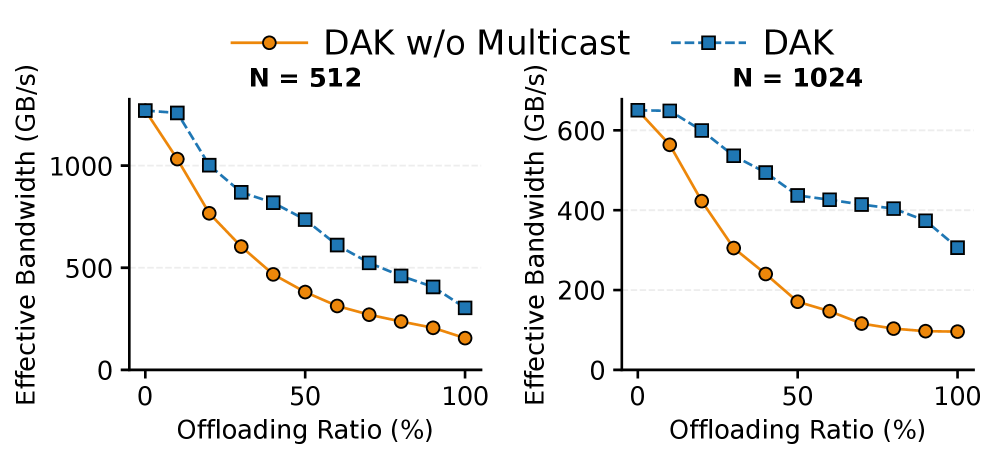
The image contains two side-by-side line graphs comparing effective bandwidth (GB/s) as a function of offloading ratio (%) for two scenarios:
1. **DAK without Multicast** (orange solid line)
2. **DAK with Multicast** (blue dashed line)
Each graph corresponds to a different system size: **N = 512** (left) and **N = 1024** (right).
### Components/Axes
- **X-axis**: Offloading Ratio (%) ranging from 0% to 100% (in 10% increments).
- **Y-axis**: Effective Bandwidth (GB/s), scaled differently for each graph:
- Left graph (N=512): 0–1200 GB/s.
- Right graph (N=1024): 0–600 GB/s.
- **Legends**:
- Top-right of each graph.
- Orange circle: "DAK w/o Multicast"
- Blue dashed square: "DAK"
### Detailed Analysis
#### N = 512 (Left Graph)
- **DAK w/o Multicast (orange)**:
- Starts at ~1200 GB/s at 0% offloading.
- Decreases linearly to ~100 GB/s at 100% offloading.
- Slope: ~11 GB/s per 1% offloading.
- **DAK (blue dashed)**:
- Starts at ~1100 GB/s at 0% offloading.
- Decreases to ~300 GB/s at 100% offloading.
- Slope: ~8 GB/s per 1% offloading.
#### N = 1024 (Right Graph)
- **DAK w/o Multicast (orange)**:
- Starts at ~600 GB/s at 0% offloading.
- Decreases to ~100 GB/s at 100% offloading.
- Slope: ~5 GB/s per 1% offloading.
- **DAK (blue dashed)**:
- Starts at ~600 GB/s at 0% offloading.
- Decreases to ~300 GB/s at 100% offloading.
- Slope: ~3 GB/s per 1% offloading.
### Key Observations
1. **Bandwidth Degradation**: Both scenarios show a consistent decline in bandwidth as offloading increases.
2. **Multicast Benefit**: The blue dashed line (DAK with multicast) consistently outperforms the orange line (DAK without multicast) across all offloading ratios.
3. **N Dependency**:
- For N=512, the bandwidth drop is steeper (11 vs. 8 GB/s per 1% offloading).
- For N=1024, the drop is gentler (5 vs. 3 GB/s per 1% offloading).
4. **Convergence**: At 100% offloading, both N=512 and N=1024 systems with multicast retain ~300 GB/s, while systems without multicast drop to ~100 GB/s.
### Interpretation
- **Multicast Impact**: Multicast significantly mitigates bandwidth loss during offloading, particularly at higher offloading ratios. This suggests multicast improves resource efficiency or reduces contention in distributed systems.
- **Scalability**: Larger systems (N=1024) exhibit more stable bandwidth degradation, implying better scalability or optimized resource allocation at scale.
- **Trade-offs**: While multicast improves performance, the absolute bandwidth for N=1024 is lower than N=512, indicating potential trade-offs between system size and raw capacity.
- **Practical Implication**: Systems prioritizing offloading should leverage multicast to maintain higher effective bandwidth, especially in high-offloading scenarios.