## Bar Chart: Most Frequent Guesses
### Overview
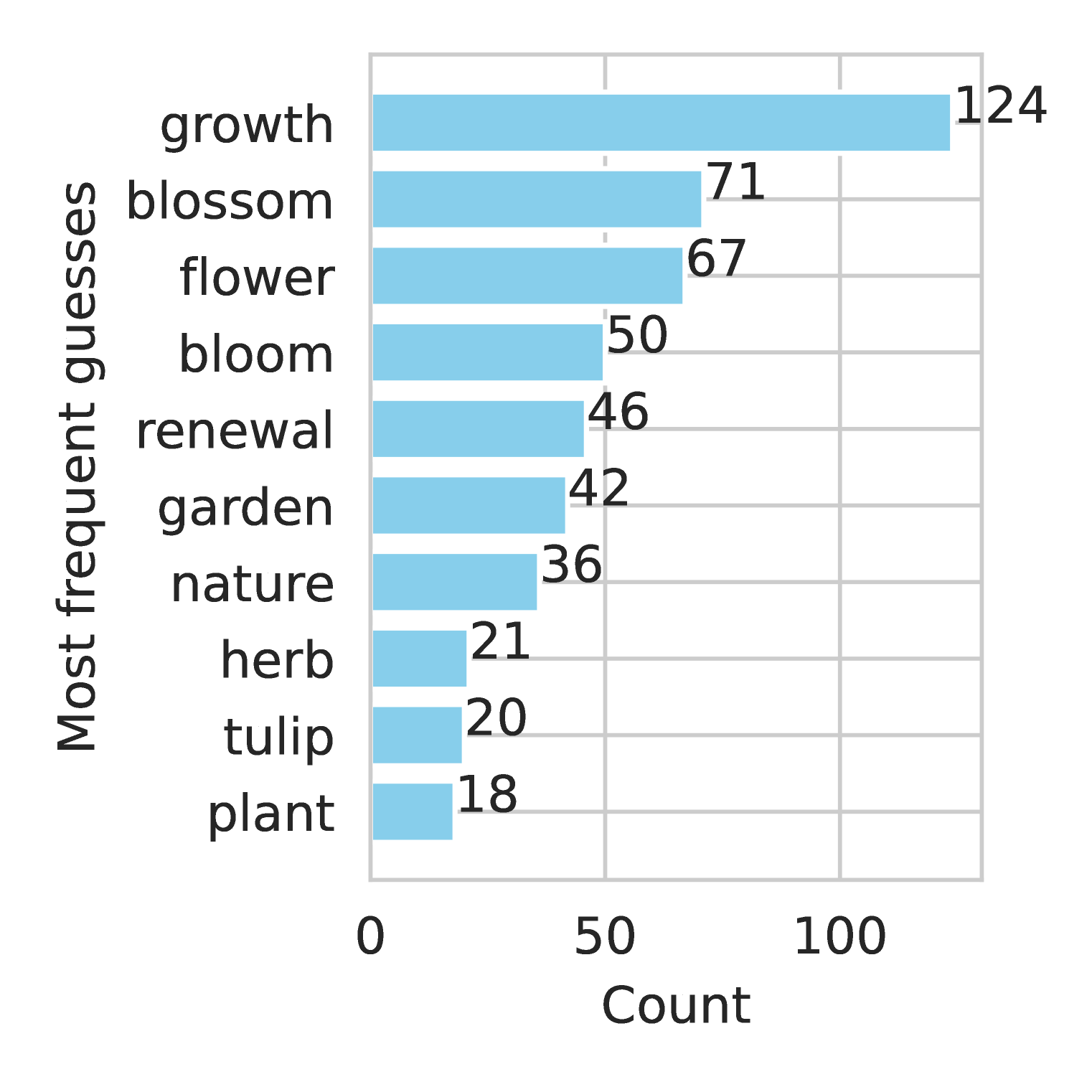
The chart displays horizontal bars representing the frequency of guesses for various categories. The y-axis lists categories, while the x-axis shows numerical counts. The highest value ("growth") exceeds the x-axis scale, indicating an outlier.
### Components/Axes
- **Y-Axis (Categories)**:
- growth, blossom, flower, bloom, renewal, garden, nature, herb, tulip, plant
- **X-Axis (Count)**:
- Scale ranges from 0 to 100, with increments of 50. Labels: 0, 50, 100.
- **Legend**:
- No explicit legend present. All bars are light blue, suggesting a single data series.
### Detailed Analysis
- **Categories and Counts**:
- growth: 124 (exceeds x-axis maximum)
- blossom: 71
- flower: 67
- bloom: 50
- renewal: 46
- garden: 42
- nature: 36
- herb: 21
- tulip: 20
- plant: 18
- **Trends**:
- Bars slope downward from left to right, with "growth" as the longest bar.
- Values decrease progressively after "growth," with the last three categories ("herb," "tulip," "plant") having the smallest bars.
### Key Observations
- "Growth" is the most frequent guess, significantly outpacing other categories.
- The next three categories ("blossom," "flower," "bloom") cluster between 50–70 counts.
- The lowest three categories ("herb," "tulip," "plant") have counts below 25.
- The x-axis scale truncates at 100, but "growth" extends beyond this, suggesting either a data anomaly or intentional emphasis.
### Interpretation
The data suggests a strong emphasis on growth-related terms, possibly reflecting a context where growth is a primary focus (e.g., gardening, plant development). The outlier for "growth" may indicate either a data entry error or a genuine high-frequency term in the survey. Lower counts for "herb," "tulip," and "plant" could imply these terms are less intuitive or contextually relevant. The absence of a legend simplifies interpretation but limits categorical differentiation. The chart prioritizes horizontal space for readability, with categories ordered by frequency.