## Circular Diagram: Taxonomy of NLP Tasks
### Overview
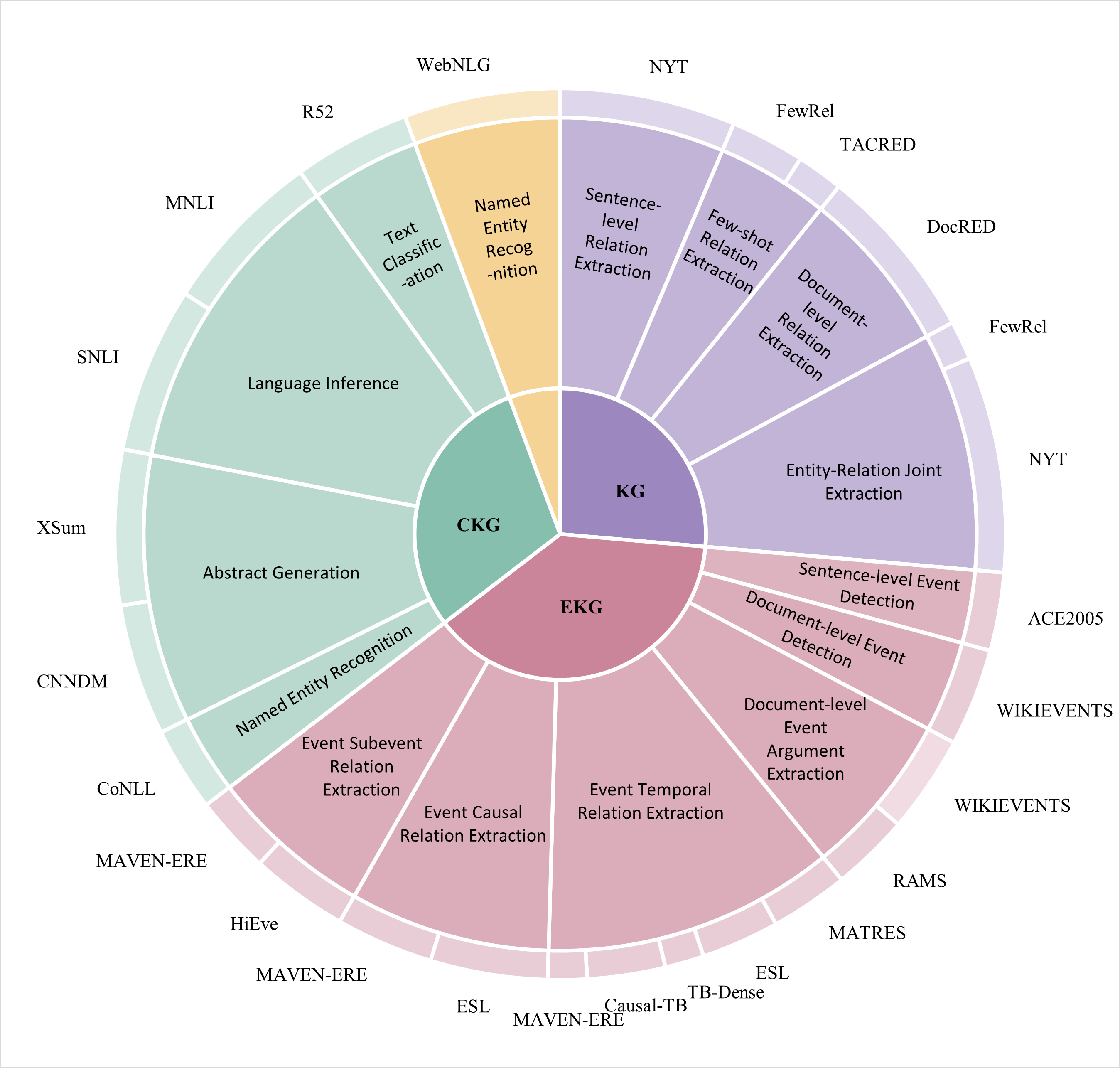
The image depicts a circular diagram categorizing natural language processing (NLP) tasks into three primary domains: **CKG** (Core Language Understanding), **KG** (Knowledge Graph Tasks), and **EKG** (Event-Centric Tasks). Each domain is subdivided into specific tasks, with datasets listed as examples. The diagram uses color-coding (green for CKG, purple for KG, pink for EKG) and a legend for clarity.
---
### Components/Axes
- **Main Sections**:
- **CKG** (Core Language Understanding): Green
- **KG** (Knowledge Graph Tasks): Purple
- **EKG** (Event-Centric Tasks): Pink
- **Subcategories**:
- **CKG**:
- Language Inference (SNLI, MNLI)
- Abstract Generation (XSum, CNN/DM)
- Named Entity Recognition (CoNLL, MAVEN-ERE)
- Text Classification (R52, WebNLG)
- **KG**:
- Entity-Relation Joint Extraction (NYT, FewRel)
- Document-level Relation Extraction (DocRED, FewRel)
- Sentence-level Relation Extraction (TACRED, FewRel)
- Few-shot Relation Extraction (NYT, FewRel)
- **EKG**:
- Event Argument Extraction (WIKIEVENTS, RAMS)
- Event Temporal Relation Extraction (MATRES, MAVEN-ERE)
- Event Causal Relation Extraction (ESL, MAVEN-ERE)
- Event Subevent Relation Extraction (TB-Dense, MAVEN-ERE)
- Document-level Event Detection (ACE2005, WIKIEVENTS)
- Sentence-level Event Detection (ACE2005, WIKIEVENTS)
- **Legend**: Located at the bottom center, mapping colors to domains.
---
### Detailed Analysis
- **CKG** (Green): Focuses on foundational NLP tasks like language understanding and text classification. Datasets include SNLI (sentence-level inference), MNLI (multilingual natural language inference), and WebNLG (text generation).
- **KG** (Purple): Centers on knowledge graph construction and relation extraction. Tasks involve joint entity-relation extraction (NYT, FewRel) and document/sentence-level relation extraction (DocRED, TACRED).
- **EKG** (Pink): Emphasizes event-centric tasks, including argument extraction (WIKIEVENTS), temporal relations (MAVEN-ERE), and event detection (ACE2005). Datasets like RAMS and MATRES are tied to temporal and causal relations.
---
### Key Observations
1. **Color Coding**: Clear differentiation between domains (green, purple, pink) aids quick identification.
2. **Dataset Placement**: Datasets are listed under their respective subcategories (e.g., FewRel appears in both KG and CKG subcategories).
3. **Hierarchical Structure**: Tasks are organized from broad categories (e.g., "Language Inference") to specific datasets (e.g., SNLI).
4. **Legend Positioning**: The legend is centrally placed at the bottom for easy reference.
---
### Interpretation
The diagram illustrates a structured taxonomy of NLP tasks, emphasizing their application areas and associated datasets. **CKG** represents foundational language tasks, **KG** focuses on knowledge graph construction, and **EKG** highlights event-driven analysis. The inclusion of datasets (e.g., ACE2005 for event detection) underscores practical benchmarks for evaluating models. The circular layout and color-coding suggest a holistic view of NLP research, with tasks interconnected yet distinct in purpose. Notably, **FewRel** and **MAVEN-ERE** appear in multiple subcategories, indicating their versatility across domains.