## Histograms: OpenAI o3 Reasoning Data Token Length Distributions
### Overview
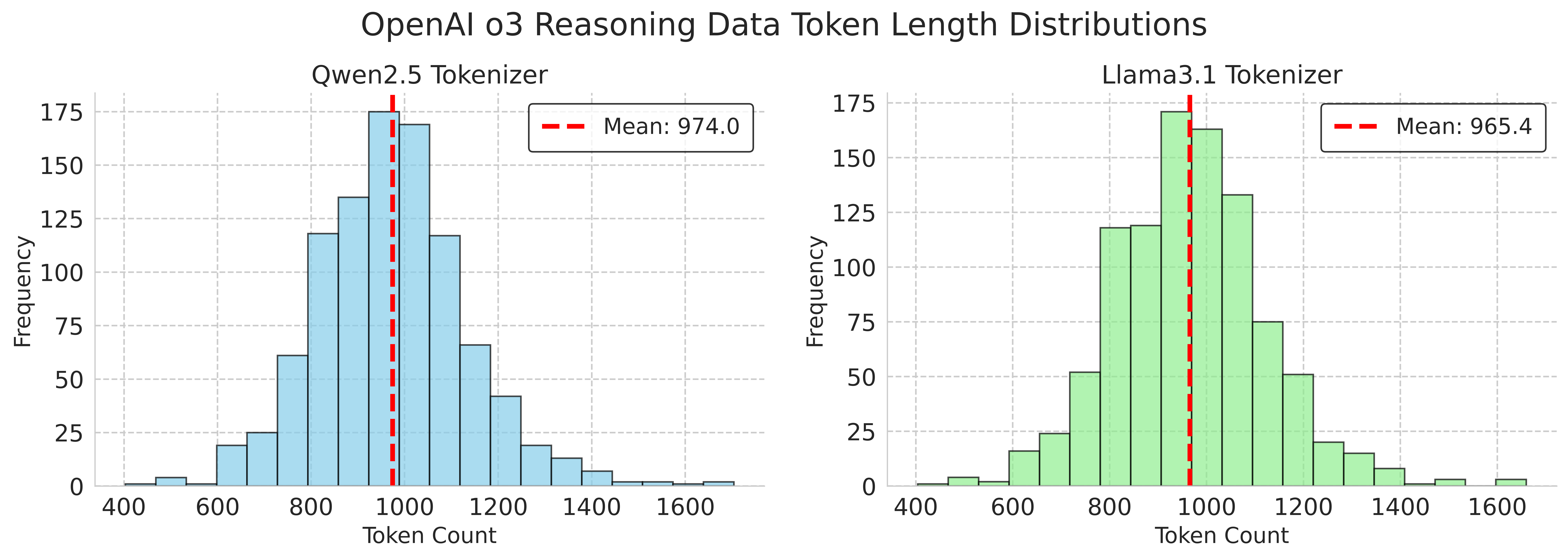
The image contains two side-by-side histograms comparing token length distributions for OpenAI o3 reasoning data processed by two tokenizers: Qwen2.5 (blue) and Llama3.1 (green). Each histogram shows frequency distributions of token counts, with red dashed lines indicating mean values.
### Components/Axes
- **Title**: "OpenAI o3 Reasoning Data Token Length Distributions"
- **Left Histogram**:
- Subtitle: "Qwen2.5 Tokenizer"
- Legend: Red dashed line labeled "Mean: 974.0"
- **Right Histogram**:
- Subtitle: "Llama3.1 Tokenizer"
- Legend: Red dashed line labeled "Mean: 965.4"
- **Axes**:
- **X-axis (Horizontal)**: "Token Count" (range: 400–1600, increments of 200)
- **Y-axis (Vertical)**: "Frequency" (range: 0–175, increments of 25)
### Detailed Analysis
- **Qwen2.5 Tokenizer (Blue)**:
- Peak frequency occurs at ~1000 tokens (~175 occurrences).
- Distribution is slightly right-skewed, with frequencies tapering off gradually toward higher token counts.
- Mean (974.0) is marked by a red dashed vertical line.
- **Llama3.1 Tokenizer (Green)**:
- Peak frequency occurs at ~1000 tokens (~175 occurrences).
- Distribution is more symmetric, with a sharper decline at higher token counts.
- Mean (965.4) is marked by a red dashed vertical line.
### Key Observations
1. Both tokenizers exhibit similar peak frequencies (~175) at ~1000 tokens, suggesting this is the most common token length for reasoning tasks.
2. Qwen2.5 has a marginally higher mean (974.0 vs. 965.4), indicating slightly longer average token lengths.
3. Llama3.1’s distribution is more symmetric, while Qwen2.5’s is slightly right-skewed.
4. Frequencies decline steadily for both tokenizers beyond 1200 tokens, with minimal occurrences above 1600.
### Interpretation
The data suggests that both Qwen2.5 and Llama3.1 tokenizers process reasoning tasks with similar token length distributions, centered around 1000 tokens. The slight difference in means (Qwen2.5: 974.0 vs. Llama3.1: 965.4) implies Qwen2.5 may handle marginally longer sequences on average, potentially offering advantages for tasks requiring extended context. The symmetry of Llama3.1’s distribution suggests more consistent tokenization across tasks, whereas Qwen2.5’s right skew indicates occasional outliers with longer token counts. These differences could reflect architectural optimizations in handling context length or efficiency trade-offs.