## Diagram: Tongs Variations
### Overview
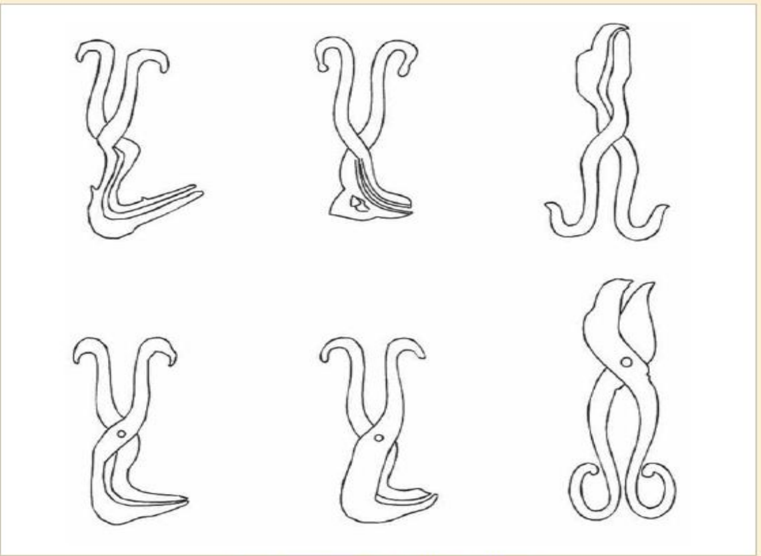
The image presents six variations of tongs, depicted as line drawings. They are arranged in a 2x3 grid. The drawings illustrate different designs and mechanisms of the tongs.
### Components/Axes
There are no axes or scales in this image. The components are the tongs themselves, with variations in their jaw shapes, handle designs, and pivot points.
### Detailed Analysis
The image contains six distinct drawings of tongs. Each drawing showcases a different design.
1. **Top-Left:** The tongs have curved handles that cross each other. The jaws are shaped like a wide, flat scoop.
2. **Top-Middle:** Similar to the top-left, but the jaws are smaller and more rounded.
3. **Top-Right:** The handles are more elongated and have a simpler curve. The jaws are narrow and pointed.
4. **Bottom-Left:** These tongs have a pivot point with a visible rivet. The jaws are flat and wide.
5. **Bottom-Middle:** Similar to the bottom-left, but the jaws are slightly curved.
6. **Bottom-Right:** The handles have decorative curls at the ends. The jaws are shaped like pointed blades. A pivot point with a visible rivet is present.
### Key Observations
The variations in the tongs designs are primarily in the shape and size of the jaws and the design of the handles. Some tongs have a pivot point, while others do not.
### Interpretation
The image likely serves as a visual reference for different types of tongs, possibly for historical documentation, design comparison, or instructional purposes. The variations suggest different applications or manufacturing techniques. The absence of scale or specific measurements indicates that the focus is on the overall design and form rather than precise dimensions.