## Diagram: Pliers Tool Variations
### Overview
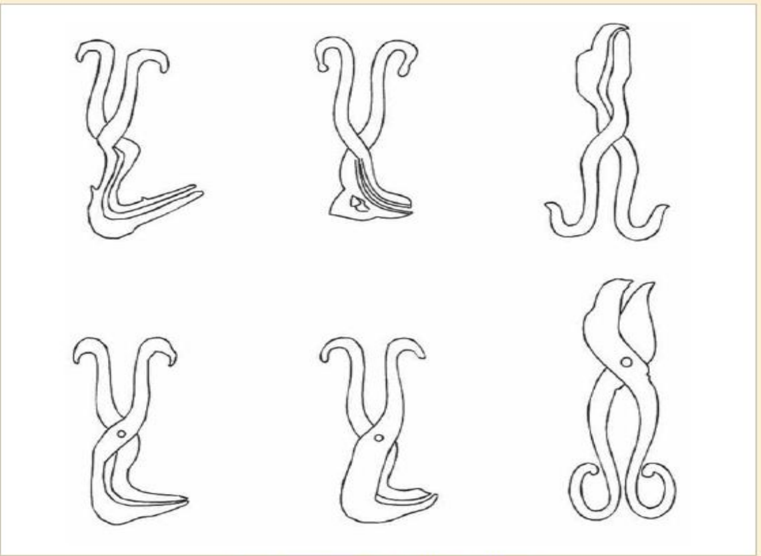
The image displays six black-and-white line drawings of pliers arranged in a 2x3 grid. Each drawing represents a distinct variation of pliers, focusing on differences in handle design, jaw shape, and overall structure. No text, labels, or numerical data are present in the image.
### Components/Axes
- **Handles**: All pliers feature symmetrical, curved handles with a central pivot point. Variations include:
- Top row: Handles with slight curvature (left), pronounced curvature (middle), and straight alignment (right).
- Bottom row: Handles with moderate curvature (left), minimal curvature (middle), and ornate, looping designs (right).
- **Jaws**: All pliers have open jaws with a standard cutting edge. No variations in jaw shape are observed.
- **Pivot**: A small circular pivot is visible at the junction of the handles and jaws in all drawings.
### Detailed Analysis
- **Top Row (Left to Right)**:
1. **Slight Curvature**: Handles curve gently outward from the pivot, forming a subtle "C" shape.
2. **Pronounced Curvature**: Handles curve sharply, creating a more pronounced "U" shape.
3. **Straight Alignment**: Handles are nearly straight, with minimal curvature.
- **Bottom Row (Left to Right)**:
1. **Moderate Curvature**: Handles curve moderately, balancing between the top row's slight and pronounced variations.
2. **Minimal Curvature**: Handles are almost straight, with only a slight inward curve near the pivot.
3. **Ornate Looping**: Handles feature intricate, looping designs at the ends, suggesting a decorative or specialized function.
### Key Observations
- **Symmetry**: All pliers are symmetrical, with identical left and right handles.
- **Jaw Consistency**: No variation in jaw design is present; all jaws are open and identical in shape.
- **Pivot Uniformity**: The pivot point is consistently depicted as a small circle in all drawings.
### Interpretation
The diagram appears to illustrate ergonomic or functional variations in plier design, likely for technical documentation or instructional purposes. The differences in handle curvature may indicate:
- **Ergonomic Adaptations**: Varying handle shapes could reduce user fatigue during prolonged use.
- **Specialized Applications**: The ornate looping design in the bottom-right pliers might serve a niche purpose, such as gripping irregular objects.
- **Aesthetic vs. Functional Trade-offs**: The straight-handled pliers (top-right) may prioritize simplicity, while the curved designs emphasize comfort or grip.
No numerical data, trends, or anomalies are present. The image focuses solely on visual representation of tool variations without contextual or quantitative information.