# Technical Document Extraction: Evolution of AI Agents
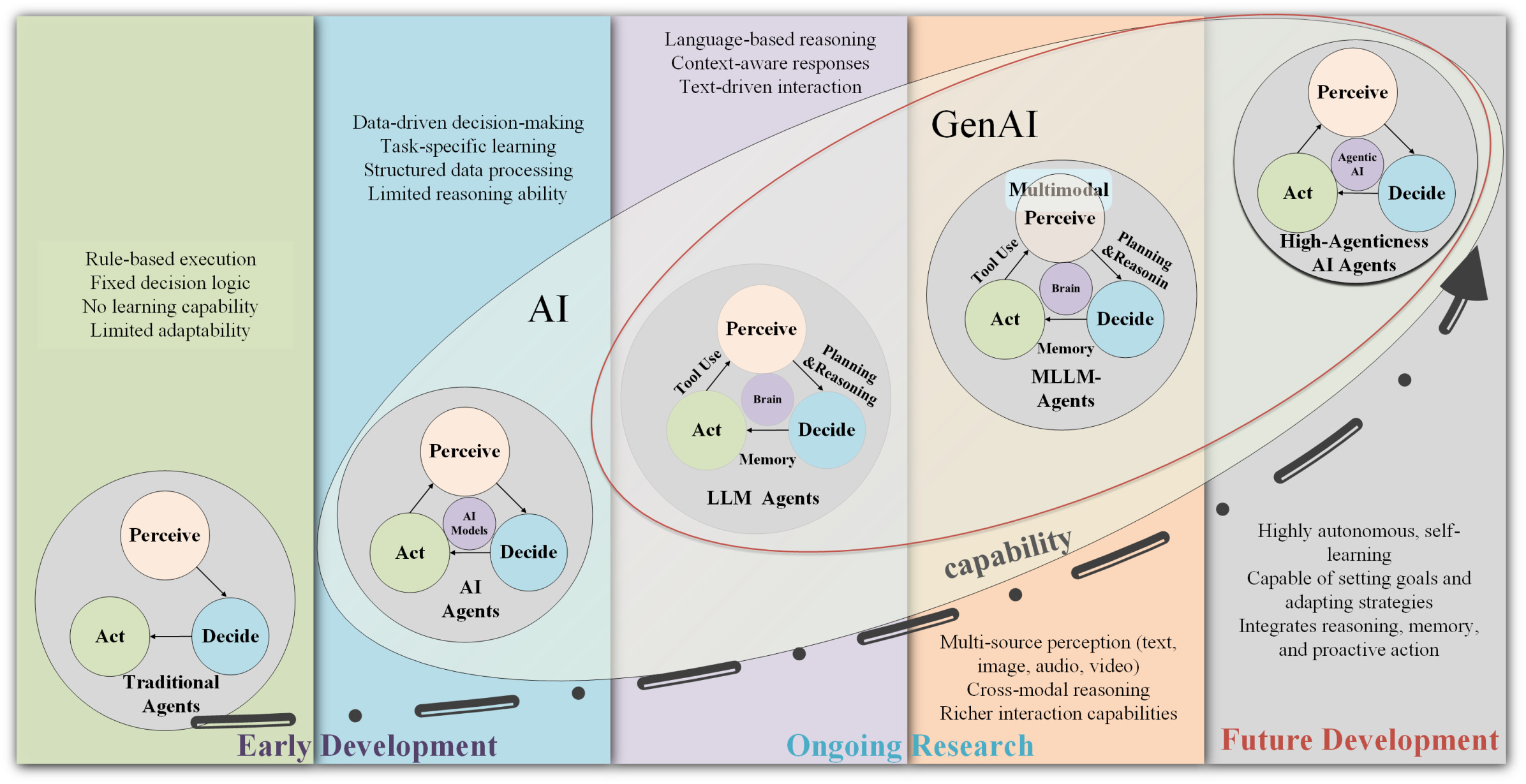
This document provides a comprehensive extraction and analysis of the provided diagram, which illustrates the evolutionary trajectory of Artificial Intelligence (AI) agents from traditional rule-based systems to future high-agenticness autonomous systems.
## 1. High-Level Structure and Timeline
The image is organized as a horizontal progression divided into three primary developmental phases, indicated by background color blocks and footer labels:
* **Phase 1: Early Development** (Green and Blue sections on the left)
* **Phase 2: Ongoing Research** (Purple and Orange sections in the center)
* **Phase 3: Future Development** (Grey section on the right)
A large, upward-sloping arrow labeled **"capability"** spans the bottom of the diagram, indicating a trend of increasing complexity and autonomy over time.
---
## 2. Segmented Analysis of Developmental Stages
### Stage 1: Traditional Agents (Early Development)
* **Background Color:** Light Green
* **Key Characteristics:**
* Rule-based execution
* Fixed decision logic
* No learning capability
* Limited adaptability
* **Internal Architecture:** A simple cycle consisting of three nodes:
1. **Perceive** (Peach circle) $\rightarrow$ points to **Decide**.
2. **Decide** (Light Blue circle) $\rightarrow$ points to **Act**.
3. **Act** (Light Green circle) $\rightarrow$ points back to **Perceive**.
* **Note:** This represents a rigid, closed-loop system without a central processing "brain" or model.
### Stage 2: AI Agents (Early Development)
* **Background Color:** Light Blue
* **Key Characteristics:**
* Data-driven decision-making
* Task-specific learning
* Structured data processing
* Limited reasoning ability
* **Internal Architecture:** Similar to Traditional Agents but introduces a central core labeled **"AI Models"** (Purple circle) that mediates the interaction between Perceive, Decide, and Act.
### Stage 3: LLM Agents (Ongoing Research)
* **Background Color:** Light Purple
* **Key Characteristics:**
* Language-based reasoning
* Context-aware responses
* Text-driven interaction
* **Internal Architecture:**
* **Central Core:** Labeled **"Brain"** (Purple circle).
* **Feedback Loops:**
* Between **Act** and **Perceive**: Labeled **"Tool Use"**.
* Between **Perceive** and **Decide**: Labeled **"Planning & Reasoning"**.
* Between **Decide** and **Act**: Labeled **"Memory"**.
* **Categorization:** This stage is enclosed within a larger oval labeled **"AI"**.
### Stage 4: MLLM-Agents (Ongoing Research)
* **Background Color:** Light Orange
* **Key Characteristics:**
* Multi-source perception (text, image, audio, video)
* Cross-modal reasoning
* Richer interaction capabilities
* **Internal Architecture:**
* Identical loop structure to LLM Agents (Tool Use, Planning & Reasoning, Memory).
* The central core is still the **"Brain"**.
* The entire agent is encapsulated in a circle labeled **"Multimodal"**.
* **Categorization:** This stage is enclosed within a larger oval labeled **"GenAI"** (Generative AI).
### Stage 5: High-Agenticness AI Agents (Future Development)
* **Background Color:** Grey
* **Key Characteristics:**
* Highly autonomous, self-learning
* Capable of setting goals and adapting strategies
* Integrates reasoning, memory, and proactive action
* **Internal Architecture:**
* The central core is now labeled **"Agentic AI"**.
* The nodes **Perceive**, **Decide**, and **Act** are interconnected with bidirectional arrows, suggesting a fully integrated and fluid cognitive process.
---
## 3. Component and Flow Summary
| Component | Description |
| :--- | :--- |
| **Perceive** | The input mechanism; sensing the environment or data. |
| **Decide** | The logic/processing mechanism; determining the next step. |
| **Act** | The output mechanism; executing a command or generating a response. |
| **Brain / AI Models** | The central processing unit that evolved from basic models to complex "Agentic AI." |
| **Tool Use** | The capability of the agent to use external software or functions to achieve goals. |
| **Planning & Reasoning** | The ability to break down complex tasks and think through steps. |
| **Memory** | The ability to store and retrieve past interactions or data to inform future actions. |
## 4. Visual Trends and Logic Check
* **Trend 1 (Complexity):** The internal architecture of the agents becomes more interconnected. It moves from a simple linear flow (Traditional) to a mediated flow (AI Agents) to a complex feedback-driven system (LLM/MLLM) and finally to a fully integrated network (High-Agenticness).
* **Trend 2 (Scope):** The diagram uses nested ovals to show that "GenAI" is a subset of "AI," and the agents within these categories gain specialized capabilities like "Multimodal" processing.
* **Trend 3 (Autonomy):** The descriptions shift from "Rule-based" (no autonomy) to "Highly autonomous" (full autonomy), matching the upward trajectory of the "capability" arrow.