TECHNICAL ASSET FINGERPRINT
030efcb92429338c0cfe85d8
Click to view fullscreen
Press ESC or click to close
FOUND IN PAPERS
EXPERT: gemini-2.0-flash VERSION 1
RUNTIME: nugit/gemini/gemini-2.0-flash
INTEL_VERIFIED
## Line Charts: Model Performance vs. Backtracking Steps
### Overview
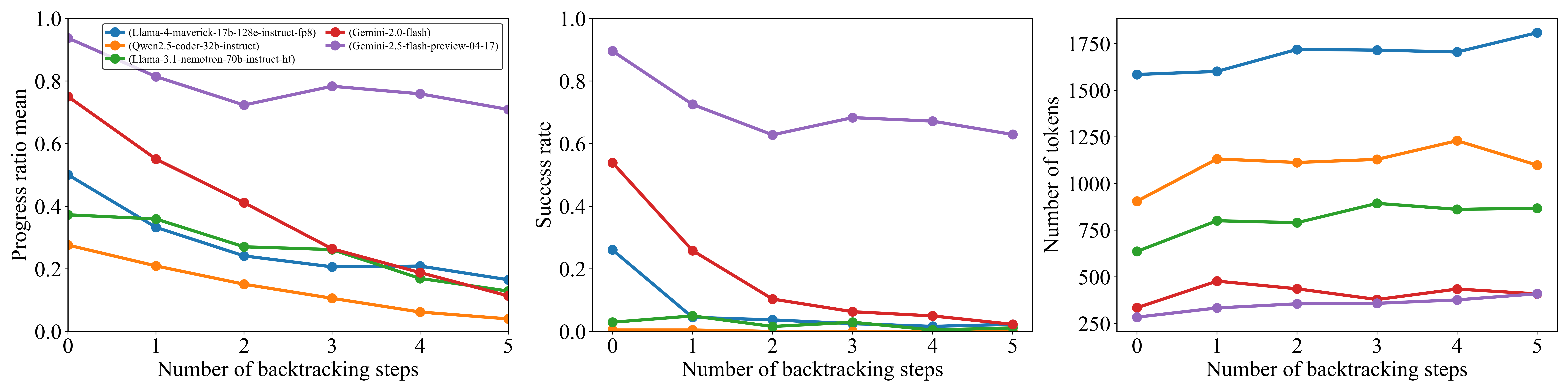
The image presents three line charts comparing the performance of different language models against the number of backtracking steps. The charts measure "Progress ratio mean", "Success rate", and "Number of tokens" as a function of backtracking steps (0 to 5). Five models are compared: Llama-4-maverick-17b-128e-instruct-fp8, Qwen2.5-coder-32b-instruct, Llama-3.1-nemotron-70b-instruct-hf, Gemini-2.0-flash, and Gemini-2.5-flash-preview-04-17.
### Components/Axes
**Chart 1: Progress Ratio Mean**
* **Y-axis:** "Progress ratio mean", ranging from 0.0 to 1.0 in increments of 0.2.
* **X-axis:** "Number of backtracking steps", ranging from 0 to 5 in increments of 1.
* **Legend (Top-Left):**
* Blue: (Llama-4-maverick-17b-128e-instruct-fp8)
* Orange: (Qwen2.5-coder-32b-instruct)
* Green: (Llama-3.1-nemotron-70b-instruct-hf)
* Red: (Gemini-2.0-flash)
* Purple: (Gemini-2.5-flash-preview-04-17)
**Chart 2: Success Rate**
* **Y-axis:** "Success rate", ranging from 0.0 to 1.0 in increments of 0.2.
* **X-axis:** "Number of backtracking steps", ranging from 0 to 5 in increments of 1.
* **Legend:** Same as Chart 1.
**Chart 3: Number of Tokens**
* **Y-axis:** "Number of tokens", ranging from 250 to 1750 in increments of 250.
* **X-axis:** "Number of backtracking steps", ranging from 0 to 5 in increments of 1.
* **Legend:** Same as Chart 1.
### Detailed Analysis
**Chart 1: Progress Ratio Mean**
* **Llama-4-maverick-17b-128e-instruct-fp8 (Blue):** Decreases from approximately 0.5 at 0 backtracking steps to approximately 0.2 at 5 backtracking steps.
* (0, 0.5) -> (1, 0.35) -> (2, 0.3) -> (3, 0.27) -> (4, 0.25) -> (5, 0.2)
* **Qwen2.5-coder-32b-instruct (Orange):** Decreases from approximately 0.3 at 0 backtracking steps to approximately 0.05 at 5 backtracking steps.
* (0, 0.3) -> (1, 0.2) -> (2, 0.15) -> (3, 0.12) -> (4, 0.08) -> (5, 0.05)
* **Llama-3.1-nemotron-70b-instruct-hf (Green):** Decreases slightly from approximately 0.4 at 0 backtracking steps to approximately 0.2 at 5 backtracking steps.
* (0, 0.4) -> (1, 0.38) -> (2, 0.3) -> (3, 0.28) -> (4, 0.25) -> (5, 0.2)
* **Gemini-2.0-flash (Red):** Decreases sharply from approximately 0.7 at 0 backtracking steps to approximately 0.15 at 5 backtracking steps.
* (0, 0.7) -> (1, 0.55) -> (2, 0.3) -> (3, 0.2) -> (4, 0.18) -> (5, 0.15)
* **Gemini-2.5-flash-preview-04-17 (Purple):** Relatively stable, fluctuating between approximately 0.7 and 0.8 across all backtracking steps.
* (0, 0.9) -> (1, 0.8) -> (2, 0.73) -> (3, 0.78) -> (4, 0.7) -> (5, 0.73)
**Chart 2: Success Rate**
* **Llama-4-maverick-17b-128e-instruct-fp8 (Blue):** Decreases from approximately 0.25 at 0 backtracking steps to approximately 0.01 at 5 backtracking steps.
* (0, 0.25) -> (1, 0.08) -> (2, 0.03) -> (3, 0.02) -> (4, 0.01) -> (5, 0.01)
* **Qwen2.5-coder-32b-instruct (Orange):** Remains near 0.0 across all backtracking steps.
* (0, 0.03) -> (1, 0.01) -> (2, 0.01) -> (3, 0.01) -> (4, 0.01) -> (5, 0.01)
* **Llama-3.1-nemotron-70b-instruct-hf (Green):** Remains near 0.0 across all backtracking steps.
* (0, 0.03) -> (1, 0.05) -> (2, 0.03) -> (3, 0.02) -> (4, 0.03) -> (5, 0.02)
* **Gemini-2.0-flash (Red):** Decreases sharply from approximately 0.55 at 0 backtracking steps to approximately 0.02 at 5 backtracking steps.
* (0, 0.55) -> (1, 0.25) -> (2, 0.08) -> (3, 0.05) -> (4, 0.03) -> (5, 0.02)
* **Gemini-2.5-flash-preview-04-17 (Purple):** Decreases from approximately 0.9 at 0 backtracking steps to approximately 0.65 at 5 backtracking steps.
* (0, 0.9) -> (1, 0.73) -> (2, 0.63) -> (3, 0.68) -> (4, 0.63) -> (5, 0.65)
**Chart 3: Number of Tokens**
* **Llama-4-maverick-17b-128e-instruct-fp8 (Blue):** Increases from approximately 1600 at 0 backtracking steps to approximately 1750 at 5 backtracking steps.
* (0, 1600) -> (1, 1620) -> (2, 1600) -> (3, 1610) -> (4, 1720) -> (5, 1750)
* **Qwen2.5-coder-32b-instruct (Orange):** Increases from approximately 900 at 0 backtracking steps to approximately 1100 at 1 backtracking step, then decreases to approximately 1050 at 5 backtracking steps.
* (0, 900) -> (1, 1150) -> (2, 1100) -> (3, 1220) -> (4, 1150) -> (5, 1050)
* **Llama-3.1-nemotron-70b-instruct-hf (Green):** Increases from approximately 650 at 0 backtracking steps to approximately 900 at 2 backtracking steps, then stabilizes.
* (0, 650) -> (1, 800) -> (2, 900) -> (3, 880) -> (4, 880) -> (5, 880)
* **Gemini-2.0-flash (Red):** Increases from approximately 300 at 0 backtracking steps to approximately 500 at 1 backtracking step, then decreases to approximately 400 at 5 backtracking steps.
* (0, 300) -> (1, 500) -> (2, 450) -> (3, 400) -> (4, 480) -> (5, 400)
* **Gemini-2.5-flash-preview-04-17 (Purple):** Relatively stable, fluctuating between approximately 300 and 400 across all backtracking steps.
* (0, 300) -> (1, 350) -> (2, 320) -> (3, 350) -> (4, 380) -> (5, 350)
### Key Observations
* **Progress Ratio Mean:** Gemini-2.5-flash-preview-04-17 consistently maintains a high progress ratio mean, while Gemini-2.0-flash experiences a significant drop with increasing backtracking steps.
* **Success Rate:** Gemini-2.5-flash-preview-04-17 has the highest success rate, while the other models show a significant decrease in success rate as backtracking steps increase.
* **Number of Tokens:** Llama-4-maverick-17b-128e-instruct-fp8 generates the most tokens, and its token count increases with backtracking steps. Gemini-2.5-flash-preview-04-17 generates the fewest tokens.
### Interpretation
The charts suggest that the Gemini-2.5-flash-preview-04-17 model is the most robust in terms of progress ratio and success rate, even with increasing backtracking steps. However, it generates the fewest tokens. The Llama-4-maverick-17b-128e-instruct-fp8 model generates the most tokens, but its progress ratio and success rate decrease with backtracking. The Gemini-2.0-flash model shows a sharp decline in both progress ratio and success rate as backtracking steps increase, indicating that it is highly sensitive to backtracking. The Qwen2.5-coder-32b-instruct and Llama-3.1-nemotron-70b-instruct-hf models have relatively low success rates across all backtracking steps.
The relationship between the number of tokens and the other metrics is complex. A higher number of tokens does not necessarily correlate with better performance (progress ratio or success rate). The choice of model and the number of backtracking steps should be carefully considered based on the specific task and desired trade-offs between performance metrics.
DECODING INTELLIGENCE...