TECHNICAL ASSET FINGERPRINT
030efcb92429338c0cfe85d8
Click to view fullscreen
Press ESC or click to close
FOUND IN PAPERS
EXPERT: gemini-2.5-flash-free VERSION 1
RUNTIME: google-free/gemini-2.5-flash
INTEL_VERIFIED
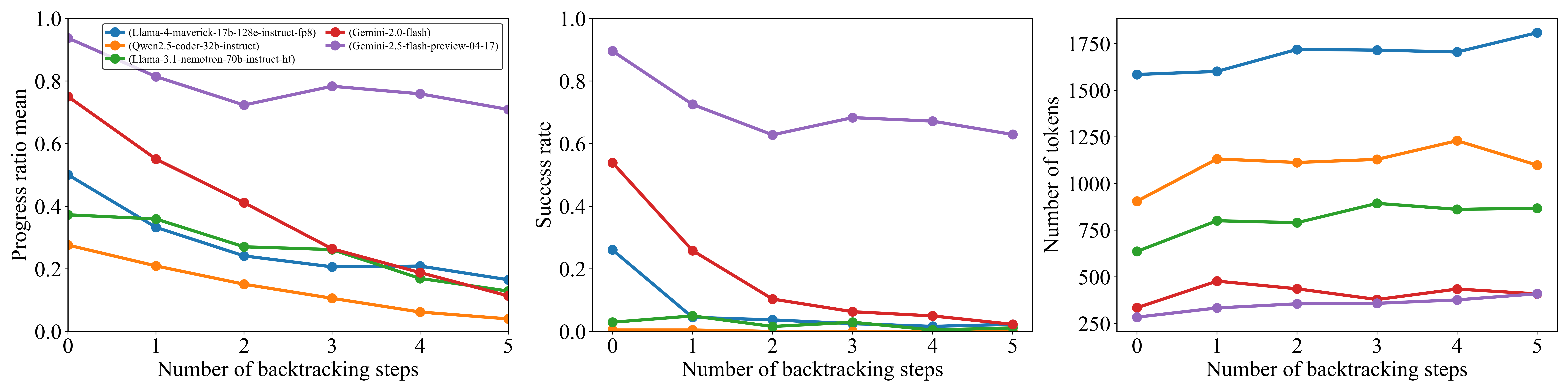
## Chart Type: Performance Metrics and Token Usage Across Backtracking Steps for Language Models
### Overview
The image displays three line charts arranged horizontally, comparing the performance (progress ratio mean, success rate) and resource usage (number of tokens) of five different language models as a function of the "Number of backtracking steps." Each chart shares the same X-axis, representing the number of backtracking steps from 0 to 5. A single legend, located in the top-right of the leftmost chart, identifies the five models by color and marker.
### Components/Axes
**Legend (located in the top-right of the leftmost chart):**
* **Blue circle**: (Llama-4-maverick-17b-128e-instruct-fp8)
* **Orange circle**: (Qwen2.5-coder-32b-instruct)
* **Green circle**: (Llama-3.1-nemotron-70b-instruct-hf)
* **Red circle**: (Gemini-2.0-flash)
* **Purple circle**: (Gemini-2.5-flash-preview-04-17)
**Common X-axis for all three charts:**
* **Label**: "Number of backtracking steps"
* **Scale**: 0, 1, 2, 3, 4, 5
**Chart 1 (Left): Progress ratio mean**
* **Y-axis Label**: "Progress ratio mean"
* **Y-axis Scale**: 0.0, 0.2, 0.4, 0.6, 0.8, 1.0
**Chart 2 (Middle): Success rate**
* **Y-axis Label**: "Success rate"
* **Y-axis Scale**: 0.0, 0.2, 0.4, 0.6, 0.8, 1.0
**Chart 3 (Right): Number of tokens**
* **Y-axis Label**: "Number of tokens"
* **Y-axis Scale**: 250, 500, 750, 1000, 1250, 1500, 1750
### Detailed Analysis
**Chart 1: Progress ratio mean vs. Number of backtracking steps**
This chart shows how the mean progress ratio changes as the number of backtracking steps increases.
* **Purple line (Gemini-2.5-flash-preview-04-17)**: Starts highest at approximately 0.9 for 0 steps, dips to about 0.72 at 2 steps, then slightly recovers to 0.78 at 3 steps before gradually declining to approximately 0.68 at 5 steps. It maintains the highest progress ratio throughout.
* **Red line (Gemini-2.0-flash)**: Starts high at approximately 0.75 for 0 steps and shows a steep, consistent decline, reaching about 0.12 at 5 steps.
* **Blue line (Llama-4-maverick-17b-128e-instruct-fp8)**: Starts at approximately 0.48 for 0 steps and generally decreases, flattening out towards the end, reaching about 0.2 at 5 steps.
* **Green line (Llama-3.1-nemotron-70b-instruct-hf)**: Starts at approximately 0.38 for 0 steps, remains relatively stable at 0.37 at 1 step, then gradually declines to about 0.18 at 5 steps.
* **Orange line (Qwen2.5-coder-32b-instruct)**: Starts lowest among the higher initial values at approximately 0.28 for 0 steps and shows a steady, continuous decline, reaching about 0.05 at 5 steps.
**Chart 2: Success rate vs. Number of backtracking steps**
This chart illustrates the success rate of each model as the number of backtracking steps increases.
* **Purple line (Gemini-2.5-flash-preview-04-17)**: Starts highest at approximately 0.88 for 0 steps, declines to about 0.62 at 2 steps, then slightly recovers to 0.68 at 3 steps before gradually declining to approximately 0.62 at 5 steps. It maintains the highest success rate.
* **Red line (Gemini-2.0-flash)**: Starts at approximately 0.55 for 0 steps and exhibits a very steep decline, dropping to about 0.02 at 5 steps.
* **Blue line (Llama-4-maverick-17b-128e-instruct-fp8)**: Starts at approximately 0.25 for 0 steps and shows a rapid decline to near zero (around 0.01-0.02) by 2 steps, remaining at that level.
* **Green line (Llama-3.1-nemotron-70b-instruct-hf)**: Starts very low at approximately 0.02 for 0 steps, slightly increases to 0.05 at 1 step, then declines to near zero (around 0.01) by 4 steps, remaining there.
* **Orange line (Qwen2.5-coder-32b-instruct)**: Starts very low at approximately 0.01 for 0 steps and remains consistently near zero (around 0.01) across all backtracking steps.
**Chart 3: Number of tokens vs. Number of backtracking steps**
This chart presents the number of tokens used by each model as the number of backtracking steps increases.
* **Blue line (Llama-4-maverick-17b-128e-instruct-fp8)**: Starts highest at approximately 1580 tokens for 0 steps, remains relatively stable until 2 steps (~1590 tokens), then shows a noticeable increase to approximately 1780 tokens at 5 steps. It consistently uses the most tokens.
* **Orange line (Qwen2.5-coder-32b-instruct)**: Starts at approximately 900 tokens for 0 steps, increases to about 1150 tokens at 2 steps, dips slightly to 1100 at 3 steps, then peaks at 1220 at 4 steps before decreasing to approximately 1100 tokens at 5 steps.
* **Green line (Llama-3.1-nemotron-70b-instruct-hf)**: Starts at approximately 650 tokens for 0 steps, increases to about 850 tokens at 2 steps, dips slightly to 800 at 3 steps, then stabilizes around 880 tokens for 4 and 5 steps.
* **Red line (Gemini-2.0-flash)**: Starts at approximately 350 tokens for 0 steps, increases to about 480 tokens at 1 step, then fluctuates between 400 and 480 tokens, ending at approximately 450 tokens at 5 steps.
* **Purple line (Gemini-2.5-flash-preview-04-17)**: Starts lowest at approximately 280 tokens for 0 steps and shows a consistent, gradual increase to approximately 420 tokens at 5 steps. It consistently uses the fewest tokens.
### Key Observations
* **Gemini-2.5-flash-preview-04-17 (Purple)**: This model consistently outperforms all others in "Progress ratio mean" and "Success rate" across all backtracking steps, maintaining high values even with increased backtracking. Notably, it also uses the *fewest* "Number of tokens" among all models, with a moderate increase in token usage as backtracking steps increase.
* **General Trend for Performance Metrics**: For most models, "Progress ratio mean" and "Success rate" generally decrease as the "Number of backtracking steps" increases. This suggests that increased backtracking often leads to diminishing returns or even detrimental effects on these performance indicators.
* **General Trend for Token Usage**: Conversely, the "Number of tokens" generally increases or remains stable with more backtracking steps, indicating that more computational effort (tokens) is expended, even if performance declines.
* **Steepest Declines**: Gemini-2.0-flash (Red) shows a very steep decline in both "Progress ratio mean" and "Success rate" after 0 backtracking steps. Llama-4-maverick (Blue) also experiences a sharp drop in "Success rate."
* **Lowest Performers**: Qwen2.5-coder-32b-instruct (Orange) and Llama-3.1-nemotron-70b-instruct-hf (Green) generally show lower initial performance and decline to very low success rates.
### Interpretation
The data suggests a complex relationship between backtracking, model performance, and resource consumption.
1. **Backtracking Trade-offs**: For most models, increasing the number of backtracking steps appears to be counterproductive for "Progress ratio mean" and "Success rate." This could imply that beyond a certain point, additional backtracking leads to unproductive exploration, getting stuck in local optima, or simply consuming more resources without yielding better results.
2. **Efficiency of Gemini-2.5-flash-preview-04-17**: The "Gemini-2.5-flash-preview-04-17" model stands out as an anomaly. It maintains significantly higher progress and success rates while simultaneously using the least number of tokens. This indicates superior efficiency and robustness to backtracking compared to the other models. It suggests that this model's backtracking mechanism is either more effective at finding solutions or more efficient at pruning unproductive paths, allowing it to achieve better outcomes with less computational overhead.
3. **Resource Consumption vs. Performance**: There isn't a direct positive correlation between token usage and performance. For instance, Llama-4-maverick (Blue) uses the most tokens but performs moderately in progress ratio and poorly in success rate, especially with backtracking. This highlights that simply increasing token usage (or allowing more backtracking) does not guarantee better performance; the quality and efficiency of the search strategy are paramount.
4. **Model Robustness**: The varying slopes of the performance curves indicate different levels of robustness to backtracking. Models with steep declines (e.g., Gemini-2.0-flash, Llama-4-maverick in success rate) are less robust, quickly losing performance as backtracking increases. Gemini-2.5-flash-preview-04-17, with its relatively flat and high-value performance curves, demonstrates high robustness.
5. **Implications for Deployment**: For applications where computational resources are constrained or real-time performance is critical, models like Gemini-2.5-flash-preview-04-17 would be highly preferred due to their superior performance-to-token ratio and resilience to backtracking. For other models, the data suggests that limiting backtracking steps might be a necessary optimization to prevent performance degradation and excessive token consumption.
DECODING INTELLIGENCE...