## Charts: Model Performance with Backtracking Steps
### Overview
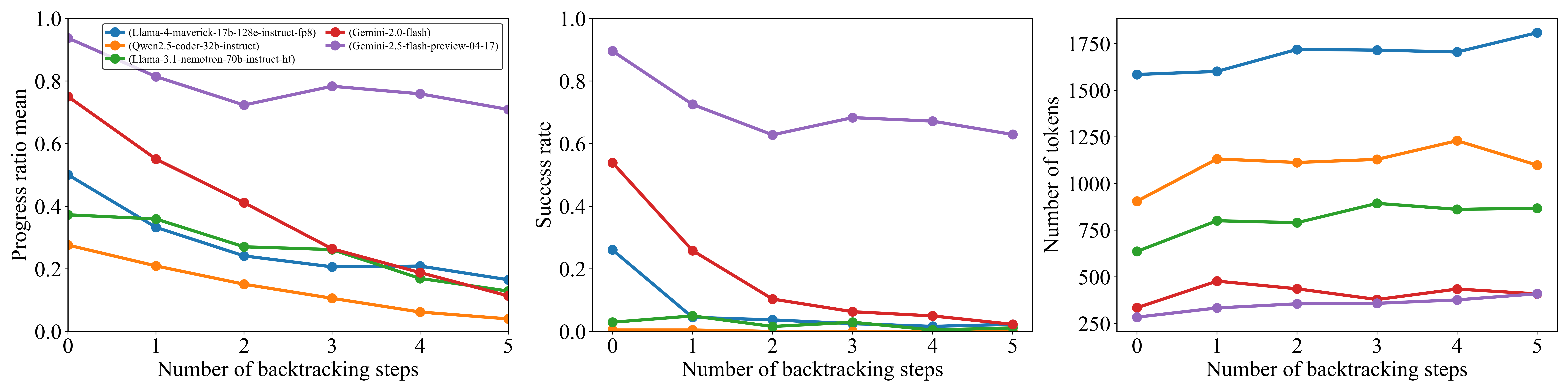
The image presents three line charts comparing the performance of several language models (Llama-2, OpenLLaMA, and Gemini) as the number of backtracking steps increases. The charts display Progress Ratio Mean, Success Rate, and Number of Tokens generated. All charts share a common x-axis representing the "Number of backtracking steps" ranging from 0 to 5.
### Components/Axes
* **X-axis (all charts):** "Number of backtracking steps" (0, 1, 2, 3, 4, 5)
* **Chart 1 (Left):** "Progress ratio mean" (Y-axis, 0 to 1.0)
* **Models:**
* Llama-2-70b-chat-hf (Blue Diamonds)
* Llama-2-13b-instruct-hf (Green Triangles)
* OpenLLaMA-30b-instruct (Gray Squares)
* Llama-2-7b-chat-hf (Red Circles)
* Gemini-2.0-flash (Purple X)
* Gemini-2.5-flash-preview-v4.17 (Orange Circles)
* **Chart 2 (Center):** "Success rate" (Y-axis, 0 to 0.8)
* **Models:** Same as Chart 1.
* **Chart 3 (Right):** "Number of tokens" (Y-axis, 250 to 1750)
* **Models:** Same as Chart 1.
* **Legend:** Located at the top of the first chart, spanning across all three charts.
### Detailed Analysis or Content Details
**Chart 1: Progress Ratio Mean**
* **Llama-2-70b-chat-hf (Blue Diamonds):** Starts at approximately 0.68, decreases slightly to 0.62 at step 1, then remains relatively stable around 0.60-0.62 until step 5.
* **Llama-2-13b-instruct-hf (Green Triangles):** Starts at approximately 0.45, decreases steadily to around 0.25 by step 4, and remains around 0.25 at step 5.
* **OpenLLaMA-30b-instruct (Gray Squares):** Starts at approximately 0.40, decreases to around 0.30 by step 2, then decreases more rapidly to approximately 0.15 by step 5.
* **Llama-2-7b-chat-hf (Red Circles):** Starts at approximately 0.35, decreases to around 0.20 by step 2, and continues to decrease to approximately 0.10 by step 5.
* **Gemini-2.0-flash (Purple X):** Starts at approximately 0.55, decreases to around 0.45 by step 2, and remains relatively stable around 0.45 until step 5.
* **Gemini-2.5-flash-preview-v4.17 (Orange Circles):** Starts at approximately 0.30, increases to around 0.40 by step 1, then decreases to approximately 0.25 by step 5.
**Chart 2: Success Rate**
* **Llama-2-70b-chat-hf (Blue Diamonds):** Starts at approximately 0.85, decreases to around 0.75 by step 1, and remains relatively stable around 0.75 until step 5.
* **Llama-2-13b-instruct-hf (Green Triangles):** Starts at approximately 0.10, increases to around 0.30 by step 2, then decreases to approximately 0.10 by step 5.
* **OpenLLaMA-30b-instruct (Gray Squares):** Starts at approximately 0.05, increases to around 0.20 by step 1, then decreases to approximately 0.05 by step 5.
* **Llama-2-7b-chat-hf (Red Circles):** Starts at approximately 0.02, increases to around 0.15 by step 1, then decreases to approximately 0.02 by step 5.
* **Gemini-2.0-flash (Purple X):** Starts at approximately 0.80, decreases to around 0.70 by step 1, and remains relatively stable around 0.70 until step 5.
* **Gemini-2.5-flash-preview-v4.17 (Orange Circles):** Starts at approximately 0.20, increases to around 0.40 by step 1, then decreases to approximately 0.20 by step 5.
**Chart 3: Number of Tokens**
* **Llama-2-70b-chat-hf (Blue Diamonds):** Starts at approximately 1600, decreases slightly to around 1550 by step 5.
* **Llama-2-13b-instruct-hf (Green Triangles):** Starts at approximately 1100, decreases to around 900 by step 5.
* **OpenLLaMA-30b-instruct (Gray Squares):** Starts at approximately 1000, decreases to around 700 by step 5.
* **Llama-2-7b-chat-hf (Red Circles):** Starts at approximately 500, increases to around 600 by step 1, then decreases to approximately 400 by step 5.
* **Gemini-2.0-flash (Purple X):** Starts at approximately 1300, decreases to around 1200 by step 5.
* **Gemini-2.5-flash-preview-v4.17 (Orange Circles):** Starts at approximately 1200, decreases to around 1000 by step 5.
### Key Observations
* Generally, increasing the number of backtracking steps leads to a decrease in Progress Ratio Mean and Success Rate for most models.
* Llama-2-70b-chat-hf consistently exhibits the highest Success Rate and Progress Ratio Mean across all backtracking steps.
* The number of tokens generated tends to decrease with increasing backtracking steps for most models.
* OpenLLaMA-30b-instruct and Llama-2-7b-chat-hf show the most significant decline in performance (Progress Ratio Mean and Success Rate) as backtracking steps increase.
### Interpretation
The data suggests that while backtracking can potentially improve model performance in some cases (as seen by the initial increase in Success Rate for some models at step 1), increasing the number of backtracking steps generally leads to diminishing returns and can even degrade performance. This could be due to the increased computational cost and potential for introducing errors with each additional backtracking step.
The consistent high performance of Llama-2-70b-chat-hf indicates that larger models are more robust to the effects of backtracking. The significant decline in performance for smaller models like OpenLLaMA-30b-instruct and Llama-2-7b-chat-hf suggests that they may be more susceptible to errors or inefficiencies introduced by backtracking.
The decrease in the number of tokens generated with increasing backtracking steps could be a result of the model terminating the generation process earlier due to the increased complexity or uncertainty introduced by the backtracking process. This could also be a consequence of the models being optimized for faster generation without backtracking.