## Line Charts: Model Performance Metrics vs Backtracking Steps
### Overview
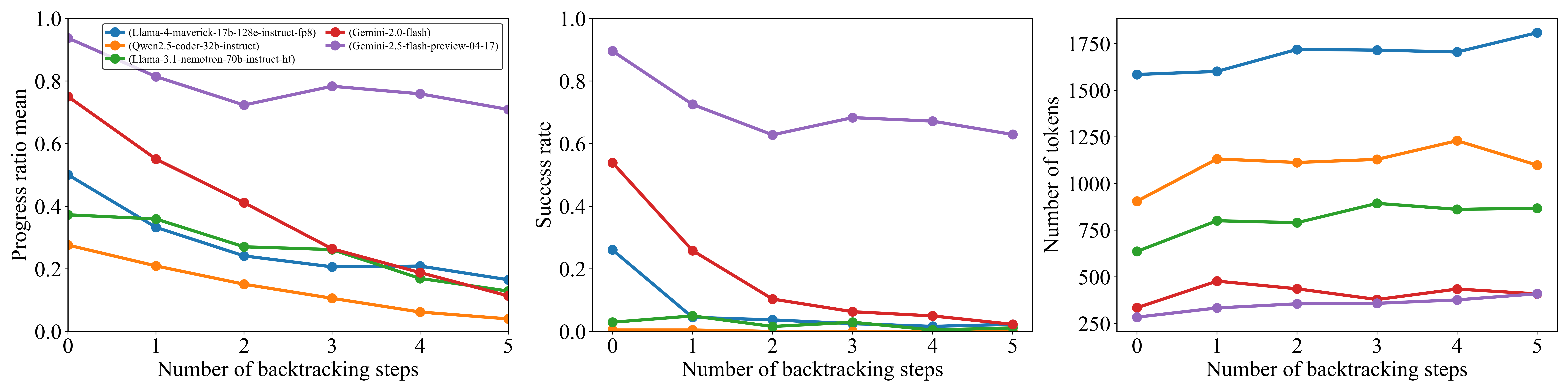
Three side-by-side line charts compare model performance metrics (progress ratio, success rate, token usage) across five backtracking steps. Each chart tracks four models with distinct color-coded lines, showing divergent trends in efficiency and resource consumption.
### Components/Axes
**Left Chart (Progress Ratio Mean):**
- X-axis: Number of backtracking steps (0-5)
- Y-axis: Progress ratio (0.0-1.0)
- Legend: Top-left, four entries:
- Blue: Llama-4-maverick-17b-128e-instruct-fp8
- Orange: Owned2.5-coder-32b-instruct
- Green: Llama-3.1-nemotron-70b-instruct-hf
- Purple: Gemini-2.0-flash
**Middle Chart (Success Rate):**
- X-axis: Number of backtracking steps (0-5)
- Y-axis: Success rate (0.0-1.0)
- Legend: Top-left, four entries:
- Blue: Llama-4-maverick-17b-128e-instruct-fp8
- Orange: Owned2.5-coder-32b-instruct
- Green: Llama-3.1-nemotron-70b-instruct-hf
- Purple: Gemini-2.5-flash-preview-04-17
**Right Chart (Number of Tokens):**
- X-axis: Number of backtracking steps (0-5)
- Y-axis: Token count (250-1750)
- Legend: Top-left, four entries:
- Blue: Llama-4-maverick-17b-128e-instruct-fp8
- Orange: Owned2.5-coder-32b-instruct
- Green: Llama-3.1-nemotron-70b-instruct-hf
- Purple: Gemini-2.0-flash
### Detailed Analysis
**Left Chart Trends:**
1. **Blue Line (Llama-4-maverick):** Steep decline from ~0.5 to ~0.1 (step 0→5)
2. **Orange Line (Owned2.5-coder):** Gradual drop from ~0.3 to ~0.02
3. **Green Line (Llama-3.1-nemotron):** Moderate decline from ~0.4 to ~0.1
4. **Purple Line (Gemini-2.0-flash):** Slowest decline from ~0.9 to ~0.65
**Middle Chart Trends:**
1. **Blue Line (Llama-4-maverick):** Sharp drop from ~0.25 to ~0.0
2. **Orange Line (Owned2.5-coder):** Minimal presence (near 0 after step 0)
3. **Green Line (Llama-3.1-nemotron):** Near-zero after step 1
4. **Purple Line (Gemini-2.5-flash):** Maintains ~0.55-0.9 range
**Right Chart Trends:**
1. **Blue Line (Llama-4-maverick):** Steady increase from 1600→1800 tokens
2. **Orange Line (Owned2.5-coder):** Peaks at 1200 tokens (step 4)
3. **Green Line (Llama-3.1-nemotron):** Stable ~600-900 tokens
4. **Purple Line (Gemini-2.0-flash):** Gradual rise from 250→400 tokens
### Key Observations
1. **Performance Degradation:** All models show declining progress ratios and success rates with more backtracking steps, except Gemini-2.5-flash-preview which maintains higher success rates.
2. **Token Efficiency:** Llama-4-maverick consumes most tokens (1800 at step 5) but shows inverse correlation between token usage and performance metrics.
3. **Model Specialization:** Gemini models (both versions) demonstrate superior efficiency in maintaining performance metrics despite backtracking.
4. **Resource Tradeoff:** Higher-performing models (Gemini) use fewer tokens, suggesting better optimization.
### Interpretation
The data reveals critical tradeoffs between computational efficiency and performance:
- **Gemini Models** excel in maintaining high success rates/progress ratios with minimal token consumption, indicating superior architectural optimization for backtracking tasks.
- **Llama-4-maverick** shows diminishing returns - while it initially performs well, its resource-intensive nature (high token usage) correlates with performance degradation as backtracking steps increase.
- **Owned2.5-coder** and **Llama-3.1-nemotron** demonstrate limited effectiveness in backtracking scenarios, with near-zero success rates beyond initial steps despite moderate token usage.
These findings suggest Gemini models are better suited for tasks requiring iterative refinement with constrained computational resources, while Llama-4-maverick may be preferable for applications where initial response quality outweighs long-term efficiency concerns.