\n
## Mathematical Problem Sheet: Probability of Drawing Balls
### Overview
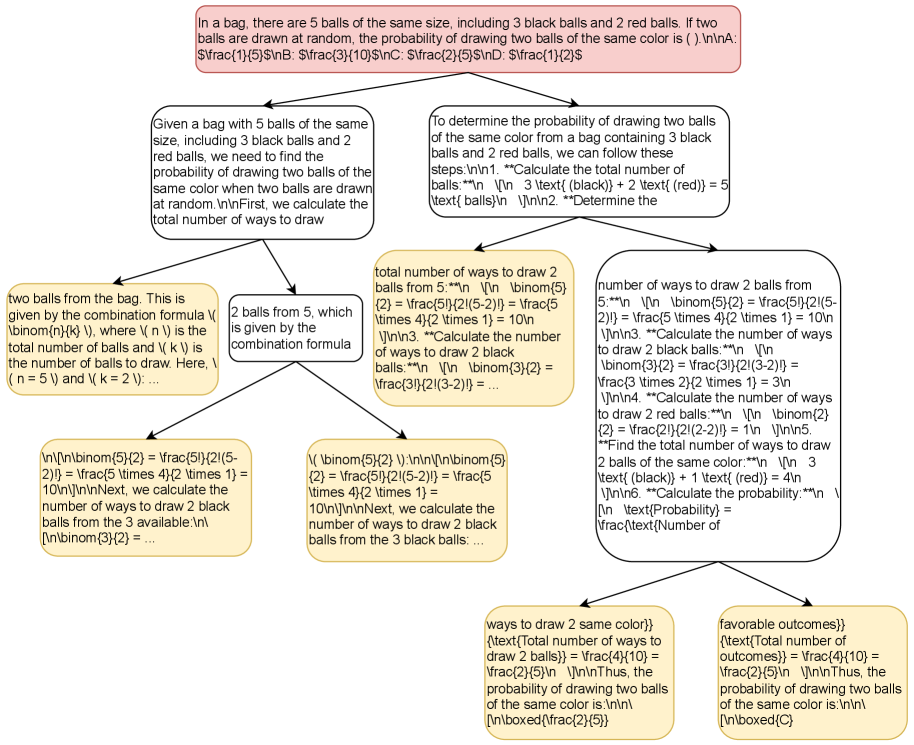
The image presents a handwritten sheet detailing the calculation of the probability of drawing two balls of the same color from a bag containing 3 black balls and 2 red balls. It uses combinatorial formulas and step-by-step explanations. The document is primarily in English, with some mathematical notation.
### Components/Axes
The sheet is structured as a series of calculations and explanations. There are no traditional axes or charts. The key components are:
* **Problem Statement:** Initial description of the scenario.
* **Formula Introduction:** Explanation of the combination formula.
* **Step-by-Step Calculation:** Breakdown of the probability calculation into smaller steps.
* **Final Probability:** The calculated probability of drawing two balls of the same color.
* **Mathematical Notation:** Use of LaTeX-like symbols for fractions and combinations (e.g., `\frac{5}{2}`, `\binom{n}{k}`).
### Detailed Analysis or Content Details
The problem begins with the statement: "In a bag, there are 5 balls of the same size, including 3 black balls and 2 red balls. If two balls are drawn at random, the probability of drawing two balls of the same color is ( )."
The solution proceeds as follows:
1. **Total Number of Balls:** The total number of balls is stated as 5.
2. **Combination Formula:** The combination formula is given as `\binom{n}{k}`, where 'n' is the total number of balls and 'k' is the number of balls to draw.
3. **Total Ways to Draw 2 Balls:** The total number of ways to draw 2 balls from 5 is calculated as `\binom{5}{2} = \frac{5!}{2!(5-2)!} = \frac{5!}{2!3!} = \frac{5 \times 4}{2 \times 1} = 10`.
4. **Ways to Draw 2 Black Balls:** The number of ways to draw 2 black balls from 3 is calculated as `\binom{3}{2} = \frac{3!}{2!(3-2)!} = \frac{3!}{2!1!} = \frac{3 \times 2}{2 \times 1} = 3`.
5. **Ways to Draw 2 Red Balls:** The number of ways to draw 2 red balls from 2 is calculated as `\binom{2}{2} = \frac{2!}{2!(2-2)!} = \frac{2!}{2!0!} = \frac{2 \times 1}{2 \times 1} = 1`.
6. **Total Ways to Draw 2 Balls of the Same Color:** The total number of ways to draw 2 balls of the same color is the sum of the ways to draw 2 black balls and 2 red balls: `3 + 1 = 4`.
7. **Probability Calculation:** The probability of drawing 2 balls of the same color is calculated as the number of ways to draw 2 balls of the same color divided by the total number of ways to draw 2 balls: `\frac{4}{10} = \frac{2}{5}`.
The final answer is stated as: "Therefore, the probability of drawing two balls of the same color is \frac{2}{5}."
### Key Observations
* The solution uses a clear, step-by-step approach.
* The mathematical notation is consistent throughout the calculation.
* The final answer is a simplified fraction.
* The handwriting is legible, but contains some minor inconsistencies in symbol formation.
### Interpretation
The document demonstrates a standard application of combinatorics to solve a probability problem. The problem is well-defined, and the solution is logically sound. The use of the combination formula is appropriate for calculating the number of ways to choose balls without regard to order. The final probability of 2/5 (or 0.4) indicates that there is a 40% chance of drawing two balls of the same color from the bag. The document serves as a clear example of how to apply mathematical principles to real-world scenarios. The consistent use of the combination formula and the step-by-step breakdown of the calculation make the solution easy to follow and understand.