## Flowchart: Probability Calculation for Drawing Two Balls of the Same Color
### Overview
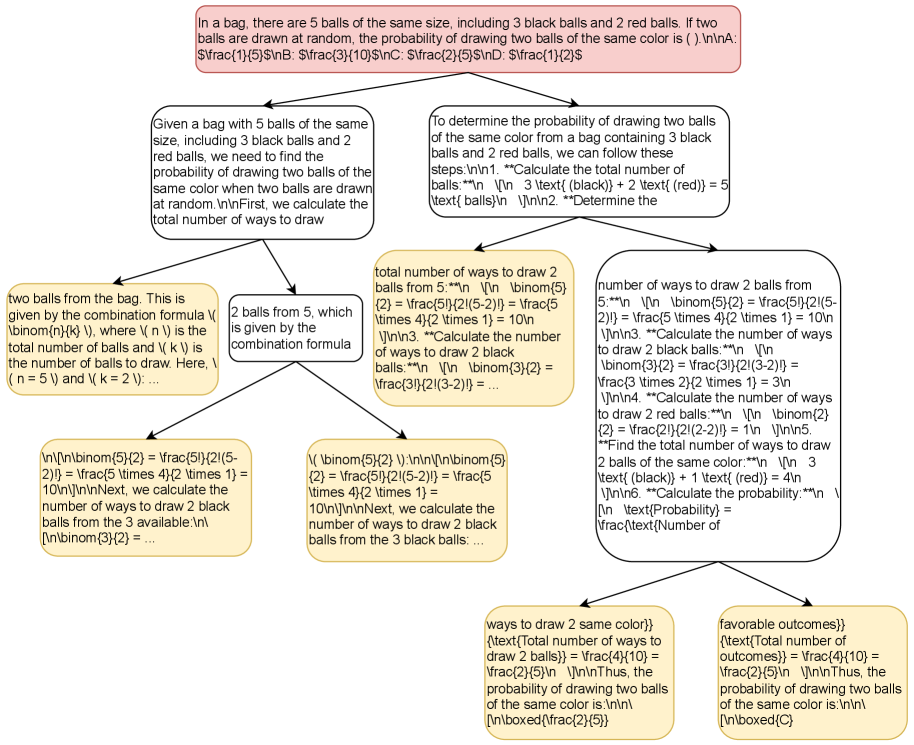
The flowchart illustrates a step-by-step probability calculation to determine the likelihood of drawing two balls of the same color from a bag containing 3 black balls and 2 red balls. It uses combinatorial mathematics (binomial coefficients and factorials) to compute favorable outcomes and total outcomes.
### Components/Axes
- **Main Title**: "In a bag, there are 5 balls of the same size, including 3 black balls and 2 red balls. If two balls are drawn at random, the probability of drawing two balls of the same color is..."
- **Key Text Boxes**:
1. **Problem Statement**: Defines the scenario (5 balls: 3 black, 2 red).
2. **Total Outcomes Calculation**:
- Formula: `binom(5, 2) = frac(5!){2!(5-2)!} = 10`
- Explanation: Total ways to draw 2 balls from 5.
3. **Favorable Outcomes for Black Balls**:
- Formula: `binom(3, 2) = frac(3!){2!(3-2)!} = 3`
- Explanation: Ways to draw 2 black balls from 3.
4. **Favorable Outcomes for Red Balls**:
- Formula: `binom(2, 2) = frac(2!){2!(2-2)!} = 1`
- Explanation: Ways to draw 2 red balls from 2.
5. **Total Favorable Outcomes**:
- Sum: `3 (black) + 1 (red) = 4`
6. **Probability Calculation**:
- Formula: `frac(4){10} = 0.4` (or 40%)
### Detailed Analysis
- **Combinatorial Logic**:
- Total outcomes: `C(5, 2) = 10` (all possible pairs).
- Favorable outcomes: `C(3, 2) + C(2, 2) = 3 + 1 = 4` (same-color pairs).
- **Code Snippets**:
- Python-like pseudocode for factorial (`frac`) and combination (`binom`) functions.
- Example: `frac(5!){2!(5-2)!} = 10` (total outcomes).
### Key Observations
- The probability of drawing two balls of the same color is **40%**.
- The calculation relies on combinatorial principles: `P = (favorable outcomes) / (total outcomes)`.
- No outliers or anomalies; the logic is deterministic.
### Interpretation
The flowchart demonstrates how combinatorial mathematics quantifies probability. By isolating favorable outcomes (same-color pairs) and dividing by total possible outcomes, it provides a clear, formulaic approach to solving probability problems. The use of `binom(n, k)` and `frac` functions simplifies complex calculations, making the process reproducible and verifiable. This method is foundational in probability theory and applicable to real-world scenarios like quality control or statistical sampling.