\n
## Line Chart: Data Trend Over Steps
### Overview
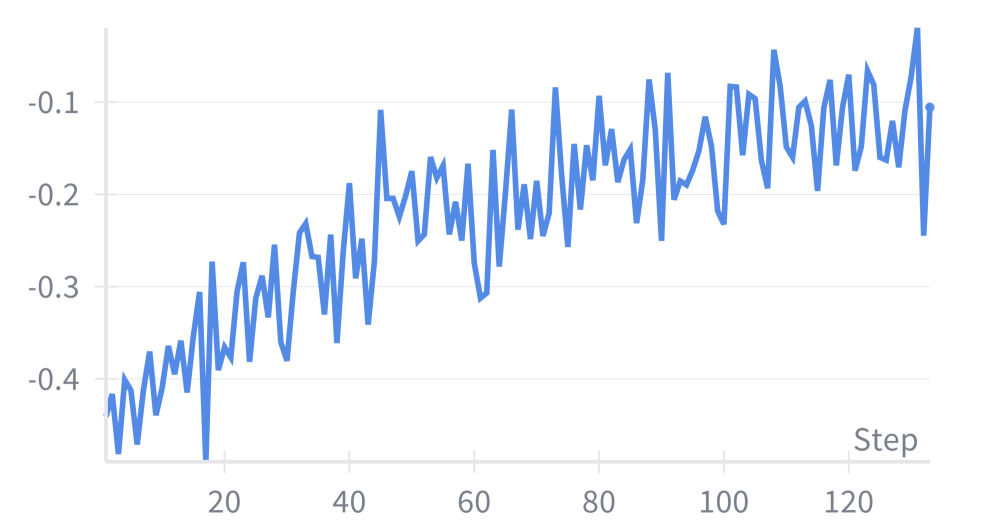
The image presents a line chart displaying a fluctuating data series plotted against "Step" values. The chart shows a generally decreasing trend with significant short-term oscillations.
### Components/Axes
* **X-axis:** Labeled "Step", ranging from approximately 0 to 130, with tick marks at intervals of 10.
* **Y-axis:** Ranges from approximately -0.4 to 0.1, with tick marks at intervals of 0.1.
* **Data Series:** A single blue line representing the data trend.
* **Legend:** Located in the bottom-right corner, labeling the line as "Step".
### Detailed Analysis
The blue line begins at approximately Step 0 with a value of -0.4.
* **Initial Trend (Steps 0-20):** The line exhibits a steep downward slope, decreasing from -0.4 to approximately -0.35. The data fluctuates significantly within this range.
* **Intermediate Trend (Steps 20-60):** The slope becomes less steep, with the line oscillating between approximately -0.35 and -0.2. There are several local minima and maxima.
* **Later Trend (Steps 60-120):** The line continues to oscillate, but the overall trend is still slightly downward, ending at approximately -0.25 at Step 120. The amplitude of the oscillations appears relatively consistent throughout this section.
Approximate data points:
* Step 0: -0.4
* Step 20: -0.35
* Step 40: -0.28
* Step 60: -0.23
* Step 80: -0.25
* Step 100: -0.22
* Step 120: -0.25
### Key Observations
* The data exhibits a clear decreasing trend over the entire range of steps.
* The oscillations are relatively consistent in amplitude, suggesting a periodic or quasi-periodic component to the data.
* There are no obvious outliers or abrupt changes in the trend.
### Interpretation
The chart likely represents a process where a value decreases over time (represented by "Step"), but is subject to constant fluctuations. This could be a measurement affected by noise, a system with inherent variability, or a process with feedback loops causing oscillations. The decreasing trend suggests a gradual decay or reduction in the underlying process. The consistent oscillation amplitude indicates that the factors causing the fluctuations are relatively stable over the observed time period. Without further context, it's difficult to determine the specific meaning of the "Step" variable or the nature of the measured value. The data suggests a system that is settling towards a lower state, but is not doing so smoothly.