## Line Graph: Step vs. Value
### Overview
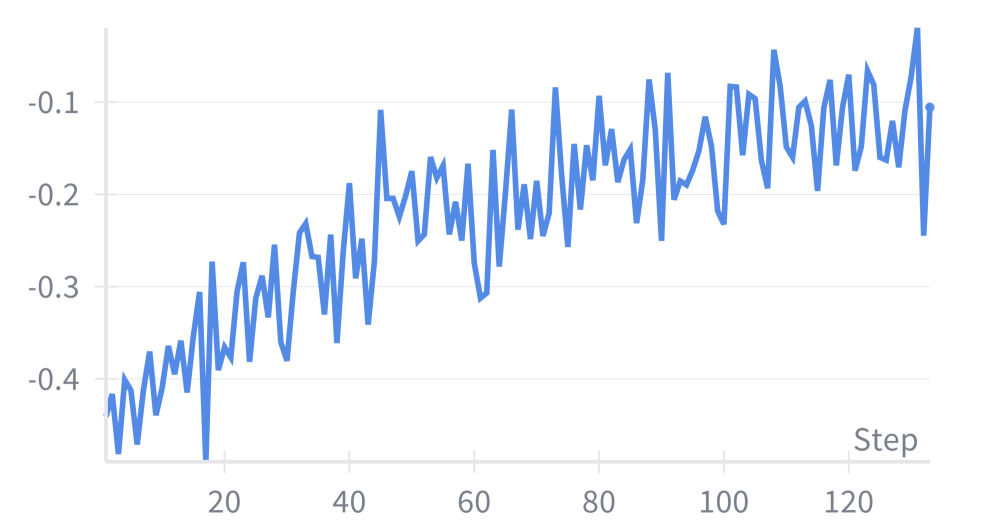
The image depicts a line graph with a single blue line fluctuating across a white background. The x-axis (horizontal) is labeled "Step" with values ranging from 0 to 120, while the y-axis (vertical) is labeled with values from -0.4 to -0.1. The line begins near -0.4 at step 0, exhibits significant oscillations, and ends near -0.1 at step 120. A legend in the bottom-right corner identifies the blue line as "Step."
---
### Components/Axes
- **X-Axis (Step)**:
- Label: "Step" (bottom-right of axis).
- Scale: Linear increments from 0 to 120 (marks at 20, 40, 60, 80, 100, 120).
- **Y-Axis (Value)**:
- Label: No explicit label, but values range from -0.4 (bottom) to -0.1 (top).
- Scale: Linear increments of 0.1 (marks at -0.4, -0.3, -0.2, -0.1).
- **Legend**:
- Position: Bottom-right corner.
- Content: "Step" with a blue line symbol.
---
### Detailed Analysis
- **Line Behavior**:
- **Start**: At step 0, the line begins at approximately -0.4.
- **Fluctuations**: The line oscillates irregularly between -0.4 and -0.1 throughout the graph, with peaks and troughs occurring at irregular intervals.
- **End**: At step 120, the line stabilizes near -0.1.
- **Trend**: Despite oscillations, the line shows a **general upward trend** (from -0.4 to -0.1) as step increases.
---
### Key Observations
1. **Volatility**: The line exhibits high variability, with sharp rises and falls (e.g., dips to -0.4 at step ~10, peaks near -0.1 at step ~50).
2. **Stabilization**: After step 100, fluctuations narrow, and the line converges toward -0.1.
3. **Outliers**: No extreme outliers; all values remain within the y-axis range (-0.4 to -0.1).
---
### Interpretation
The graph suggests a process or system that **gradually improves** (increases toward less negative values) over 120 steps, despite intermittent instability. The oscillations may indicate transient disruptions or variability in the measured phenomenon. The stabilization near -0.1 at step 120 implies convergence toward a steady state. The lack of explicit context (e.g., units, system description) limits definitive conclusions, but the trend aligns with scenarios like damping oscillations, iterative optimization, or noise reduction over time.