## Block Diagram: Sequence-to-Sequence Processing Architecture
### Overview
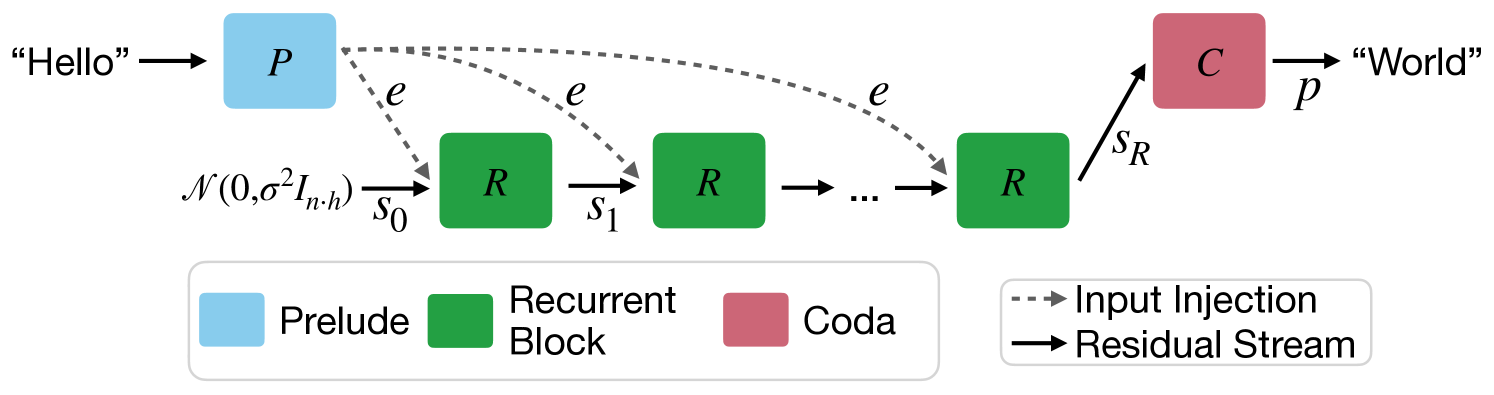
The diagram illustrates a computational architecture for processing sequential input ("Hello") into output ("World") using a combination of Prelude, Recurrent Blocks, and Coda components. The system employs residual connections and input injection mechanisms.
### Components/Axes
1. **Legend** (bottom-left):
- Blue: Prelude (P)
- Green: Recurrent Block (R)
- Red: Coda (C)
- Dotted lines: Residual Stream (e)
- Solid arrows: Main data flow
2. **Key Elements**:
- Input: "Hello" (left)
- Output: "World" (right)
- Residual connections: Dashed lines labeled "e"
- Input Injection: Dashed arrow labeled "Input Injection"
- Residual Stream: Solid arrow labeled "S_R"
### Detailed Analysis
1. **Flow Path**:
- "Hello" → P (Prelude) → R₁ (Recurrent Block 1) → R₂ (Recurrent Block 2) → ... → Rₙ (Final Recurrent Block) → C (Coda) → "World"
- Residual connections (e) bypass each R block to subsequent blocks
- Final residual stream (S_R) connects last R block to C
2. **Component Relationships**:
- **Prelude (P)**: Initial processing unit receiving raw input
- **Recurrent Blocks (R)**: Sequential processing units with internal state (s₀, s₁, ..., s_R)
- **Coda (C)**: Final output generator
- Residual streams enable gradient propagation through deep networks
### Key Observations
1. **Residual Architecture**: Multiple residual connections (e) between R blocks suggest skip connections for improved gradient flow
2. **State Progression**: Internal states (s₀ → s₁ → ... → s_R) indicate sequential memory maintenance
3. **Input Injection**: External information can be injected at any processing stage
4. **Output Transformation**: "Hello" → "World" implies sequence-to-sequence mapping capability
### Interpretation
This architecture resembles a Transformer-based encoder-decoder model with residual connections, optimized for:
1. **Long Sequence Handling**: Recurrent blocks with residual streams mitigate vanishing gradient problems
2. **Contextual Processing**: Input injection allows mid-sequence modifications
3. **Efficient Training**: Residual connections enable deeper networks without performance degradation
4. **Sequence Generation**: Final Coda component suggests autoregressive output generation
The "Hello" → "World" transformation exemplifies a basic sequence-to-sequence task, potentially representing text generation, translation, or speech synthesis systems. The residual stream (S_R) acts as a memory buffer preserving critical information across processing stages.