## Model Comparison: Solving a Number Puzzle
### Overview
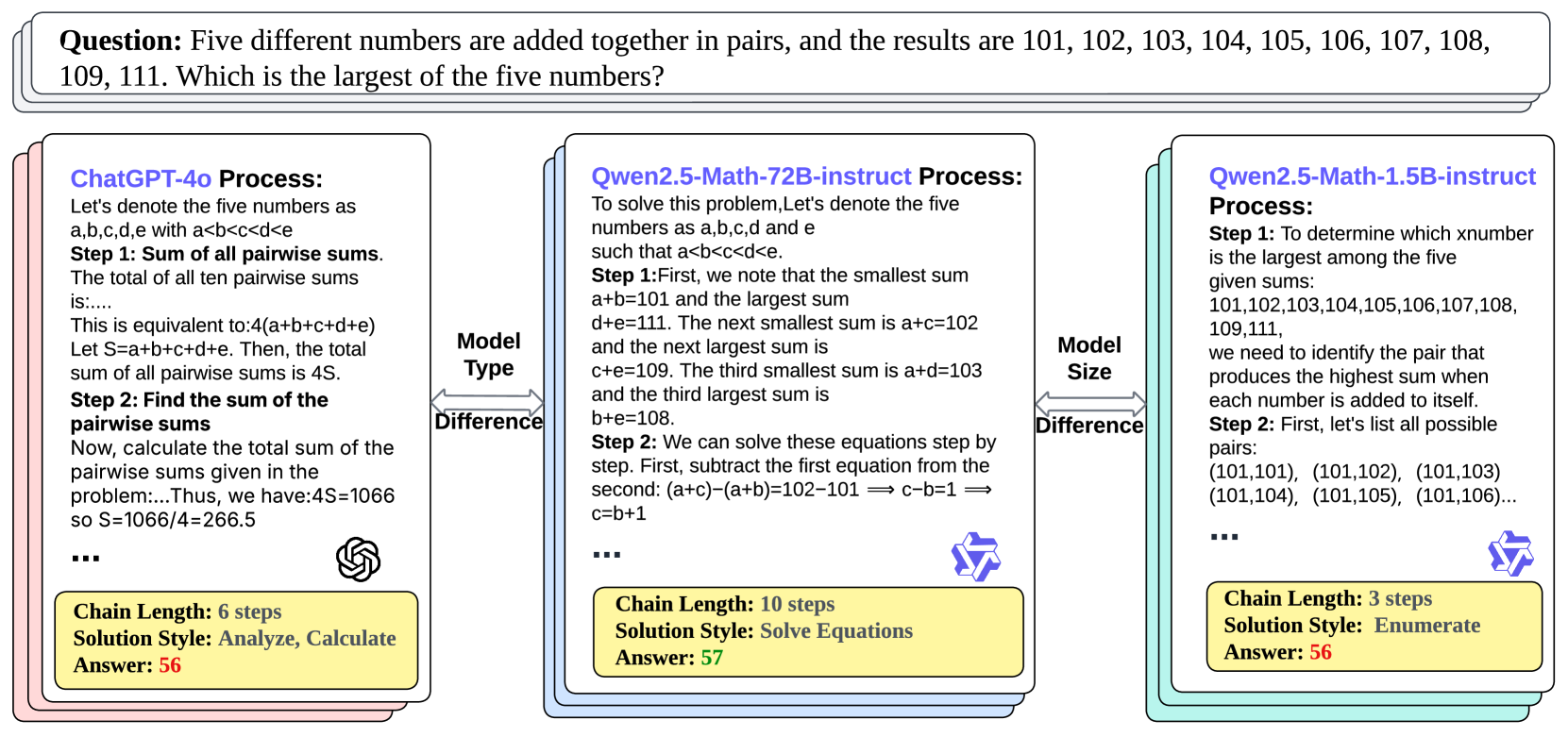
The image presents a comparison of three different language models (ChatGPT-4o, Qwen2.5-Math-72B-instruct, and Qwen2.5-Math-1.5B-instruct) attempting to solve the same mathematical problem. The problem involves finding the largest of five numbers given the sums of all possible pairs of those numbers. The image highlights the different approaches each model takes, their chain length (number of steps), solution style, and final answer.
### Components/Axes
* **Question:** The problem statement is at the top of the image.
* "Five different numbers are added together in pairs, and the results are 101, 102, 103, 104, 105, 106, 107, 108, 109, 111. Which is the largest of the five numbers?"
* **Model Processes:** Three separate boxes, each detailing the process of one model.
* **ChatGPT-4o Process:** (Leftmost box, pink border)
* Model Name: ChatGPT-4o
* Process Description: Begins by denoting the five numbers as a, b, c, d, and e, where a < b < c < d < e. It then attempts to find the sum of all pairwise sums.
* Chain Length: 6 steps
* Solution Style: Analyze, Calculate
* Answer: 56
* Includes an OpenAI logo at the bottom.
* **Qwen2.5-Math-72B-instruct Process:** (Center box, blue border)
* Model Name: Qwen2.5-Math-72B-instruct
* Process Description: Denotes the five numbers as a, b, c, d, and e, where a < b < c < d < e. It identifies the smallest sum as a+b=101 and the largest sum as d+e=111.
* Chain Length: 10 steps
* Solution Style: Solve Equations
* Answer: 57
* Includes a model logo at the bottom.
* **Qwen2.5-Math-1.5B-instruct Process:** (Rightmost box, green border)
* Model Name: Qwen2.5-Math-1.5B-instruct
* Process Description: Aims to determine the largest number among the five given sums. It attempts to identify the pair that produces the highest sum when each number is added to itself.
* Chain Length: 3 steps
* Solution Style: Enumerate
* Answer: 56
* Includes a model logo at the bottom.
* **Model Type Difference:** An arrow points from the ChatGPT-4o box to the Qwen2.5-Math-72B-instruct box, indicating a difference in model type.
* **Model Size Difference:** An arrow points from the Qwen2.5-Math-72B-instruct box to the Qwen2.5-Math-1.5B-instruct box, indicating a difference in model size.
### Detailed Analysis or Content Details
* **ChatGPT-4o:**
* The process description includes the statement: "The total of all ten pairwise sums is:...."
* It states: "This is equivalent to: 4(a+b+c+d+e). Let S=a+b+c+d+e. Then, the total sum of all pairwise sums is 4S."
* It calculates 4S=1066, so S=1066/4=266.5.
* **Qwen2.5-Math-72B-instruct:**
* It identifies a+b=101, d+e=111, a+c=102, c+e=109, a+d=103, and b+e=108.
* It performs the subtraction (a+c)-(a+b)=102-101, leading to c-b=1, and c=b+1.
* **Qwen2.5-Math-1.5B-instruct:**
* It lists possible pairs: (101,101), (101,102), (101,103), (101,104), (101,105), (101,106)...
### Key Observations
* The three models use different approaches to solve the problem.
* ChatGPT-4o and Qwen2.5-Math-1.5B-instruct arrive at the same answer (56), while Qwen2.5-Math-72B-instruct arrives at a different answer (57).
* The chain length varies significantly between the models, with Qwen2.5-Math-72B-instruct having the longest chain (10 steps) and Qwen2.5-Math-1.5B-instruct having the shortest (3 steps).
* The solution styles also differ, with ChatGPT-4o using "Analyze, Calculate," Qwen2.5-Math-72B-instruct using "Solve Equations," and Qwen2.5-Math-1.5B-instruct using "Enumerate."
### Interpretation
The image demonstrates how different language models can approach the same problem in various ways, leading to potentially different solutions. The chain length and solution style reflect the model's internal reasoning process and algorithmic approach. The fact that two models arrive at the same answer while one differs suggests that there might be multiple ways to interpret or solve the problem, or that one of the models made an error in its reasoning. The comparison highlights the strengths and weaknesses of each model in the context of mathematical problem-solving. The differences in model type and size also likely contribute to the variations in approach and accuracy.