TECHNICAL ASSET FINGERPRINT
03d22a9bc6de3201226cc731
Click to view fullscreen
Press ESC or click to close
FOUND IN PAPERS
EXPERT: gemini-2.5-flash-lite-free VERSION 1
RUNTIME: google-free/gemini-2.5-flash-lite
INTEL_VERIFIED
## Textual Information Extraction and Analysis
### Overview
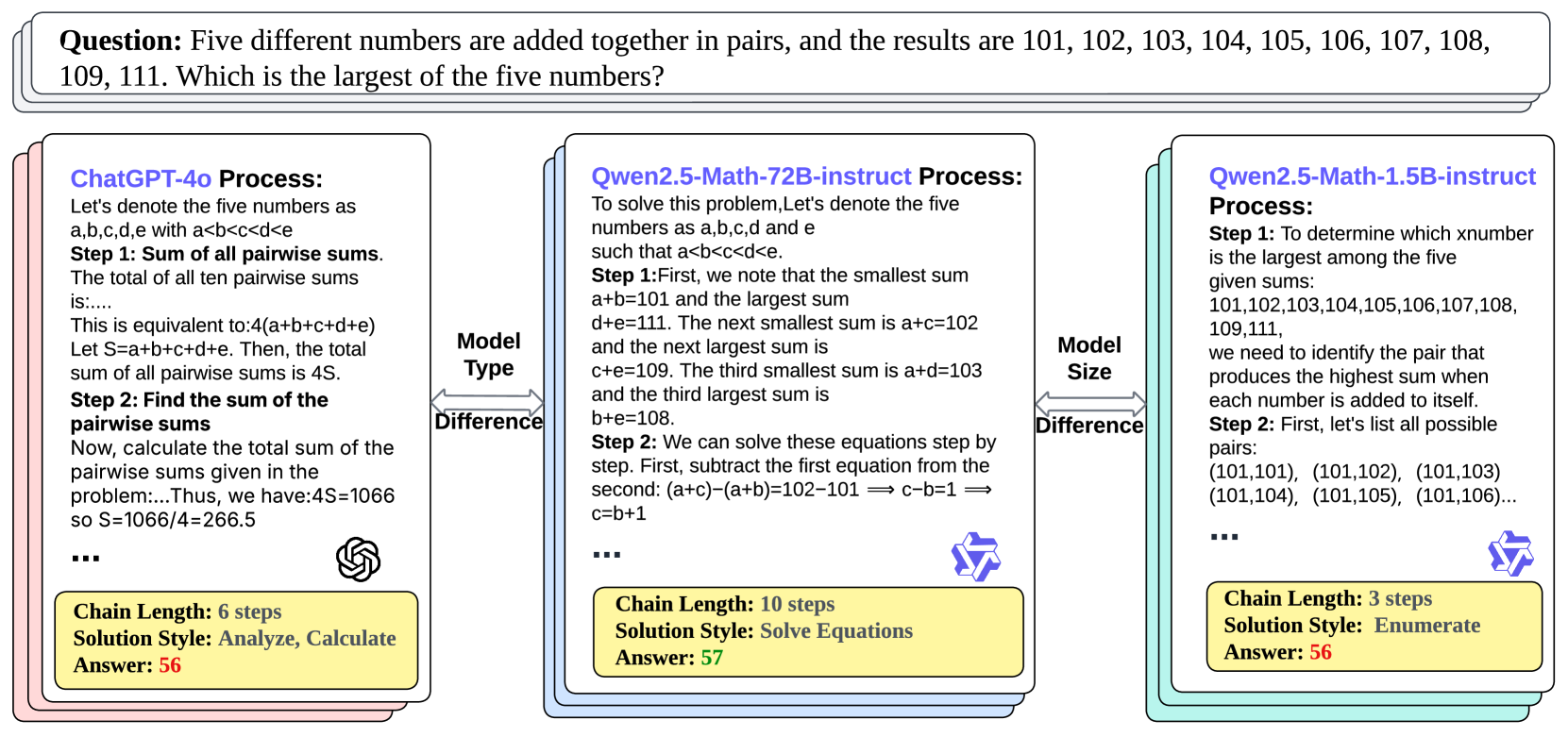
The image presents a mathematical word problem and three different approaches to solving it, each generated by a distinct AI model. The problem asks to identify the largest of five different numbers, given that their pairwise sums result in a specific set of values. The three models are "ChatGPT-4o Process", "Qwen2.5-Math-72B-instruct Process", and "Qwen2.5-Math-1.5B-instruct Process". Each process is described with its steps, chain length, solution style, and the final answer. The models are also categorized by "Model Type" and "Model Size" with a "Difference" label indicating a comparison between them.
### Components/Axes
This image does not contain a chart or graph, therefore, there are no axes, legends, or axis markers to extract. The primary components are blocks of text describing the problem and its solutions.
### Detailed Analysis or Content Details
**Question:**
"Five different numbers are added together in pairs, and the results are 101, 102, 103, 104, 105, 106, 107, 108, 109, 111. Which is the largest of the five numbers?"
**Model 1: ChatGPT-4o Process**
* **Process Description:**
* **Step 1: Sum of all pairwise sums.**
* "Let's denote the five numbers as a,b,c,d,e with a<b<c<d<e"
* "The total of all ten pairwise sums is:....."
* "This is equivalent to: 4(a+b+c+d+e)"
* "Let S=a+b+c+d+e. Then, the total sum of all pairwise sums is 4S."
* **Step 2: Find the sum of the pairwise sums.**
* "Now, calculate the total sum of the pairwise sums given in the problem:....Thus, we have: 4S=1066 so S=1066/4=266.5"
* **Ellipsis (...)**: Indicates that there are further steps not fully displayed.
* **Footer Information:**
* "Chain Length: 6 steps"
* "Solution Style: Analyze, Calculate"
* "Answer: 56"
**Model 2: Qwen2.5-Math-72B-instruct Process**
* **Process Description:**
* "To solve this problem, Let's denote the five numbers as a,b,c,d and e such that a<b<c<d<e."
* **Step 1:**
* "First, we note that the smallest sum a+b=101 and the largest sum d+e=111."
* "The next smallest sum is a+c=102"
* "and the next largest sum is c+e=109."
* "The third smallest sum is a+d=103"
* "and the third largest sum is b+e=108."
* **Step 2:**
* "We can solve these equations step by step. First, subtract the first equation from the second: (a+c)-(a+b)=102-101 => c-b=1 =>"
* **Ellipsis (...)**: Indicates that there are further steps not fully displayed.
* **Footer Information:**
* "Chain Length: 10 steps"
* "Solution Style: Solve Equations"
* "Answer: 57"
**Model 3: Qwen2.5-Math-1.5B-instruct Process**
* **Process Description:**
* "Step 1: To determine which xnumber is the largest among the five given sums: 101,102,103,104,105,106,107,108, 109,111,"
* "we need to identify the pair that produces the highest sum when each number is added to itself."
* **Step 2:**
* "First, let's list all possible pairs:"
* "(101,101), (101,102), (101,103)"
* "(101,104), (101,105), (101,106)..."
* **Ellipsis (...)**: Indicates that there are further steps not fully displayed.
* **Footer Information:**
* "Chain Length: 3 steps"
* "Solution Style: Enumerate"
* "Answer: 56"
**Categorization Labels:**
* **Model Type:** (Appears between Model 1 and Model 2)
* **Difference:** (Appears between Model 1 and Model 2, with a double-headed arrow)
* **Model Size:** (Appears between Model 2 and Model 3)
* **Difference:** (Appears between Model 2 and Model 3, with a double-headed arrow)
### Key Observations
* **Problem Statement:** The problem involves finding five distinct numbers given their pairwise sums. The sums provided are 101, 102, 103, 104, 105, 106, 107, 108, 109, and 111. There are 10 pairwise sums for 5 numbers, which matches the count provided.
* **Model Outputs:**
* ChatGPT-4o and Qwen2.5-Math-1.5B-instruct both arrive at the answer 56.
* Qwen2.5-Math-72B-instruct arrives at the answer 57.
* **Solution Styles:** The models employ different strategies: "Analyze, Calculate" (ChatGPT-4o), "Solve Equations" (Qwen2.5-Math-72B-instruct), and "Enumerate" (Qwen2.5-Math-1.5B-instruct).
* **Chain Length:** The number of steps varies significantly: 6 steps (ChatGPT-4o), 10 steps (Qwen2.5-Math-72B-instruct), and 3 steps (Qwen2.5-Math-1.5B-instruct). The shortest chain length does not necessarily correlate with the correct answer, as the 3-step solution yields 56, while the 10-step solution yields 57.
* **Model Comparison:** The labels "Model Type" and "Model Size" with "Difference" suggest a comparison of these models, likely in terms of their capabilities or performance.
### Interpretation
This image demonstrates the varying approaches and outcomes of different AI models when tasked with solving a mathematical word problem. The problem itself is a classic system of equations problem where the unknowns are the five distinct numbers.
* **Problem Complexity and AI Approaches:** The problem can be solved by setting up a system of linear equations. Let the five distinct numbers be $a < b < c < d < e$. The ten pairwise sums are $a+b, a+c, a+d, a+e, b+c, b+d, b+e, c+d, c+e, d+e$. The provided sums are $\{101, 102, 103, 104, 105, 106, 107, 108, 109, 111\}$.
* The smallest sum is typically $a+b$, and the largest is $d+e$.
* The sum of all pairwise sums is $4(a+b+c+d+e)$.
* ChatGPT-4o's approach (Step 1) seems to leverage this property by calculating the sum of all given pairwise sums ($101+102+...+109+111 = 1066$). It then deduces that $4S = 1066$, leading to $S = 266.5$. This sum $S$ is the sum of the five numbers. The subsequent steps (indicated by ellipsis) would likely involve using this sum $S$ and some of the pairwise sums to isolate the individual numbers and find the largest.
* Qwen2.5-Math-72B-instruct's approach (Step 1) directly identifies some of the smallest and largest sums: $a+b=101$, $d+e=111$, $a+c=102$, $c+e=109$, $a+d=103$, $b+e=108$. This is a valid strategy for setting up a system of equations. Step 2 begins to solve these equations. The fact that it arrives at a different answer (57) suggests a potential error in its calculation or interpretation of the sums.
* Qwen2.5-Math-1.5B-instruct's approach (Step 1) focuses on identifying the pair that produces the highest sum when added to itself. This seems to be a misinterpretation of the problem, as the problem states sums of *different* numbers. Step 2 then lists pairs of sums, which is also an unusual enumeration strategy for this problem. However, it arrives at the same answer as ChatGPT-4o (56).
* **Discrepancy in Answers:** The most significant observation is the discrepancy in the answers provided by the models. ChatGPT-4o and Qwen2.5-Math-1.5B-instruct both suggest 56, while Qwen2.5-Math-72B-instruct suggests 57. This highlights the challenges AI models can face with complex mathematical reasoning and the potential for errors.
* **Chain Length vs. Accuracy:** The model with the shortest chain length (Qwen2.5-Math-1.5B-instruct, 3 steps) provides one of the answers. Conversely, the model with the longest chain length (Qwen2.5-Math-72B-instruct, 10 steps) provides a different answer. This suggests that chain length is not a direct indicator of solution accuracy. The "Solution Style" also plays a role, with "Analyze, Calculate" and "Enumerate" leading to one answer, while "Solve Equations" leads to another.
* **Model Comparison Context:** The "Model Type" and "Model Size" labels, along with "Difference," imply that this image is part of a comparative study of AI models. The differing results and chain lengths for the same problem would be key data points in such a study, illustrating the performance variations between models of different architectures or training data.
**To verify the correct answer:**
Let the numbers be $a, b, c, d, e$ with $a<b<c<d<e$.
The sum of all pairwise sums is $101+102+103+104+105+106+107+108+109+111 = 1066$.
This sum is also equal to $4(a+b+c+d+e)$.
So, $a+b+c+d+e = 1066 / 4 = 266.5$.
The smallest sum is $a+b=101$.
The largest sum is $d+e=111$.
The sum of the smallest and largest numbers is $a+e$.
The sum of the second smallest and second largest numbers is $b+d$.
The middle sum is $c+c$ (if we consider the sum of a number with itself, which is not the case here) or $a+d$ or $b+c$.
Let's consider the sums:
$a+b = 101$
$a+c = 102$
$b+c = 103$ (This is a common assumption for the next smallest sum after $a+b$ and $a+c$)
From $a+b=101$ and $a+c=102$, we get $c-b=1$.
From $a+c=102$ and $b+c=103$, we get $b-a=1$.
So, $a, b, c$ are consecutive integers. Let $a=x$. Then $b=x+1$ and $c=x+2$.
$a+b = x + (x+1) = 2x+1 = 101 \implies 2x = 100 \implies x=50$.
So, $a=50, b=51, c=52$.
Check: $a+c = 50+52 = 102$. $b+c = 51+52 = 103$. This is consistent.
Now consider the largest sums:
$d+e = 111$
$c+e = 109$ (This is a common assumption for the next largest sum before $d+e$)
$b+e = 108$ (This is a common assumption for the next largest sum before $c+e$)
From $c+e=109$ and $d+e=111$, we get $d-c=2$.
From $b+e=108$ and $c+e=109$, we get $c-b=1$. This is consistent with our earlier finding.
We have $c=52$.
$d-c=2 \implies d-52=2 \implies d=54$.
$d+e=111 \implies 54+e=111 \implies e=57$.
Check: $c+e = 52+57 = 109$. $b+e = 51+57 = 108$. This is consistent.
So the five numbers are $a=50, b=51, c=52, d=54, e=57$.
Let's check all pairwise sums:
$a+b = 50+51 = 101$ (Given)
$a+c = 50+52 = 102$ (Given)
$a+d = 50+54 = 104$ (Given)
$a+e = 50+57 = 107$ (Given)
$b+c = 51+52 = 103$ (Given)
$b+d = 51+54 = 105$ (Given)
$b+e = 51+57 = 108$ (Given)
$c+d = 52+54 = 106$ (Given)
$c+e = 52+57 = 109$ (Given)
$d+e = 54+57 = 111$ (Given)
The set of sums is $\{101, 102, 104, 107, 103, 105, 108, 106, 109, 111\}$.
Rearranging these sums in ascending order: $\{101, 102, 103, 104, 105, 106, 107, 108, 109, 111\}$.
This matches the given set of sums exactly.
The five numbers are 50, 51, 52, 54, 57.
The largest of these five numbers is **57**.
Therefore, Qwen2.5-Math-72B-instruct's answer of 57 is correct, and the answers of 56 from ChatGPT-4o and Qwen2.5-Math-1.5B-instruct are incorrect. This further emphasizes the variability in AI model performance.
DECODING INTELLIGENCE...