## Diagram: Process Flow for ProveTEE and VerifyTEE
### Overview
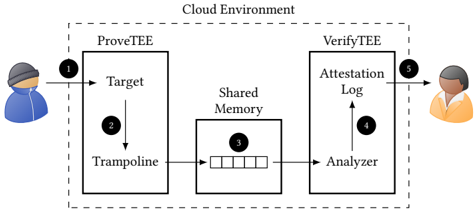
The image depicts a high-level architectural process flow for a secure attestation mechanism operating within a "Cloud Environment." The diagram illustrates the interaction between two Trusted Execution Environments (TEEs)—labeled "ProveTEE" and "VerifyTEE"—which communicate via a "Shared Memory" buffer. The process is sequential, indicated by numbered markers 1 through 5, showing data moving from a user, through the TEEs, and back to a user.
### Components/Axes
The diagram is enclosed within a dashed rectangle representing the **Cloud Environment**.
* **Left Region (ProveTEE):**
* **Actor:** A user icon (wearing a grey hat and blue jacket) positioned to the far left.
* **Container:** A rectangular box labeled "ProveTEE" at the top.
* **Internal Components:** "Target" (top) and "Trampoline" (bottom).
* **Center Region (Shared Memory):**
* **Container:** A rectangular box labeled "Shared Memory" at the top.
* **Internal Component:** A buffer represented by a rectangle divided into five empty slots.
* **Right Region (VerifyTEE):**
* **Container:** A rectangular box labeled "VerifyTEE" at the top.
* **Internal Components:** "Attestation Log" (top) and "Analyzer" (bottom).
* **Actor:** A user icon (wearing an orange/yellow shirt) positioned to the far right.
* **Sequence Markers:** Numbered circles (1-5) indicating the flow of operations.
### Detailed Analysis
The process follows a linear, left-to-right progression:
1. **Step 1:** The user (left) initiates a request or interaction with the "Target" component located inside the "ProveTEE" block.
2. **Step 2:** The "Target" component processes the request and passes data down to the "Trampoline" component within the same "ProveTEE" block.
3. **Step 3:** The "Trampoline" component writes data into the "Shared Memory" block, which is depicted as a 5-slot buffer.
4. **Step 4:** The "Analyzer" component, located inside the "VerifyTEE" block, reads the data from the "Shared Memory" and updates the "Attestation Log" located above it.
5. **Step 5:** The "Attestation Log" provides the final output or verification result to the user (right).
### Key Observations
* **Isolation:** The diagram explicitly separates the "ProveTEE" and "VerifyTEE" environments, suggesting that these two components operate in isolated security domains.
* **Communication Channel:** The "Shared Memory" acts as the sole bridge between the two TEEs, implying a controlled, asynchronous communication mechanism.
* **Directionality:** The flow is strictly unidirectional (left to right), indicating a producer-consumer relationship where "ProveTEE" produces attestation data and "VerifyTEE" consumes/validates it.
* **Buffer Representation:** The 5-slot buffer in the "Shared Memory" suggests a queue or a fixed-size data structure used for inter-process communication.
### Interpretation
This diagram represents a **Remote Attestation** or **TEE-to-TEE communication protocol**.
* **Security Context:** The use of "ProveTEE" and "VerifyTEE" suggests a system designed to verify the integrity of a "Target" application or process. The "Target" is likely the code or state being measured.
* **The "Trampoline" Function:** In TEE architecture, a "Trampoline" is often used to transition execution context from a secure environment to a less secure one (or vice versa) or to bridge memory boundaries. Here, it serves as the interface to move data out of the "ProveTEE" into the shared memory.
* **The "Analyzer" Function:** The "Analyzer" acts as the verifier. It consumes the raw data (likely measurements or hashes) placed in the shared memory by the "Trampoline" and logs them into an "Attestation Log."
* **Peircean Investigative View:** The separation of the two users (left vs. right) suggests that the entity requesting the proof (left) may be different from the entity consuming the attestation result (right), or it represents the lifecycle of a single user's request being processed through a secure pipeline. The "Cloud Environment" boundary implies that this entire operation is occurring within a potentially untrusted or multi-tenant infrastructure, necessitating the use of TEEs to ensure data integrity and confidentiality.