# Technical Document Extraction: Search and Evaluation Logic Diagram
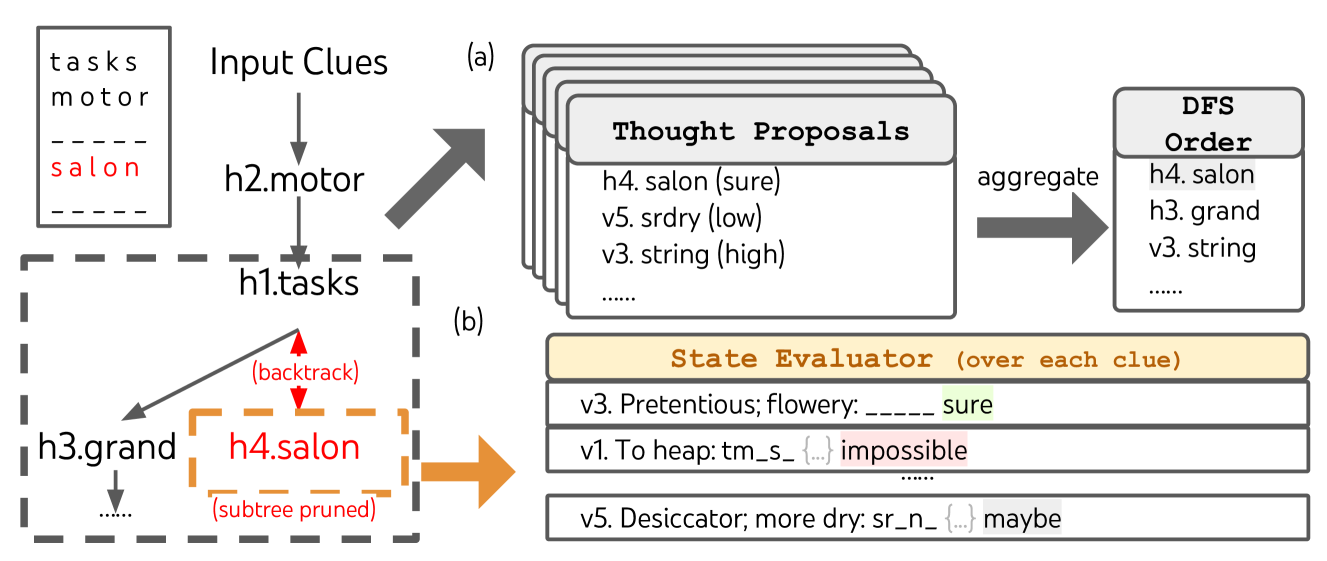
This image illustrates a computational workflow for solving a crossword-style puzzle using a combination of "Thought Proposals" and a "State Evaluator." The process is divided into two primary branches, labeled **(a)** and **(b)**, which represent the generation of candidates and the pruning of the search space, respectively.
---
## 1. Component Isolation
### Region 1: Input and Search Tree (Left)
This section defines the initial state and the hierarchical search process.
* **Input Clues Box:** A vertical list representing a crossword grid state.
* `tasks`
* `motor`
* `-----`
* `salon` (highlighted in red)
* `-----`
* **Search Flow:**
* **Input Clues** leads via a downward arrow to `h2.motor`.
* `h2.motor` leads via a downward arrow to a dashed bounding box containing the active search state.
* **Active Search State (Dashed Box):**
* Root node: `h1.tasks`
* Child node 1: `h3.grand` (leads to `......`)
* Child node 2: `h4.salon` (Text in red, enclosed in an orange dashed box).
* **Control Logic:**
* A double-headed red arrow between `h1.tasks` and `h4.salon` is labeled **(backtrack)**.
* Below `h4.salon`, text in red reads: **(subtree pruned)**.
### Region 2: Branch (a) - Thought Proposals (Top Right)
This branch describes the generation and aggregation of potential solutions.
* **Thought Proposals:** Represented as a stack of multiple cards/windows.
* **Content of top card:**
* `h4.salon (sure)`
* `v5.srdry (low)`
* `v3.string (high)`
* `......`
* **Process:** An arrow labeled **aggregate** points from the proposals to the final ordering.
* **DFS Order (Depth-First Search Order):** A grey-header table listing the prioritized candidates.
* `h4.salon` (highlighted in light grey)
* `h3.grand`
* `v3.string`
* `......`
### Region 3: Branch (b) - State Evaluator (Bottom Right)
This branch describes the validation logic that informs the pruning seen in the search tree. An orange arrow points from the pruned node (`h4.salon`) to this section.
* **Header:** **State Evaluator (over each clue)** (Orange background).
* **Evaluation Rows:**
1. `v3. Pretentious; flowery: _____` -> **sure** (highlighted in green).
2. `v1. To heap: tm_s_ {...}` -> **impossible** (highlighted in red).
3. `......` (Separator)
4. `v5. Desiccator; more dry: sr_n_ {...}` -> **maybe** (highlighted in grey).
---
## 2. Process Flow and Logic Summary
### Data Trends and Logic
1. **Search Strategy:** The system uses a hierarchical approach (`h1` -> `h2` -> `h3/h4`). The presence of the "DFS Order" box indicates a Depth-First Search strategy is employed to explore the solution space.
2. **Pruning Mechanism:** Branch **(b)** acts as a filter. When the **State Evaluator** determines a path is "impossible" (as seen in the `v1` evaluation), it triggers a **backtrack** and the **subtree is pruned** in the main search tree (Region 1).
3. **Confidence Scoring:** The "Thought Proposals" include qualitative confidence markers: `(sure)`, `(low)`, and `(high)`. These are aggregated to determine the final "DFS Order."
4. **Cross-Reference:** The red text `h4.salon` in the search tree directly corresponds to the top proposal in branch (a) and the orange arrow leading to the evaluation logic in branch (b).
---
## 3. Textual Transcription
| Category | Transcribed Text |
| :--- | :--- |
| **Header/Labels** | Input Clues, Thought Proposals, DFS Order, State Evaluator (over each clue) |
| **Search Nodes** | h2.motor, h1.tasks, h3.grand, h4.salon |
| **Logic Annotations** | (backtrack), (subtree pruned), aggregate, (a), (b) |
| **Proposal Data** | h4. salon (sure), v5. srdry (low), v3. string (high) |
| **Evaluator Data** | v3. Pretentious; flowery: _____ sure; v1. To heap: tm_s_ {...} impossible; v5. Desiccator; more dry: sr_n_ {...} maybe |
| **Grid State** | tasks, motor, -----, salon, ----- |