## Bar Chart: Comparison Across Methods on Collaborative Tasks
### Overview
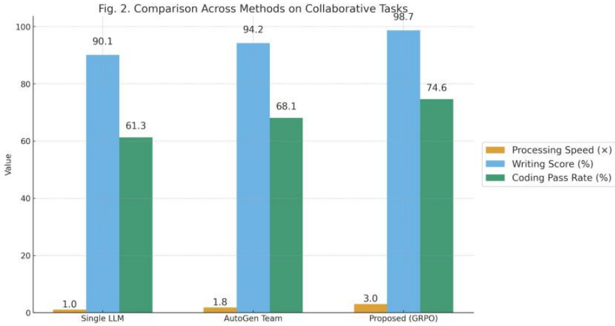
This is a grouped bar chart titled "Fig. 2. Comparison Across Methods on Collaborative Tasks." It compares the performance of three different methods—Single LLM, AutoGen Team, and Proposed (GRPO)—across three distinct metrics: Processing Speed, Writing Score, and Coding Pass Rate. The chart visually demonstrates the relative performance of each method for each metric.
### Components/Axes
* **Chart Title:** "Fig. 2. Comparison Across Methods on Collaborative Tasks" (located at the top center).
* **X-Axis (Horizontal):** Represents the different methods being compared. The categories are, from left to right:
1. `Single LLM`
2. `AutoGen Team`
3. `Proposed (GRPO)`
* **Y-Axis (Vertical):** Labeled "Value". The scale runs from 0 to 100 in increments of 20 (0, 20, 40, 60, 80, 100).
* **Legend:** Located on the right side of the chart. It defines the three data series:
* **Orange Bar:** `Processing Speed (x)` - A multiplier value.
* **Blue Bar:** `Writing Score (%)` - A percentage score.
* **Green Bar:** `Coding Pass Rate (%)` - A percentage score.
* **Data Labels:** Numerical values are displayed directly above each bar for precise reading.
### Detailed Analysis
The chart presents the following data points for each method:
**1. Single LLM**
* **Processing Speed (Orange):** 1.0 (x)
* **Writing Score (Blue):** 90.1 (%)
* **Coding Pass Rate (Green):** 61.3 (%)
**2. AutoGen Team**
* **Processing Speed (Orange):** 1.8 (x)
* **Writing Score (Blue):** 94.2 (%)
* **Coding Pass Rate (Green):** 68.1 (%)
**3. Proposed (GRPO)**
* **Processing Speed (Orange):** 3.0 (x)
* **Writing Score (Blue):** 98.7 (%)
* **Coding Pass Rate (Green):** 74.6 (%)
**Trend Verification:**
* **Processing Speed (Orange Bars):** The trend is strictly upward. The bar height increases from left (Single LLM) to right (Proposed), indicating a consistent improvement in speed.
* **Writing Score (Blue Bars):** The trend is strictly upward. The bar height increases from left to right, showing a consistent improvement in writing quality.
* **Coding Pass Rate (Green Bars):** The trend is strictly upward. The bar height increases from left to right, demonstrating a consistent improvement in coding task success.
### Key Observations
1. **Consistent Superiority of the Proposed Method:** The "Proposed (GRPO)" method achieves the highest value in all three metrics compared to the other two methods.
2. **Magnitude of Improvement:** The most dramatic relative improvement is seen in **Processing Speed**, where the Proposed method (3.0x) is three times faster than the Single LLM baseline (1.0x) and 66.7% faster than the AutoGen Team (1.8x).
3. **High Baseline for Writing:** All methods achieve a Writing Score above 90%, suggesting this is a task where even the baseline (Single LLM) performs well, though incremental gains are still achieved.
4. **Coding as a Differentiator:** The Coding Pass Rate shows the largest absolute percentage point gap between the baseline (61.3%) and the top performer (74.6%), a difference of 13.3 points. This suggests the collaborative methods, especially the Proposed one, significantly enhance coding task performance.
5. **Correlation of Metrics:** There is a positive correlation across all three metrics; as one improves from method to method, the others do as well. This suggests the improvements are holistic rather than trade-offs.
### Interpretation
The data strongly suggests that the "Proposed (GRPO)" method is the most effective among those compared for collaborative tasks. It demonstrates a balanced and significant enhancement across diverse performance dimensions: it is substantially faster, produces higher-quality written output, and is more reliable at completing coding tasks.
The progression from `Single LLM` to `AutoGen Team` to `Proposed (GRPO)` indicates that moving from a single model to a team-based approach, and then to the specific GRPO framework, yields compounding benefits. The fact that all metrics improve in tandem implies the Proposed method's architecture or process is fundamentally better suited for these collaborative tasks, rather than being optimized for one metric at the expense of others. The chart serves as compelling evidence for the efficacy of the GRPO approach in the context presented.