## Screenshot: AI Agent Simulation Environment
### Overview
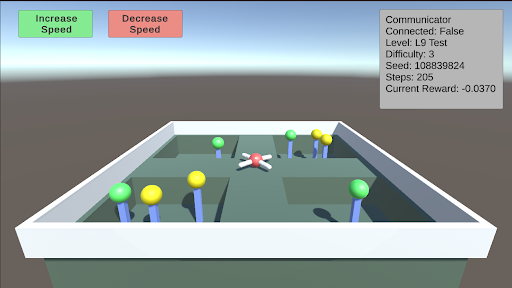
This image is a screenshot of a 3D simulation environment, likely used for training or testing an autonomous agent (a drone). The scene depicts a walled maze containing a central drone and several colored spheres on poles. A user interface overlay provides control buttons and a status panel with real-time metrics.
### Components/Axes
The image is divided into two primary regions: the 3D simulation viewport and the 2D UI overlay.
**UI Overlay Elements:**
1. **Control Buttons (Top-Left):**
* A green button labeled "Increase Speed".
* A red button labeled "Decrease Speed".
2. **Status Panel (Top-Right):** A semi-transparent grey box containing the following text fields and values:
* `Communicator`
* `Connected: False`
* `Level: L9 Test`
* `Difficulty: 3`
* `Seed: 108839824`
* `Steps: 100`
* `Current Reward: -0.0370`
**3D Simulation Viewport:**
* **Environment:** A rectangular, walled arena with a light grey floor and darker grey walls. The interior is divided by low walls into several compartments or pathways.
* **Agent:** A white and red quadcopter drone is positioned near the center of the arena, hovering above the floor.
* **Objects:** Multiple colored spheres are mounted on thin blue poles of varying heights, placed throughout the maze compartments.
* **Green Spheres:** At least 5 are visible.
* **Yellow Spheres:** At least 4 are visible.
* **Perspective:** The view is from an elevated, angled perspective looking down into the arena.
### Detailed Analysis
* **Text Transcription:** All text from the UI overlay has been transcribed exactly as shown in the "Components/Axes" section above.
* **Spatial Grounding:**
* The control buttons are anchored to the top-left corner of the screen.
* The status panel is anchored to the top-right corner.
* The drone is centrally located within the maze structure.
* The colored spheres are distributed across different sections of the maze. For example, a cluster of one green and two yellow spheres is in the bottom-left compartment, while another cluster of two green and two yellow spheres is in the top-right compartment.
* **Data Points:** The only quantitative data provided are from the status panel:
* Difficulty Level: 3
* Simulation Seed: 108839824
* Step Count: 100
* Current Cumulative Reward: -0.0370 (a negative value).
### Key Observations
1. **Simulation State:** The agent is disconnected (`Connected: False`), suggesting the simulation may be paused, the controlling program is not attached, or it's in a pre-run state.
2. **Negative Reward:** The `Current Reward` is negative (-0.0370) after 100 steps. In reinforcement learning contexts, this typically indicates the agent is incurring penalties, possibly for time elapsed, collisions, or not reaching goals.
3. **Environment Design:** The maze layout with colored spheres suggests a navigation or collection task. The different colors (green vs. yellow) likely represent different types of targets, objectives, or penalties.
4. **Control Interface:** The presence of "Increase/Decrease Speed" buttons implies manual override or adjustment of the simulation speed is possible.
### Interpretation
This screenshot captures a snapshot of a reinforcement learning or robotics simulation testbed. The "L9 Test" at "Difficulty: 3" indicates a specific, likely challenging, scenario configuration. The negative reward after 100 steps suggests the agent (the drone) has not yet successfully completed its objective and may be exploring inefficiently or violating constraints. The colored spheres are almost certainly the goal objects; the agent's task is probably to navigate the maze and collect specific spheres (e.g., only green ones) while avoiding others or minimizing path length. The disconnected status and manual speed controls point to this being a development or debugging view, allowing a human operator to monitor and influence the agent's training environment. The specific seed number (`108839824`) allows for exact replication of this maze layout and initial conditions for reproducible experiments.