## Diagram: Block Overhang
### Overview
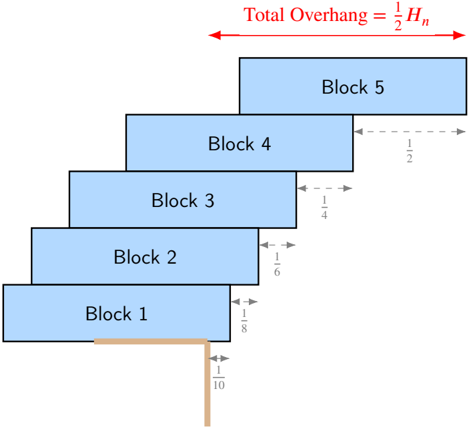
The image is a diagram illustrating the concept of block overhang, showing five rectangular blocks stacked on top of each other with progressively increasing overhangs. The total overhang is indicated as being equal to 1/2 * H_n, where H_n is likely a harmonic number. The diagram also shows the overhang distance of each block relative to the block below it.
### Components/Axes
* **Blocks:** Five rectangular blocks labeled "Block 1" through "Block 5". They are light blue.
* **Support:** Two tan colored rectangles forming an L shape, supporting Block 1.
* **Overhang Distances:** Gray dashed lines with arrows indicating the overhang distance of each block relative to the block below it. The values are: 1/10 (for the support), 1/8, 1/6, 1/4, and 1/2.
* **Total Overhang:** A red double-headed arrow indicating the total overhang, labeled "Total Overhang = 1/2 H_n".
### Detailed Analysis
* **Block 1:** Rests on the tan L-shaped support.
* **Block 2:** Overhangs Block 1 by 1/8.
* **Block 3:** Overhangs Block 2 by 1/6.
* **Block 4:** Overhangs Block 3 by 1/4.
* **Block 5:** Overhangs Block 4 by 1/2.
* **Support:** The vertical part of the L-shaped support extends downward from Block 1 by 1/10.
### Key Observations
* The overhang distance increases as you move up the stack of blocks.
* The total overhang is proportional to the harmonic number H_n.
### Interpretation
The diagram demonstrates how to create an overhang with stacked blocks by progressively increasing the overhang distance of each block. The total overhang is related to the harmonic series, suggesting that the maximum possible overhang can be increased indefinitely by adding more blocks, although the rate of increase diminishes as more blocks are added. The diagram illustrates a physical representation of a mathematical concept.