## Timeline Diagram: Evolution of Artificial Intelligence Paradigms
### Overview
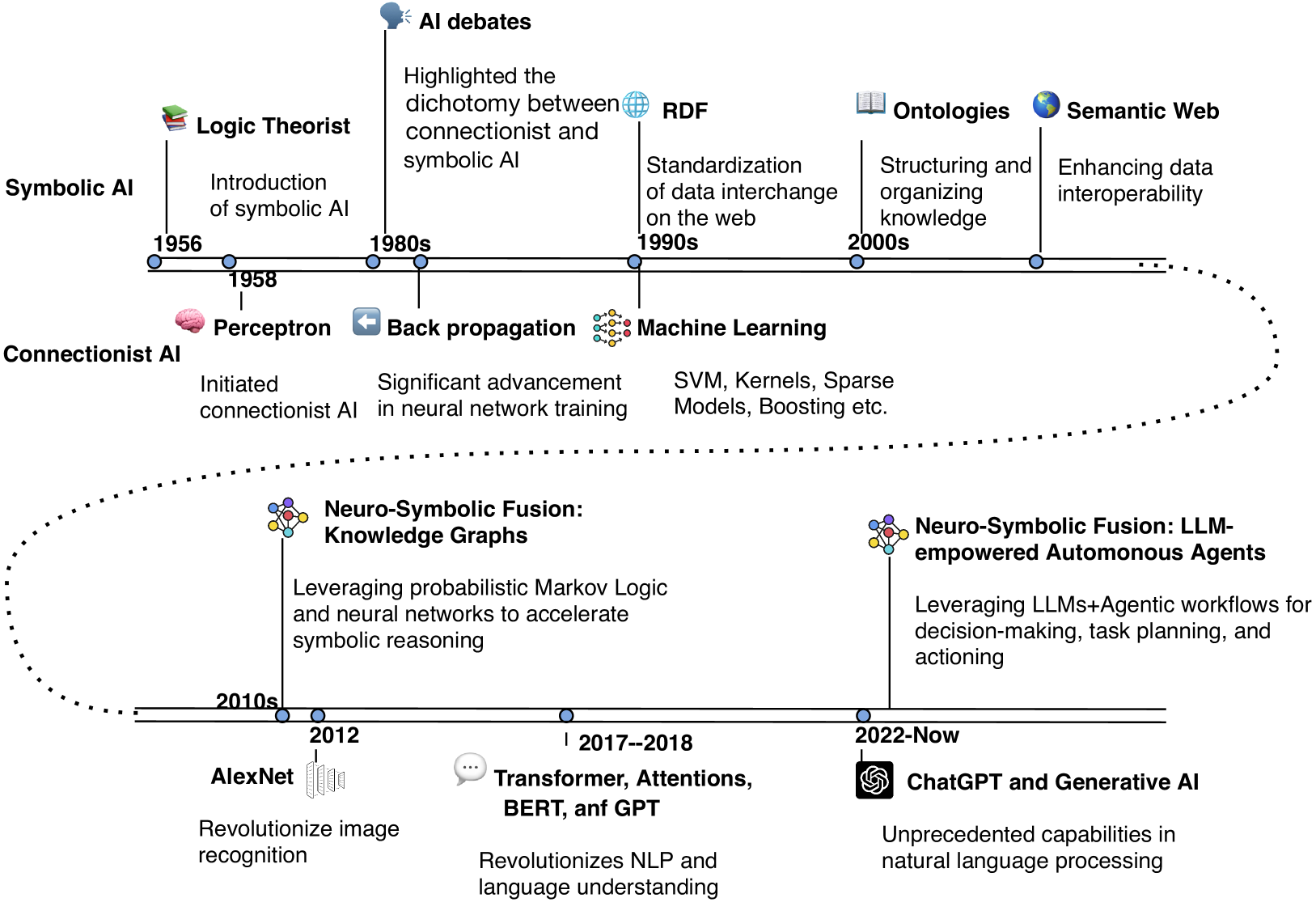
This diagram illustrates the historical progression of AI research paradigms from 1956 to the present, highlighting key milestones, debates, and technological breakthroughs. It contrasts Symbolic AI and Connectionist AI approaches, culminating in modern Neuro-Symbolic Fusion frameworks.
### Components/Axes
- **X-axis (Time)**: 1956 → 2022-Now, divided into decades (1950s, 1980s, 1990s, 2000s, 2010s)
- **Y-axis (AI Paradigms)**:
- Symbolic AI (represented by book icon)
- Connectionist AI (represented by brain icon)
- **Key Elements**:
- Dotted line connecting paradigms (symbolizing integration)
- Neuro-Symbolic Fusion section (2010s onward)
- Technology icons (e.g., neural networks, transformers)
### Detailed Analysis
1. **Symbolic AI Era (1956-1980s)**
- 1956: Logic Theorist (Introduction of symbolic AI)
- 1958: Perceptron (Initiated connectionist AI)
- 1980s: Backpropagation (Significant advancement in neural network training)
2. **1990s Developments**
- RDF (Standardization of data interchange on the web)
- Ontologies (Structuring and organizing knowledge)
- Semantic Web (Enhancing data interoperability)
3. **2000s Machine Learning**
- SVM, Kernels, Sparse Models, Boosting (Technical advancements)
4. **2010s Neuro-Symbolic Fusion**
- AlexNet (2012): Revolutionized image recognition
- Knowledge Graphs (Leveraging probabilistic Markov Logic and neural networks)
5. **2017-2018 Transformers**
- BERT, GPT (Revolutionized NLP and language understanding)
6. **2022-Now Generative AI**
- ChatGPT (Unprecedented capabilities in natural language processing)
### Key Observations
- **Paradigm Shift**: Connectionist AI (neural networks) gained prominence after initial symbolic dominance
- **Integration Trend**: Dotted line shows increasing convergence between symbolic and connectionist approaches
- **Acceleration**: Breakthroughs became more frequent post-2010s (AlexNet → Transformers → Generative AI)
- **Technical Depth**: Each era includes specific technical innovations (e.g., backpropagation, transformers)
### Interpretation
This timeline demonstrates AI's evolution from rule-based systems (Symbolic AI) to data-driven neural networks (Connectionist AI), with modern research focusing on hybrid approaches. The 2010s marked a turning point with deep learning breakthroughs (AlexNet), followed by transformer architectures enabling advanced language models. The Neuro-Symbolic Fusion section suggests current efforts to combine probabilistic reasoning with neural networks for more robust AI systems. The diagram emphasizes both technical milestones and conceptual debates (e.g., "AI debates" label), reflecting the field's dynamic nature. The progression from specialized systems (Logic Theorist) to general-purpose models (ChatGPT) highlights AI's trajectory toward human-like cognitive capabilities.