## Diagram: Knowledge Graph Question Answering Pipeline
### Overview
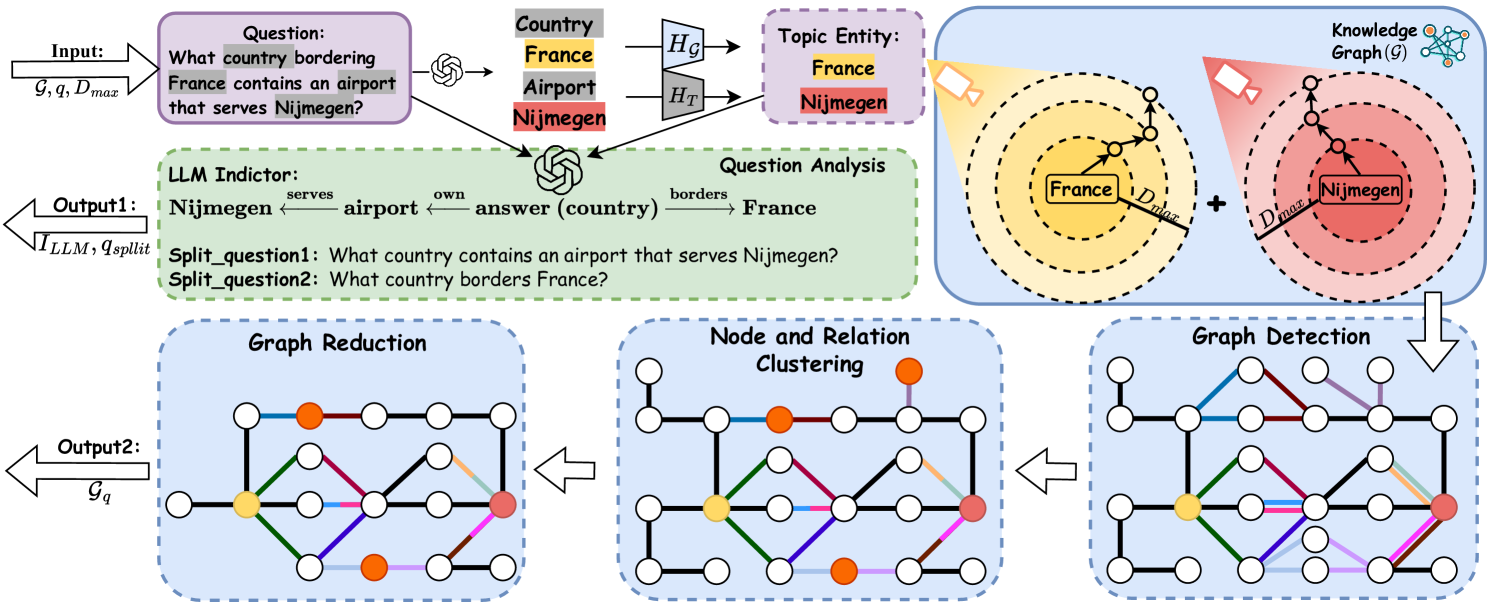
This diagram illustrates a pipeline for answering complex questions using a knowledge graph. The process involves taking an input question, analyzing it to identify key entities and relationships, and then performing operations on a knowledge graph to extract relevant information. The pipeline outputs processed graph representations and potentially intermediate LLM outputs.
### Components/Axes
The diagram is structured into several distinct sections, each representing a stage in the pipeline:
**1. Input and Initial Processing:**
* **Input Arrow:** Labeled "Input:", pointing to a purple box.
* **Input Variables:** Below the "Input:" label, the variables "G, q, Dmax" are shown, representing the Knowledge Graph, the Question, and a maximum distance parameter, respectively.
* **Question Box (Purple):** Contains the text "Question:", followed by the question: "What country bordering France contains an airport that serves Nijmegen?". Key entities "France" and "Nijmegen" are highlighted with gray boxes.
* **LLM Symbol:** A stylized "S" symbol within a circle, indicating a Large Language Model (LLM) process. This symbol connects the Input Question to subsequent analysis.
* **Entity Extraction Box:** A box with a light purple background, listing:
* "Country" (Yellow highlight)
* "France" (Yellow highlight)
* "Airport" (No highlight)
* "Nijmegen" (Red highlight)
* **Relation/Feature Extraction:** Two boxes labeled "HG" and "HT" with arrows pointing to the right, suggesting extracted graph-based and text-based features, respectively.
**2. Question Analysis and LLM Indicator:**
* **LLM Indicator Box (Green):** Contains the label "LLM Indictor:" and a stylized "S" symbol within a circle.
* It shows a relationship: "Nijmegen" <- "serves" <- "airport" <- "own" <- "answer (country)".
* It also shows a relationship: "answer (country)" -> "borders" -> "France".
* **Split Question Output:** Below the LLM Indicator, two split questions are presented:
* "Split_question1: What country contains an airport that serves Nijmegen?"
* "Split_question2: What country borders France?"
* **Output 1 Arrow:** Labeled "Output1:", pointing left from the LLM Indicator box.
* **Output 1 Variables:** Below the "Output1:" label, the variables "I LLM, qsplit" are shown, likely representing LLM intermediate outputs and split questions.
**3. Knowledge Graph Visualization:**
* **Knowledge Graph (G) Symbol:** A small icon of a connected graph with orange and blue nodes, labeled "Knowledge Graph (G)".
* **Entity-Centric Views:** Two concentric circle diagrams are shown, representing proximity within the knowledge graph.
* **Left Circle (Yellow):** Centered around "France". It has dashed concentric circles indicating distance. A camera icon is positioned above and to the left, with a red gradient cone pointing towards the center. A variable "Dmax" is indicated as the maximum radius. A path within the graph is shown originating from "France".
* **Right Circle (Red):** Centered around "Nijmegen". Similar concentric dashed circles and a "Dmax" radius are shown. A camera icon is positioned above and to the right, with a red gradient cone pointing towards the center. A path within the graph is shown originating from "Nijmegen".
* **Combination Symbol:** A "+" symbol between the two circle diagrams, indicating their combination or interaction.
* **Arrow to Graph Detection:** A downward-pointing arrow originates from the combined entity-centric views, leading to the "Graph Detection" section.
**4. Graph Processing Stages (Bottom Row):**
These three boxes, arranged from right to left with arrows indicating flow, represent stages of graph processing.
* **Graph Detection Box (Light Blue, Rightmost):**
* **Title:** "Graph Detection"
* **Content:** A grid-like representation of nodes (white circles) connected by edges of various colors (black, blue, dark red, purple, green, light blue, pink, brown, light pink). A yellow node is present in the bottom-left quadrant, and a red node is present in the bottom-right quadrant.
* **Node and Relation Clustering Box (Light Blue, Middle):**
* **Title:** "Node and Relation Clustering"
* **Content:** Similar to "Graph Detection" but with some nodes and edges potentially grouped or highlighted differently. The yellow node is prominent in the center-left, and the red node is in the center-right. An orange node appears near the top. The connections and colors of edges are largely preserved but might be visually clustered.
* **Graph Reduction Box (Light Blue, Leftmost):**
* **Title:** "Graph Reduction"
* **Content:** A further processed graph. The yellow node is on the left, and the red node is on the right. The connections are simplified, and some nodes/edges might be removed or consolidated. An orange node is present in the top-middle.
* **Output 2 Arrow:** Labeled "Output2:", pointing left from the "Graph Reduction" box.
* **Output 2 Variable:** Below the "Output2:" label, the variable "Gq" is shown, likely representing the final processed query graph.
### Detailed Analysis or Content Details
* **Input Question:** The question "What country bordering France contains an airport that serves Nijmegen?" is a multi-hop question requiring the integration of information about countries, borders, airports, and services.
* **Entity Extraction:** The LLM identifies "France" as a "Country" and "Nijmegen" as an "Airport" (or related to an airport). This suggests the LLM is capable of recognizing entities and their types.
* **LLM Indicator Relationships:** The LLM indicator suggests it can infer relationships like "Nijmegen serves airport" and "answer (country) borders France". It also breaks down the original question into two sub-questions:
1. "What country contains an airport that serves Nijmegen?"
2. "What country borders France?"
This demonstrates a capability for question decomposition.
* **Knowledge Graph Visualization:** The concentric circles with "Dmax" indicate a focus on nodes within a certain distance from the target entities ("France" and "Nijmegen") in the knowledge graph. The camera icon and gradient suggest a "view" or "focus" mechanism, possibly related to graph traversal or attention.
* **Graph Processing Stages:**
* **Graph Detection:** This stage appears to identify relevant subgraphs or paths within the larger knowledge graph based on the query. The diverse edge colors suggest different types of relationships (e.g., "borders", "serves", "located_in").
* **Node and Relation Clustering:** This stage likely groups similar nodes or relationships to simplify the graph structure or highlight important clusters of information.
* **Graph Reduction:** This final stage aims to produce a concise and relevant subgraph (Gq) that directly addresses the decomposed questions, potentially removing redundant information.
### Key Observations
* The pipeline leverages an LLM for initial question understanding, entity/relation extraction, and question decomposition.
* It utilizes a knowledge graph (G) as the primary data source.
* The process involves focusing on entities and their local neighborhoods within the knowledge graph (indicated by Dmax and concentric circles).
* A multi-stage graph processing approach (Detection, Clustering, Reduction) is employed to refine the relevant information from the knowledge graph.
* The output is a processed graph representation (Gq) suitable for answering the original complex question.
### Interpretation
This diagram outlines a sophisticated approach to knowledge graph question answering, particularly for complex, multi-hop questions. The integration of an LLM at the initial stages is crucial for understanding natural language queries, identifying key entities, and breaking down complex questions into simpler, manageable sub-questions. This decomposition is a common strategy to overcome the limitations of directly querying complex knowledge graphs with natural language.
The visualization of the knowledge graph around specific entities ("France" and "Nijmegen") with a distance parameter (Dmax) suggests a method for retrieving relevant local subgraphs. This is more efficient than searching the entire graph and helps to focus on information directly related to the entities in question. The "camera" icon might represent a form of attention mechanism or a focused traversal strategy within the graph.
The subsequent graph processing stages (Detection, Clustering, Reduction) are essential for transforming the raw, potentially noisy, retrieved subgraph into a clean, structured representation (Gq) that can be used to derive the final answer. Graph Detection likely identifies potential paths and connections, Node and Relation Clustering groups similar entities or relationships to simplify the structure, and Graph Reduction prunes irrelevant nodes and edges, leaving only the most pertinent information.
Overall, the pipeline demonstrates a hybrid approach, combining the linguistic understanding capabilities of LLMs with the structured reasoning power of knowledge graphs. The process aims to efficiently extract and refine information from a knowledge graph to answer complex natural language questions, producing a processed graph (Gq) as an intermediate or final output. This methodology is likely designed to improve the accuracy and efficiency of knowledge graph question answering systems.